A first apartment checklist for couples should cover six stages in order: what to agree before you search, what to check on a viewing, what to settle before signing, what to do on moving week, what to buy first, and who owns which job once you live there. The full list is below, written for two people, whether you are moving in with a boyfriend, girlfriend, husband or wife.
Most first apartment checklists are shopping lists, and you do need those. But the mistakes that hurt couples tend not to be about a missing can opener. They come from an unspoken assumption about who pays what, whose couch stays and who deals with the landlord. So this list has those items too. As you go, write one name next to every item. If something has no name, nobody is doing it.
Stage 1: What should you agree before you start looking?
Have this conversation before you view a single place. A checked box here means you actually said it out loud.
- The top monthly housing cost you are both comfortable with, including utilities
- How you will split rent and bills: evenly, in proportion to income, or some other way
- Whether you will have a shared account, a shared card, or just pay each other back
- How much you can each put toward the deposit, moving costs and new furniture
- Where you want to live, and how long a commute each of you will accept
- Must-haves and deal-breakers, such as laundry, a second bedroom, pets, parking or outdoor space
- How long you each expect to stay, and what happens to the deposit and lease if one of you has to leave
The last one can feel awkward. It takes a few minutes, and it is much easier to talk about while you are happy. The money conversation script and the couples money guide can help. Split bills in whatever way you both think is fair: Nationwide's guide to combining households points out that the options include a joint account or dividing costs based on income.
Stage 2: What should you check on a viewing?
Go together if you can. If only one of you can make it, video-call the other one. Check:
- Water pressure and how quickly hot water arrives
- Whether all the windows open and lock, and whether doors close properly
- Signs of damp, pests or mold, including under sinks
- Phone signal and available internet providers, if either of you works from home
- Storage: closets, kitchen cabinets, and where the vacuum and suitcases will go
- Whether your bed, sofa and desk will fit, and through the door. Take measurements
- Noise at the hours you will be home, including if one of you works nights or sleeps early
- A place to work, if either of you works from home, and whether two calls can happen at once
- Laundry, trash and recycling arrangements, and where you take them
- Parking and transport for both of your commutes
- Who you contact for repairs and how quickly they respond, if you can find out
Think about how the two of you will live in it, not just whether it looks good. Can one person get up early without waking the other? Is there a door to close if someone needs quiet?
Stage 3: What should you settle before signing?
- Read the entire lease, both of you. Do not leave this to one person
- Whose names go on the lease
- What the lease says about one person leaving early, and who remains responsible
- Rules on pets, guests, painting and subletting
- Total move-in cost: first month, deposit, fees
- Who gets the deposit back, and in what proportion
- Who is the main contact for the landlord or property manager
- Renters insurance. Ask whether one policy can cover you both or whether you need separate ones
- Take dated photos of the condition on the day you get the keys, and send them to the landlord if your lease calls for it
We are not lawyers, and rules vary by location. If you are unsure what you are signing, ask your local tenants' organization or a lawyer before you sign.
Naming a landlord point person helps, as the Half Half Home guide to moving in as a couple also recommends. One person should own that relationship, so nothing falls between you. That person keeps the contact details, handles repair requests and passes on anything important.
Stage 4: What goes on the moving week checklist?
Do this about a month ahead if you can, and earlier for a van at the end of the month.
A month before
- Give notice on your current places
- Book the moving truck or movers, or ask friends for help
- Compare what you each own and decide what stays
- Measure the rooms and the furniture you are keeping
- Sell, donate or give away duplicates. Nationwide's guide also suggests keeping the better-quality or sentimental items, and donating extras such as second coffee makers or dish sets
Two weeks before
- Set up electricity, gas, water and internet in the new place
- Change your address with your bank, employer, insurers, and the post office
- Transfer or cancel your old utilities
- Move your renters insurance if you have it
- Start packing what you do not use every day
The week before
- Confirm the movers and the time you get the keys
- Pack a first-night box for each person
- Buy or collect boxes, tape and marker pens
- Clean your old place, if your lease asks you to, and take photos
- Book your parking permit or elevator if your building requires it
The first-night box
- Bedding and pillows
- Toilet paper, soap, towels and any medications
- Phone chargers
- A kettle or coffee, and something easy to eat
- A few plates, cups and forks
- Trash bags
- Basic tools and a flashlight
The first 30 days guide picks up from here.
Stage 5: What do you actually need to buy?
Before you buy anything, combine what you each own. You may not need much, and you may have two of many things. Below is a list of what is needed by room. Buy the essentials first and wait on the rest, because it is easier to know what you want after you have lived there for a few weeks.
Kitchen: start here
- Pots, a frying pan, a baking tray
- Chef's knife and cutting board
- Plates, bowls, glasses, mugs and cutlery
- Can opener, wooden spoon, spatula, tongs and measuring cups
- Dish soap, sponges, dish towels and a drying rack
- Trash can and bags
- Food storage containers
- Salt, pepper, oil and a few staples
Bedroom
- Mattress and bed frame, the one decision you both need to agree on
- Two sets of sheets, so one can be in the wash
- Pillows and a duvet. You could each have your own duvet if you sleep differently
- Laundry hamper
- Hangers
- Curtains or blinds that actually block light, if one of you sleeps late
Bathroom
- Towels, shower curtain and liner, bath mat
- Toilet brush and plunger, which you will want before you need them
- Toilet paper, soap and shampoo
- First aid kit and basic medicine
- Small trash can
Living room
- Sofa, which one of you probably already has
- Lamps, since overhead light is rarely enough
- A table for eating, even a small one
- A place for keys, mail and bags at the door
Cleaning and tools
- Vacuum or broom and dustpan
- Mop and bucket
- All-purpose cleaner, bathroom cleaner and trash bags
- Screwdriver set, hammer, tape measure, picture hooks and batteries
- Step stool
- Laundry detergent
Safety
- Check that smoke and carbon monoxide alarms work
- Find the fuse box and the water shut-off
- Save the landlord's number and an emergency plumber's number in both phones
How do you decide whose stuff stays?
This is the question the shopping lists skip. Two people arrive with two sets of everything, and each has feelings about it. Try these rules.
- Decide before moving day. It is far harder when the second sofa is already in the hallway.
- Function comes first. Which one is in better condition, and which fits the room?
- Each person gets a few items that stay, no questions asked. Agree on a number. The chair from your grandparents can stay, and the poster from college might too.
- The rest is shared. Each of you can say no to something, but it should not be the only thing the other person loves.
- Store it for a set time. Put a date on anything you cannot agree on, and revisit it.
- New shared items, chosen together. Even one purchase that you choose together, such as a lamp or a table, helps make it feel like a home for two.
Stage 6: Who owns what once you live there?
The list of things to buy ends. These jobs do not. Give each a name during the first week.
- Rent and how it is paid
- Bills and utilities, and checking they have gone through
- The landlord and any repairs
- Groceries and restocking household items
- Trash and recycling, including pickup days
- Laundry for shared items
- Bathrooms, floors and the kitchen
- The shared calendar
- The internet and any shared subscriptions
- Renters insurance and any renewal dates
- Lease end date, on the calendar, with time to decide
Most of these jobs have an invisible part. Paying rent is simple, but someone also has to notice the increase, plan for it and check that it went through. See the four jobs in every chore for how to think about this, and how to split chores when moving in together for how to divide them.
Put the end date of your lease on a shared calendar now, with a reminder well ahead of it. Then it will not sneak up on you.
How do you keep this list between you?
Print it, or copy it to a shared note and add the names. That costs nothing, and it is enough for many couples. The chore split worksheet is useful for the chores part.
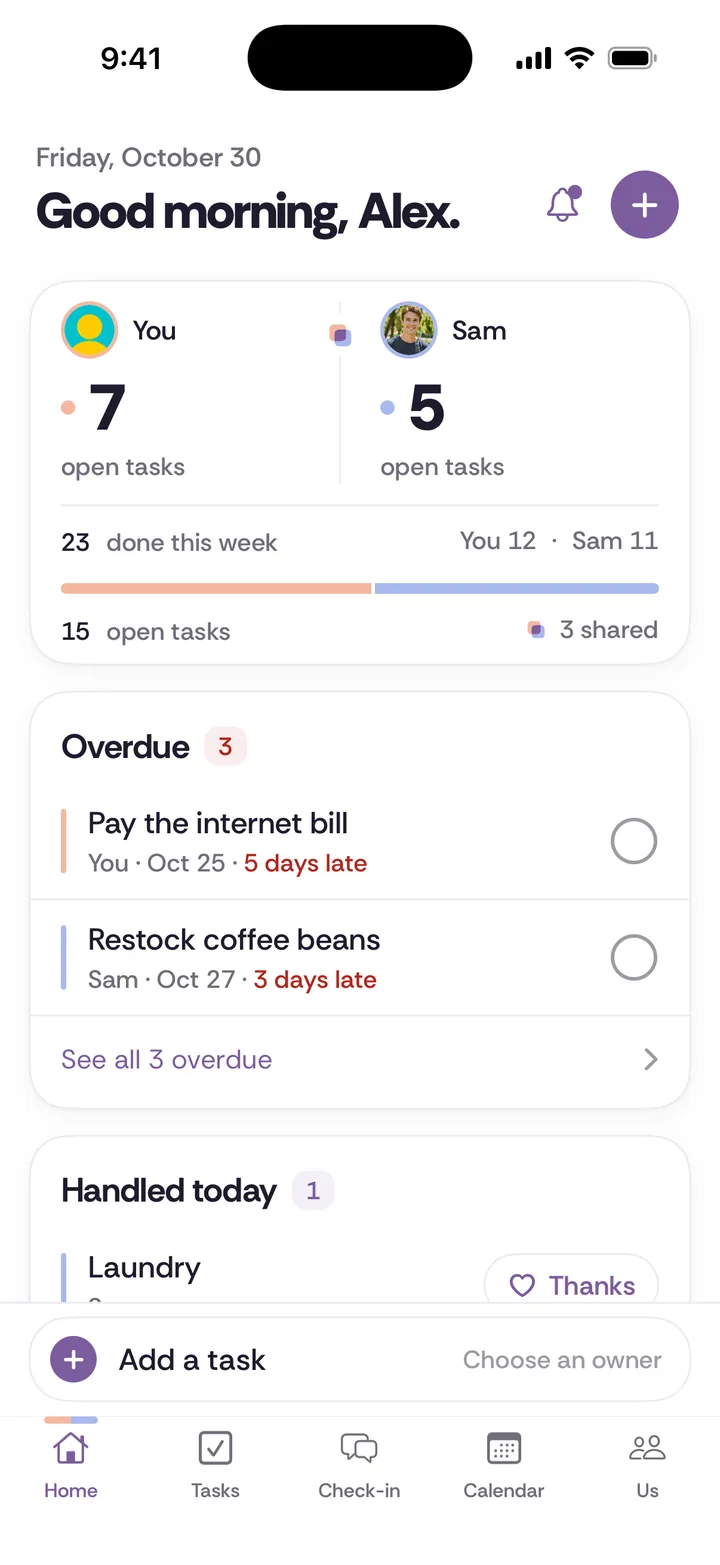
If you would like shared lists and tasks in one place, Tiptoe is free for both partners on iPhone and web. Each task goes to you, your partner or both of you together, and shared lists are good for the apartment items. There is no Android app, so if one of you uses Android, that person can use the web version at app.tiptoe.ai.
Once you have settled in, a weekly check-in is a good way to deal with the small stuff before it builds up, such as the towels, the thermostat and who has been buying all the coffee.