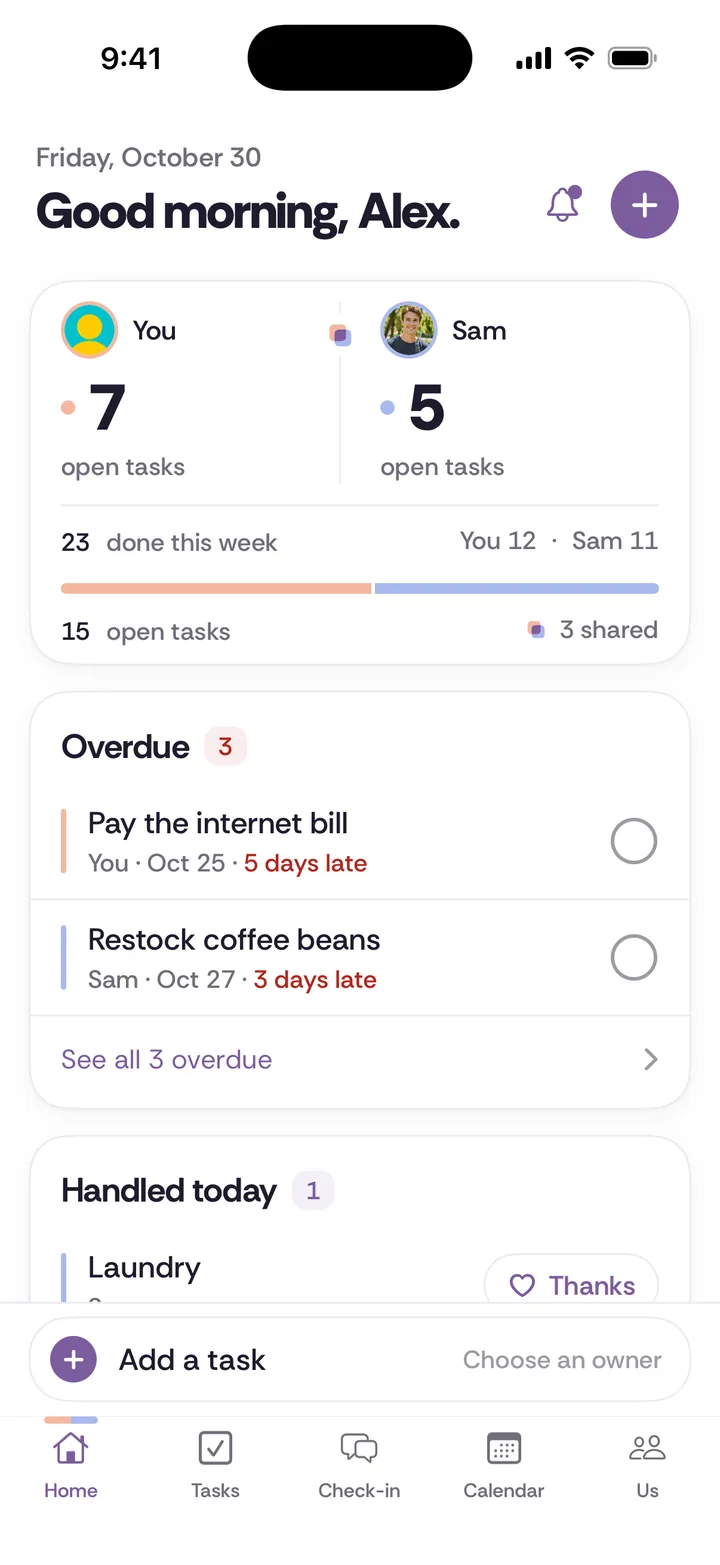
Couples who live together run a small organization without ever agreeing to. Most of the friction is not about love or big values, but about who noticed the trash, who remembered your mother's birthday and whose job the landlord is. This page sets out how to make those jobs visible, give each one an owner and keep the arrangement current as your life changes.
How do couples run a shared home without one person managing everything?
Write down all the recurring work, including the noticing, planning and follow-up. Give each partner whole areas to own, agree what done means, and review it together once a week. It works because the home stops depending on one person's memory, and problems get raised while they are still small.
What does it really take to run a home together?
A shared home runs on a long list of small, recurring jobs. Some are visible: dishes, laundry, bathrooms, trash. Many are not: knowing the rent went through, noticing the dish soap is low, working out what to give your partner's parents, remembering the lease ends in June. Everything in a home has four jobs inside it, which are noticing, planning, doing and following up. Only the third one is easy to see from across the room.
This is why two people can honestly describe the same home in very different ways. One person says it feels pretty even, because they do plenty of what they can see. The other person is tired, because they also carry the noticing and the planning. Neither of them is lying. Nobody can count work they did not know was there. Our household chores statistics summary shows how often partners answer the same question differently in published surveys, and it also explains why those figures do not describe your particular home.
So the job is not to work out who is right. It is to put the work somewhere you can both see it. Once it is on paper, you can make choices about it. A home with an agreed split is different from a home where the split just happened, even if the two look identical on the surface. You will find a longer version of this idea on our mental load and chore split pages.
Three habits do most of this work. Own whole jobs rather than helping with parts of them. Credit the job to the person who owned it, so nobody needs to keep score. And say the small thing while it is small, rather than tiptoeing around it for six months and then bringing it up all at once in a fight about towels.
How should you handle the first month?
The first month matters because defaults set fast. Whoever buys the dish soap in week one knows the brand, where it is kept and when it runs low, and within a couple of months it has quietly become their job. An hour of planning in the first week is much easier than unpicking a year of habit later.
Start with our guide to the first 30 days of moving in together, which goes week by week: making the home usable, agreeing the first split, talking through unwritten rules, making time for each other and reviewing how it actually went. If you are looking for the practical pieces, the first apartment checklist for couples covers what to agree before you search, what to check on a viewing, what to settle before signing, what to buy first and whose couch stays.
For the chores themselves, read how to split chores when moving in together. It has questions to ask each other before the boxes arrive, a sample split for two people, and words to use when something gets dropped. If you want to see how the app side of this could look, we also have a page for couples moving in together, but a sheet of paper on the fridge does the same job.
One thing to raise early is standards. You grew up in different homes, so one of you sees a mess where the other sees a room. Agree on a shared minimum you can both live with, and let whoever cares about going further own that extra work, with credit. Then leave it alone. A job that gets redone behind someone's back has not really been handed over.
How do you split chores in a way that lasts?
Most chore charts fail because they list tasks and leave the management with one person. "Can you put a load on?" still leaves someone else tracking the laundry. Moving a whole area, from noticing to follow-up, is what actually takes something off a person's mind. Our complete chore split guide and guide to splitting chores fairly walk through this in detail.
Fair does not have to mean identical. Work hours, commutes, health and what each person minds or does not mind all count. Being home more is not the same as being free. If one partner pays more rent and the other does more around the house, that can be a fair deal, but only if you both chose it and can say so out loud. The chore split calculator can give you a rough sense of hours as a starting point for that conversation, and it stores nothing.
If you need a place to begin, the list of household chores gives you an inventory to mark up, and the daily, weekly and monthly chores list shows you a rhythm. If you already suspect the split has drifted, try the self-check on uneven mental load, and then read how to explain the mental load for the words to use.
What about money, calendars and the rest of life together?
Chores are the part people argue about, but they are not the only shared work. Money needs an owner too: who checks the bills went through, who notices the insurance renewal, who raises it when the budget is tight. How you split costs is your decision, whether evenly, in proportion to income or some other way. What matters is that you made the choice together and you review it. The couples money guide and the money conversation script can help you open that conversation.
A shared calendar removes a surprising amount of friction. Once both people's plans and the key dates are in one place, nobody has to be the household's memory, and "are we free on the 14th?" can be answered without asking. Put the lease end date, renewals and family birthdays on it, with one name beside each.
Then there is the rest of your life together. A shared home can turn into a logistics operation where every conversation is about the fridge. Make some time that is not admin. Date nights do not need to be elaborate. They only need to be planned by someone, and that job can be owned and shared by turns as well.
How do you handle the big moments: weddings, holidays and blended families?
Big events are the same work on a shorter clock, and they tend to expose whatever pattern you already have. If one partner runs the spreadsheet while the other approves choices, that pattern tends to continue. Each of these has its own guide.
Wedding planning, who does what sets out what to decide together, how to divide nine areas of work into owned jobs and how to stop vendors emailing only one of you. It is a good chance to practice a system you can keep after the wedding is over.
The couples Christmas to-do list gives you a week-by-week holiday plan from early November, covering money, gifts, travel and family, plus the invisible jobs that tend to land on one person. Agree early where you will be on which day, and let each partner speak to their own family. You can also read holidays with two families.
Chores in a blended family covers what the two adults need to settle before telling the children anything, who gives instructions during the first period, how to handle custody schedules and what to do when you feel your partner's children do less than yours. Blended families carry extra invisible work, such as the handoffs between homes, and it can fall to a stepparent by default unless you name an owner.
How do you keep it working over time?
No split survives unchanged. New jobs, babies, illness, moves and aging parents all shift the load, often quietly. What keeps a home running fairly is not the original plan, but a short habit of looking at it. A weekly check-in of about 15 minutes is usually enough. Say thanks for one thing, look at what was dropped, ask whether anything has become one person's default, and decide what should change. Our weekly check-in questions can help you get going.
When something does slip, say it simply and specifically, on the day or soon after. "The bins did not go out. Can you sort it for next week?" is something a person can act on. "You never do anything" is not. Our guides on bringing up something small and how to stop nagging have more words to use. Once a year, a longer sit-down such as the New Year reset for couples is a good way to look at the whole picture.
All of this assumes that both of you are safe with each other. If you are afraid of your partner, or if there are threats, or money and access to people are being controlled, a chore plan is the wrong tool. Please see our safety page. Tiptoe is not therapy or a crisis service, and no app or list can fix a relationship.
A written list on the fridge is free and works if you both look at it. If you would like the same thing on your phones, Tiptoe is a free app for iPhone and web, with shared tasks, repeating chores with one owner, a calendar and a weekly check-in. Stop tiptoeing, and write it down.
Set up your shared home in one week
- Walk through the home and write down every recurring job, plus the ones that do not live in a room, such as bills, birthdays and the calendar.
- Group the jobs into whole areas and give each area one owner, who notices it, plans it, does it and follows up.
- Agree in one sentence what done means for the three jobs most likely to cause friction.
- Set a 15-minute check-in for the same time next week, and change one thing based on what actually happened.
One useful rule
Make the next step clear enough that either person can explain it.
Keep the system kind and current
A planning tool can hold an agreement, but it cannot make the first agreement fair or permanent. Both partners need a real say, a way to raise a problem, and permission to change the plan when work, health, or capacity changes.
Questions couples ask
- How do you split chores when you first live together?
- In the first week, list every recurring job and group them into whole areas. Each take what you mind least, divide the rest fairly and agree what done means for the most contentious jobs. Then review after seven days and adjust.
- How do you share a home with a boyfriend or girlfriend without fighting about mess?
- Agree on a shared minimum you can both live with, and let whoever wants a higher standard own that extra part. Give mess one allowed place, such as a chair or a shelf. Raise problems briefly and specifically, on a calm day.
- What should a husband and wife divide when they move in together?
- Everything recurring: chores, meals, shopping, bills, the calendar, family events and home repairs. Include the noticing and planning along with the doing. Nothing about being a husband or a wife decides who owns what, so go by time, preference and skill.
- What should you talk about before moving in together?
- Money, cleanliness standards, sleep and work schedules, guests, time alone, what each of you owns and what happens if one of you needs to leave the lease. A 30-minute conversation before you sign is much easier than the same talk six months later.
- How often should couples review their household split?
- A short weekly check-in is a practical default, plus a fuller look when something big changes, such as a new job or a baby. Frequency is less important than the habit of actually looking at what happened.
- Is it normal to fight about chores after moving in together?
- Disagreements over chores are common enough that many guides are written about them, and they usually point to unspoken expectations rather than a deeper problem. If you feel afraid to raise them or they involve threats or control, see our safety page.