Good new year goals for couples are few, specific and owned: for example, "We save $200 a month, and Sam moves it on the first," rather than "We will be better with money." Spend one evening reviewing last year, choose up to three shared goals and one small goal each, name an owner for each, and check on them in a weekly conversation.
Most lists of couple resolutions are a menu: more date nights, better communication, less screen time. All of those can be good, but a list of ideas is not a plan. Whether you are doing this with a husband, wife, boyfriend or girlfriend, what makes a goal work is usually the dull part: what exactly happens, who sees to it, and when you will look at it again. The Gottman Institute's piece on goals for couples names a few of the same reasons that goals fail, among them that they are too big and that they cannot be measured. "We want to communicate better" gives you no way of knowing whether you did.
How do you run the reset?
Set aside about 90 minutes, sometime between Christmas and the second week of January. Make it pleasant: food, no phones, and no chores in the background. Bring last year's calendar and, if you can face it, a rough view of what you spent. There are five parts.
Part 1: Look back at the year (20 minutes)
Each of you answers these separately on paper first, then read them to each other. Try to listen without correcting anything.
- What was the best ordinary day we had this year?
- What are you proud of us for?
- What did your partner do this year that you do not think you ever thanked them for?
- What was hardest for you?
- What did we keep meaning to do and never did?
- Which part of running our home felt heaviest to you?
Look through last year's calendar together. It may help you remember things, and it also shows you where your time went, which isn't always what you would have guessed.
Part 2: Reset the house before you set goals (20 minutes)
This is what most new-year lists leave out, and it may be the most useful part. Before adding anything, look at who is carrying what right now. Goals added on top of an uneven home tend to fall to whoever is already holding the rest.
Step 1. Go through the list of household chores or the mental load examples and mark who actually held each area last year.
Step 2. Ask what changed during the year. A new job, a move, a baby or a sick parent can quietly change who does what, without anybody revisiting the split.
Step 3. Choose one area to move this January, whole: notice, plan, do and follow up. A chore split calculator or worksheet can help.
Step 4. Agree on one job you can both stop doing.
If that conversation might be a hard one, here is how to explain the mental load without starting a fight.
Part 3: Each person names what they want (15 minutes)
Before you talk about shared goals, each of you writes down, on your own:
- One thing I want for myself this year, and what I need from you for it
- One thing I want for us this year
- One thing I want to stop doing
- One thing that I am worried about, and have not said
Reading these out loud can be a little uncomfortable. It is also the point. A shared goal that only one of you truly wants will probably become one person's job. The Gottman piece makes a related point: a goal that does not support each person's values will not help the relationship either.
Part 4: Choose up to three shared goals (20 minutes)
Pick no more than three. Each has to pass this test:
- What exactly happens? Something you could see or count.
- Who owns it? One name, even for a shared goal. The owner is not the only one doing it, but they make sure it does happen.
- When? A day, a frequency, or a date.
- How will we know? What you will check, and when.
Here is how to rewrite a vague goal
- "Be better with money" becomes "We move $200 to savings on the first of every month. Sam owns it. We check the balance at the first check-in of each month."
- "More quality time" becomes "One date night every second Thursday. Alex books it, and we swap owners each quarter."
- "Communicate better" becomes "We hold a 15-minute check-in on Sundays at 8 p.m. Each of us raises one thing, and we end by saying thanks."
- "Be healthier" becomes "We walk together on Saturday and Tuesday mornings. Each of us books our own annual physical by February 28."
- "Sort out the house" becomes "One room per month, starting with the hall closet. Jordan owns January."
- "See friends more" becomes "We have people over once a month. Whoever owns that month invites them and plans the food."
The dollar amounts and names here are examples. Use what suits your life.
Goals you could choose from
Use these as ideas, and change the details.
Money
- Set up one monthly money conversation, on a set day
- Save a set amount for a trip, moved automatically
- Pay off one specific card by a chosen date
- Cancel subscriptions you do not use, reviewed each quarter
- Decide how you each spend money with no questions asked
Home
- Move one whole area of work from one partner to the other
- Finish the one repair you have been putting off, with a date
- Clear one room or closet each month
- Agree what done means for your three most common chore disagreements
Time together
- Book a date night on a regular day, with turns planning it
- Take one overnight trip in the spring
- Eat dinner without phones three nights a week
- Learn one thing together, such as a class or a walking route
Each other
- Hold a weekly check-in for 12 weeks and then review it
- Say one specific thanks a day
- Bring up small things within 48 hours, rather than saving them up
- Protect one evening a week for each person's own time
Family and friends
- Decide in January what next year's holidays will look like, and tell both families
- Have people over once a month
- Each person calls their own parent or sibling on a schedule
- Take one trip to see someone you have been meaning to see
Future
- Decide one big question this year: moving, a child, a job change or where to live
- Update key documents: insurance, beneficiaries and anything you have been meaning to write down
- Plan what a good year looks like, one year from now
Part 5: Put it on the calendar (15 minutes)
Goals that are not on a calendar tend not to survive. Before you go to bed:
- Put each goal's first action on the shared calendar, with a name.
- Set up your first check-in for the coming Sunday.
- Put a 90-day review on the calendar for early April.
- Pick one small thing you will do this week, so that the goal is already underway.
What does a finished plan look like?
Here is an example of what you might have on one page at the end of the evening. Every detail is made up, so swap in your own.
- Home: Groceries move from Sam to Alex, the whole job, starting January 4. We stop ironing sheets.
- Goal 1, money: We move $200 to savings on the first of each month. Sam owns it. We check the balance at the first check-in of each month.
- Goal 2, time: Date night every second Thursday. Alex books the first two, then we swap.
- Goal 3, each other: Sunday check-in at 8 p.m. for 12 weeks. Sam adds it to the calendar tonight.
- Sam, personal: Finish the certificate course. Needs Tuesday evenings free.
- Alex, personal: Run twice a week. Needs Saturday mornings free.
- Review: April 4.
It should fit on one page. If it does not, you have probably chosen too much, so cut something now. It is far easier to add a goal in April than to feel as though you have already failed by February.
How do you keep goals alive past January?
Goals often fail because nobody looks at them again, not because they were bad goals. The fix is a short, regular slot. Fifteen minutes a week is plenty. See our weekly check-in guide and weekly check-in questions.
- Weekly: Did the owner do the next step? What gets in the way this coming week?
- Monthly: Are we on track? Is this still the right goal?
- Every 90 days: Keep, change or drop each goal. Dropping a goal on purpose is fine.
When a goal slips, try plain words rather than a hint or a reminder.
- "We said Sunday check-ins, and we have missed two. Is the time wrong, or do we not want this?"
- "You own the savings transfer, and it did not go through this month. What do you need to get it back on track?"
- "I have been the one booking date nights, and I thought we were taking turns. Could you do the next two?"
The point of this is to say it instead of tiptoeing around it. For more help, try how to stop nagging and how to bring up something small.
What if you do not want the same things?
It may become clear during this evening that you want different things for the year, and that is worth knowing. Do not try to solve it during the reset. Say what you heard, and put it on your calendar to talk about separately. Big disagreements, about money, children or where you live, may need more than one conversation and, for some couples, a counselor who works with couples.
If you feel afraid to say what you want, or you are worried how your partner will respond, that matters more than any goal. Please see our safety page.
Where should you keep your goals?
Write them on one sheet of paper and put it somewhere you will both see it. That can be enough, and it is free. A Sunday reminder on your phones takes care of the rest.
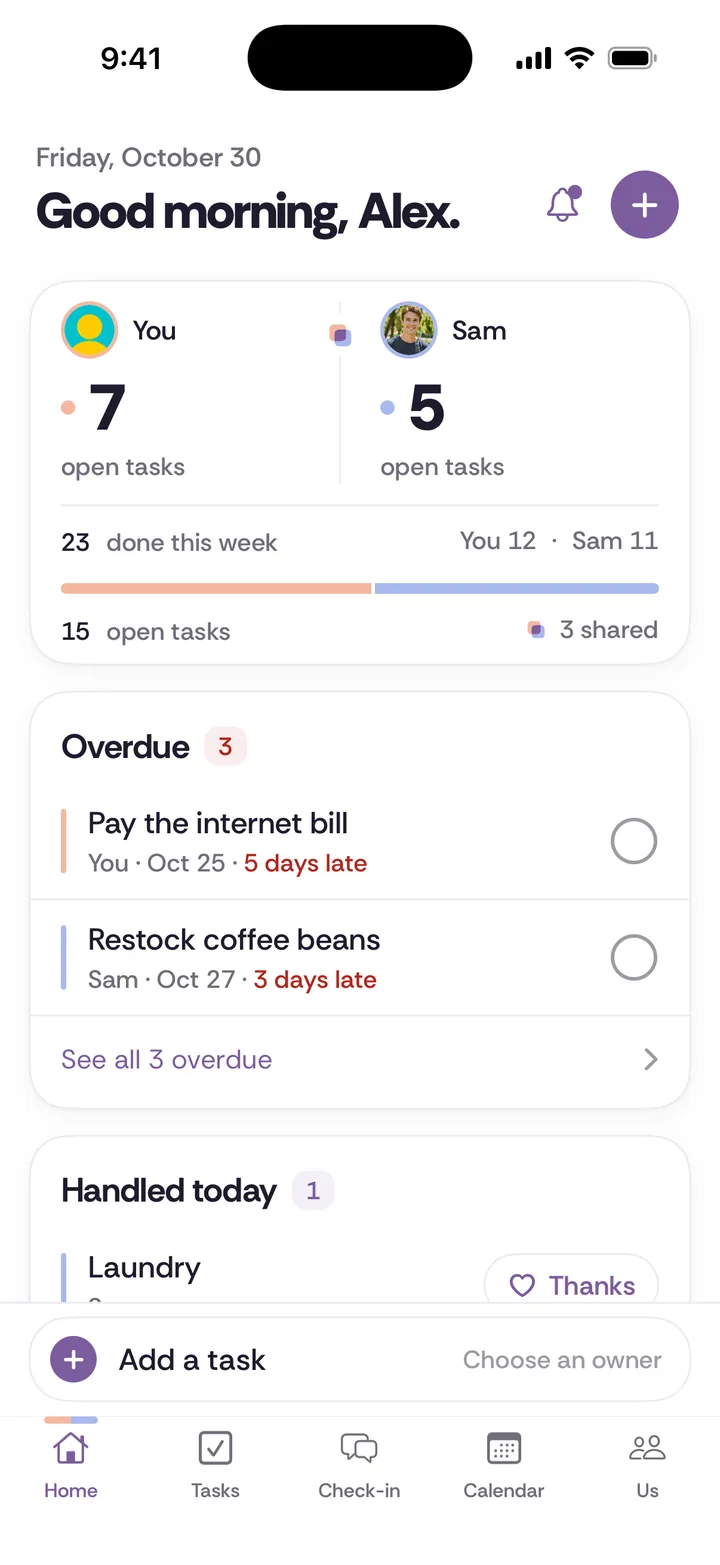
If you want the goals alongside your tasks, Tiptoe is a free app for iPhone and web with a weekly check-in that you both can add topics to. Decisions you make there can become tasks with one owner. It does not make a relationship better on its own. It only keeps what you agreed where you both can see it.