The best check-in questions about chores ask how the split feels, what is being carried that the other person can't see, and what should change this week, rather than who did more. Pick three questions from the lists below, ask them at a calm, regular time, listen to the full answer before replying, and end with one change that has a named owner.
These questions work for married and unmarried couples alike, whether you're asking a husband, wife, boyfriend or girlfriend. They're grouped by purpose so you can choose the right three for the week you've had, rather than working through all of them.
Why ask about fairness instead of counting chores
Two people living in the same house often see the split differently, and both can be sincere. A University of Bath study of 3,000 US parents found that parents often overestimate their own contributions to household planning, and that fathers in the sample were more likely than mothers to see the load as equally shared. That's a reason to ask instead of assume: your own picture of the split is probably flattering to you.
How fair the split feels also matters in its own right. In a study of 389 dual-earner couples in Austria, Germany and Switzerland, wives' sense of justice in the division of housework was linked to their own relationship satisfaction, and to their husbands' satisfaction through the conflict the husbands experienced. The researchers argue that the division of housework should be understood as something between two people, not something each person experiences alone.
Counting chores answers "who did more." Good check-in questions answer "does this feel fair to both of us, and if not, what one thing would help." That's also why we suggest credit by assignment rather than keeping score: if a job is yours, finishing it counts for you, and nobody needs a tally. More on that in our guide to keeping score in a relationship.
How to use these questions
Step 1. Choose a regular time. Weekly is a good rhythm. Ten minutes is often enough. If you already hold a weekly household meeting for logistics, either add two questions at the end or hold this check-in on a different evening so it doesn't get squeezed by the calendar.
Step 2. Pick three questions. One from the opening set, one or two from whichever section fits your week, one from the closing set. Take turns choosing.
Step 3. Both answer every question. One person answers fully, then the other. No interrupting, no correcting the facts in the middle of the answer.
Step 4. Reflect before you respond. Say back what you heard in a sentence. "So the school emails feel like they're always yours, and you'd like me to take some." Then respond.
Step 5. End with one change. Not a list. One job that moves, one habit that starts, or one thing that stops, with a name next to it.
Step 6. Check last week's change first next time. "Last week we said I'd take the bins. How did that go?"
Opening questions: start with what went well
Starting with appreciation sets the tone. The Gottman Institute's weekly State of the Union meeting begins with each partner naming five things the other did that week that they appreciated, before any problem is raised.
- What's one thing I did around the house this week that made your life easier?
- What's something you did this week that you think I didn't notice?
- Which part of the house ran smoothly this week, and why do you think it did?
- What's one thing you'd like to thank me for that you haven't said yet?
The second question is especially useful. It gives the person who does invisible work a direct way to mention it without sounding like they're complaining.
Questions about how the load feels right now
- On a scale from "fine" to "too much," where's your share of the house this week?
- Was there a moment this week when you felt like you were doing it all?
- Is there a time of day or week that feels especially hard to juggle?
- What do you most need from me at that point?
- Is there a job you dread every week? What makes it worse?
- Did anything this week make you feel taken for granted?
The third and fourth questions come from the discussion guide for the *Fair Play* documentary, as quoted by clinical psychologist Julie Radico in Psychology Today. They work because they're about a specific time, not a general verdict.
Questions about the invisible work
Every chore has four jobs: noticing it needs doing, planning it, doing it, and following up. The doing is visible. The other three often aren't. Our guide to the four jobs of the mental load explains this in detail. These questions bring the other three into the open.
- What are you keeping track of right now that I might not know about?
- Which jobs do I do, but only after you remind me?
- Is there anything you're planning for the next month that I could take over completely?
- Which jobs do you do the "noticing" for, even if I do the actual task?
- What would you stop thinking about if I owned it from start to finish?
- When something goes wrong in the house, who do you think gets the call or the blame?
If the answer to the first question is long, write it down together. That list is often the most useful thing a check-in produces. Our mental load examples can help prompt answers, and our guide on how to explain the mental load helps if one of you finds the idea new.
Questions about standards
Some chore conflicts are not about how much each person does but about what "done" means. These questions separate the two.
- Is there a job where we have different ideas of "done"?
- What's the minimum that would be fine for you on that job?
- Is there a job where you'd rather I did it my way than not at all?
- Do you ever redo something I've done? Which one?
- Which jobs matter to you a lot, and which could slip without bothering you?
For more on this, see our guide to different cleanliness standards.
Questions about fairness and the split itself
Ask these monthly rather than weekly, or when something has changed, such as a new job, a new baby or a move.
- Does our split still feel fair to you? If not, what's the first thing you'd change?
- Is there a job that's become yours by default that we never actually agreed on?
- Has anything changed in our work hours or energy that the split hasn't caught up with?
- If you could hand off one job completely, which would it be?
- Is there a job you'd like to take on, or take back?
- Do you feel you can say "no" to a job without it turning into a fight?
- When one of us is busier at work, how should the house adjust?
If one of you earns more or works longer hours, the question of what's fair can get tangled up with money. Our guide on dividing chores when one partner works more helps with that, and the free chore split calculator gives you a starting point to compare.
Questions about follow-through
Use these to review agreements, not to prosecute anyone.
- Last time we agreed on a change. How did it go for you?
- Is anything we agreed on not working in practice?
- Is there a job you own that you need help with this week, or want to hand back?
- Did either of us step in on the other's job this week? Was that welcome?
The last question matters. If one person owns a job but the other keeps quietly finishing it, the owner never really owns it, and the person stepping in never gets the load off their mind.
Questions for the partner who does less
If you know you do less at home, asking first can change the tone of the whole conversation. Try:
- What's one thing I could take over completely, including remembering it?
- Is there something I do that creates more work for you without me realizing?
- What would make it easier for you to stop reminding me?
- Is there a job where you'd like me to just figure it out rather than ask you how?
Then follow through on one answer without asking for instructions.
Questions for when it's tense
If chores have become a sore subject, softer questions make it possible to talk at all.
- Can we agree to talk about the house for ten minutes, without bringing up the past?
- What's one thing about how we talk about chores that you'd like to change?
- When I bring up a chore, how does it sound to you?
- Is there something underneath the chores that we're really arguing about?
The Gottman Institute's guidance on a gentle start-up suggests describing how you feel, about what specific situation, and what you need, rather than criticizing the person. That works for the answers too.
If raising chores makes you afraid of your partner's reaction, or if the conversation is used to threaten or control, please read our safety page. Check-in questions are not the right tool there.
Closing questions: turn talk into one change
- What's the one change we're making this week?
- Who owns it?
- How will we know it worked?
- Is there anything you need to hear from me before we finish?
An example check-in
Here's how three questions might go for a couple in their first year of living together.
"What's something you did this week that you think I didn't notice?" Priya says she rebooked the internet installer twice and cleaned out the fridge before the shopping came. Sam didn't know about either and says so.
"What are you keeping track of right now that I might not know about?" Priya lists the lease renewal date, her sister's visit, the gas bill that's higher than usual, and the smoke alarm battery. Sam writes them down.
"What's the one change we're making this week?" Sam takes the lease renewal and the gas bill, start to finish, including calling the provider. Priya agrees not to ask about either. They'll check next week.
That took about 12 minutes. Nothing was resolved forever. One job moved, and both of them can see it moved.
Common mistakes with check-in questions
Asking all of them. Forty questions is an interrogation. Three is a conversation.
Using a question as a trap. "Do you think the split is fair?" asked with a list of evidence ready isn't a question. Ask only what you want to hear the answer to.
Arguing with the answer. If your partner says they feel the load is uneven, that's their experience. You can share yours too, but "that's not true" ends the conversation.
Leaving with no change. A good talk with no decision tends to make the next talk harder.
Only checking in when it's bad. A weekly habit keeps things small. Waiting until you're both angry makes every question sound like an accusation.
Keeping the questions and answers somewhere
The free option is a shared note: three questions at the top, the date, and the one change you agreed. Over a few months, it becomes a record of what you've moved and what keeps coming back. Tiptoe also has a library of check-in questions you can browse.
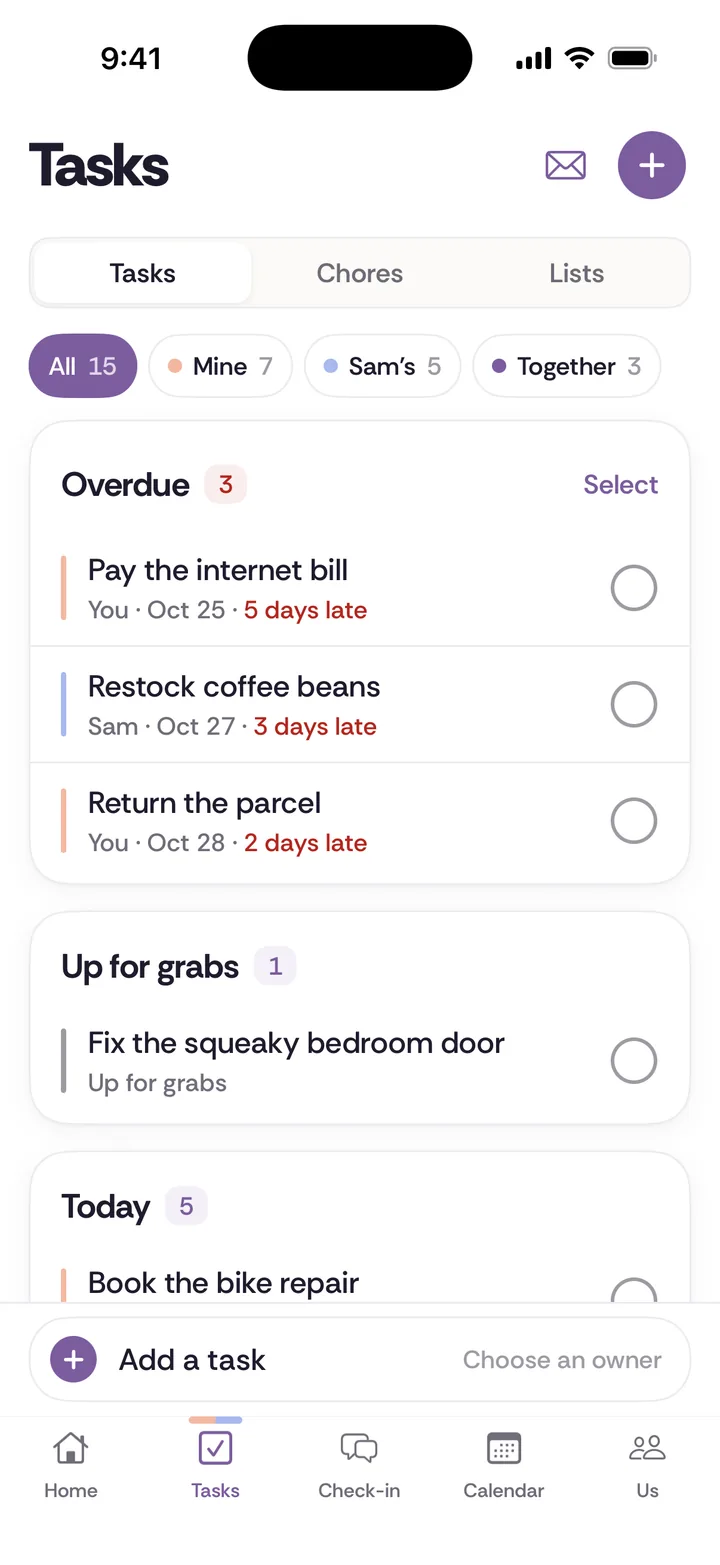
If you want the check-in to happen without one of you having to organize it, Tiptoe's weekly check-in runs at a time you choose, lets either partner add topics during the week, and turns decisions into tasks with an owner. Chores have a named owner and a schedule, and a finished chore counts for the person it was assigned to. It works on iPhone and on the web, and it's free for both partners for your first 30 tasks and chores. The questions only help if you both answer them honestly. No app can do that part.
For the bigger picture on regular check-ins, see our weekly check-in hub.