A weekly family meeting for couples works best as a 20 to 30 minute sit-down at the same time every week, with the same agenda each time: thanks, the week ahead, food, money due, household jobs and who owns them, one bigger topic, and a quick "how are we doing." Collect topics during the week, give every decision an owner before you get up, and stop on time.
That's the whole method. The rest of this page is a copy-ready agenda, a sample meeting from a real-feeling week, the words to use for the first one, and what to do when your husband, wife, boyfriend or girlfriend isn't keen on the idea.
Why a weekly meeting helps
Most household friction between partners comes from information arriving at bad moments. A dentist appointment mentioned while one person is cooking. A late meeting announced by text at 4:45. A bill noticed the day it's due. A weekly meeting moves those conversations to a time you both chose, when nobody is hungry or halfway out the door.
It also does something quieter. In most homes one person carries the planning, the mental load, and the meeting puts that planning on the table where both of you can see it and share it. Katie Seavey Pegoraro, writing on the SAS work-life blog and drawing on therapist Gina Senarighi's book *Love More, Fight Less*, describes the aim as reducing uncertainty, feeling heard, and making shared responsibilities visible.
The 30-minute weekly family meeting agenda for couples
Here is the agenda with suggested times. Shorten any item that has nothing in it.
Part 1: Thanks (3 minutes). Each of you names a few specific things the other did this week that you appreciated. The Gottman Institute's version of a weekly couples meeting, the State of the Union, opens with each partner naming five appreciations before any problems come up. Be specific: "Thanks for calling the plumber and staying home for him" lands better than "thanks for everything."
Part 2: The week ahead (7 minutes). Go day by day. Who is working late, who is travelling, what the kids have on, who does each drop-off and pickup, which evenings are free. Put anything new on the shared calendar while you're talking.
Part 3: Food (4 minutes). Who shops, roughly what's for dinner on which nights, which nights are takeout or leftovers. Add anything missing to the shared grocery list.
Part 4: Money due (3 minutes). Bills, renewals, subscriptions and any larger purchase coming up, and who pays or handles each. Keep big money conversations, such as savings goals or a car, for a separate time. Our couples money hub has more on that.
Part 5: Household jobs and owners (5 minutes). What needs doing this week beyond the routine: the leaking tap, the school forms, the birthday present. Each item gets one owner and a rough day. If something was promised last week and didn't happen, the owner says what's happening with it. No commentary from the other person.
Part 6: One bigger topic (5 minutes). Something either of you added during the week: holiday plans, a change to the chore split, a visit from family. One topic, not three. If it needs more than 5 minutes, book a separate time.
Part 7: How are we doing (3 minutes). One question each: "Anything that felt off this week?" or "Anything you need from me next week?" Then end by asking how the meeting went, which is also suggested in the SAS post.
Copy-ready agenda
Paste this into a shared note or print it:
- Thanks: three specific things each
- This week: work, kids, evenings, drop-offs and pickups
- Food: who shops, dinners, takeout nights
- Money due: bills, renewals, anything over our agreed amount
- Jobs: new items, each gets an owner and a day. Last week's items: done, moved or dropped
- One topic: added during the week
- How are we doing: one thing that felt off, one thing I need
- Next meeting: same time next week
How to run it so it doesn't feel like a board meeting
Same time, every week. Sunday evening after the kids are in bed is common because it sits just before the week starts. A weekday breakfast works for couples who are wiped out by Sunday night. What matters is that it's fixed, so neither of you has to arrange it.
Collect topics during the week. Keep one shared list. When something comes up on Wednesday that isn't urgent, say "I'll put it on Sunday's list" and actually add it. That one habit removes a lot of mid-week nagging. Our guide to stop nagging explains why.
Phones away, except the calendar. Have one device open to the shared calendar and list. Everything else is face down.
Eat first. Both the SAS post and common sense agree: don't start a planning conversation hungry or exhausted.
Alternate who leads. The person leading reads the agenda and keeps time. If the same person always leads, the meeting becomes one more thing they manage.
Decisions become tasks with owners. "We should sort out the garage" is not a decision. "Sam clears the garage shelves by Saturday" is. If nobody owns it, it goes back on next week's list or it's dropped on purpose.
Stop on time. A meeting that runs to an hour every week will get skipped. If you're out of time, move the open topic to next week.
A sample meeting
Here is what the notes might look like for a couple who both work full time, with a 6-year-old.
- Thanks. "Thanks for doing both pickups on Tuesday when my meeting ran late." "Thanks for booking the car service without me asking."
- This week. Jordan has a work dinner Wednesday. Alex does both pickups that day. Swimming moved to Thursday at 5:30. Friday evening is free.
- Food. Jordan shops Saturday. Pasta Monday, tacos Tuesday, leftovers Wednesday, takeout Friday.
- Money due. Car insurance renews on the 14th, Alex checks the quote. School trip payment $35, Jordan pays by Wednesday.
- Jobs. Bathroom fan is noisy, Alex calls the electrician by Thursday. Birthday party Saturday: Jordan buys the present and RSVPs tonight. Last week's job, the passport photos: done.
- One topic. Thanksgiving: whose family this year? Not decided. Both think about it, back on the list next week.
- How are we doing. Alex: "I felt like I was the only one getting up early with her last week." Jordan: "Fair. I'll take Tuesday and Thursday mornings." Added to the chore list.
That took 25 minutes. Many weeks will be shorter.
What to say to start the first one
If you're suggesting this for the first time, keep it light and practical:
I keep feeling like we're figuring out the week by text, and things fall through. Could we try a 20-minute sit-down on Sunday nights to go over the week? I'll make a short agenda. If it's useless after a month, we'll drop it.
If your partner is skeptical, offer a test run with an end date. "Four Sundays, then we decide" is easier to agree to than "every week forever."
What if one of you doesn't want a weekly meeting?
Ask what puts them off. Common reasons, and what helps:
- "It feels like being managed." Alternate who leads, and make sure both people add topics. If only one of you ever adds items, the meeting will feel like a review.
- "It always turns into a fight." Keep the big conflict out of it. Use the one-topic slot for something small. Heavier conversations deserve their own time, and our guide to bringing up something small helps with the way you raise them.
- "We don't need it, we talk all the time." Try it for a month anyway, and see how many mid-week "did you remember" messages disappear.
- "I'm too tired on Sunday." Change the time, not the idea.
If one partner is afraid of how the other will react, or a meeting would be used to control or punish, please read our safety page. A planning ritual is not the right tool for that situation.
Keep logistics and feelings separate
The weekly family meeting is mostly logistics. That is its strength. But if every conversation you have about the relationship happens in the same 30 minutes as the electricity bill, the relationship can start to feel like a shared office.
Two habits help. First, keep the "how are we doing" question short in the meeting, and save longer conversations about how the split feels for a separate check-in. Our list of check-in questions about chores and fairness is built for that. Second, protect some time together where logistics are off limits. The authors of the National Marriage Project's Date Night Opportunity report note that some marriage experts recommend keeping conflicts and problems off the table during time set aside for fun, and setting aside separate time to handle issues. Our guide on how to plan date night when you're busy covers that half.
Variations for different households
No kids. Drop the pickups and keep the rest. Many couples without children find the food, money and jobs sections are where most of the friction is anyway.
A new baby. Shrink it to 10 minutes: who's doing which nights, what needs buying, who handles visitors and appointments. See splitting chores with a new baby.
Shift work or travel. Hold it at the start of whichever partner's week is less predictable, and do it by video if you need to. The agenda doesn't change.
One partner works from home. Check that home-working days aren't quietly becoming the default for every delivery and repair. See chores when one partner works from home.
Older kids. A family meeting with the children is useful for chores and plans, but keep a short couple-only meeting too. Some topics, like money worries or one partner feeling overloaded, aren't for the kids.
One partner does much more at home. Use the jobs section to move one whole area each month rather than reshuffling small tasks every week. See what to do when one partner does more.
Where to keep it
The free version is a shared note with the agenda at the top, a running topic list underneath, and a shared calendar. A paper notebook kept by the kettle works too, as long as both of you can add to it.
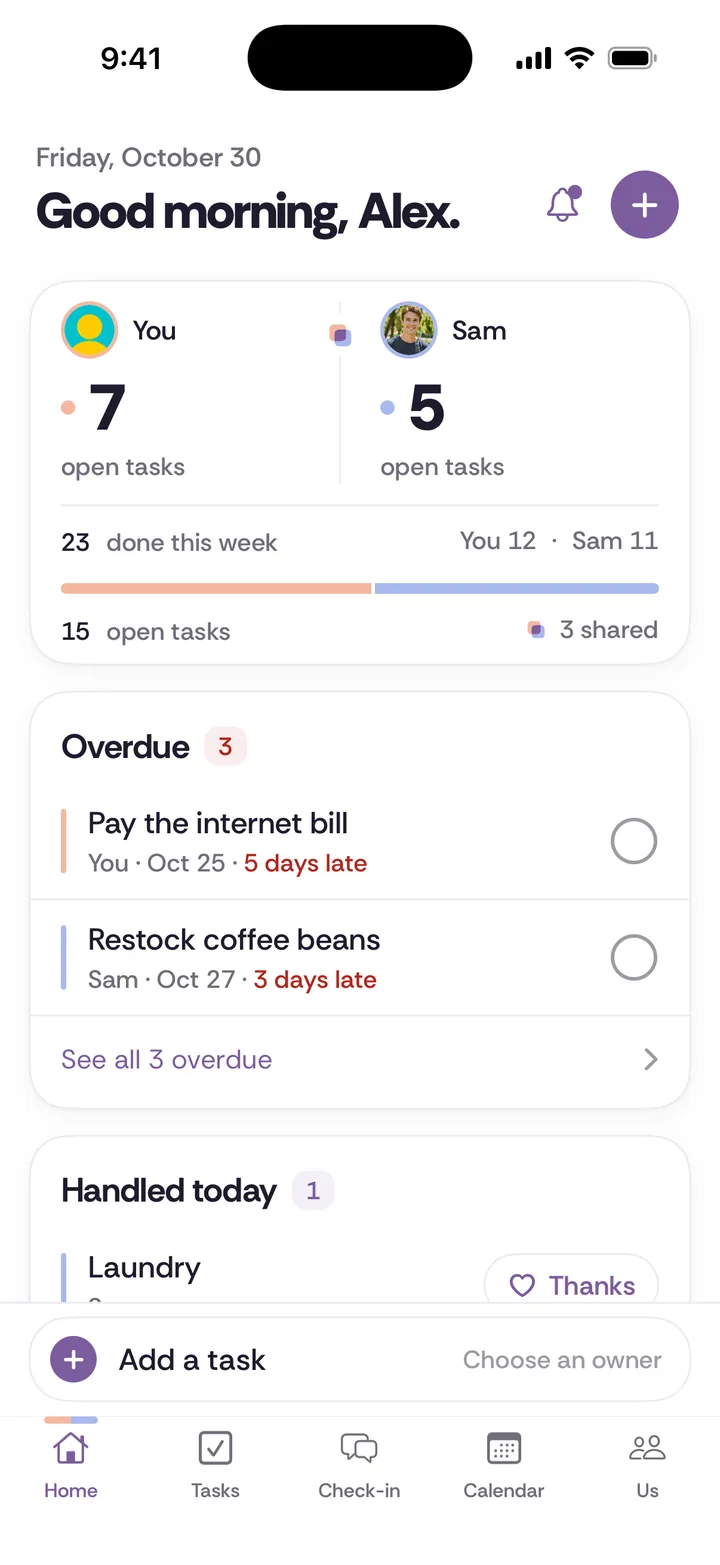
If you'd rather have it in one place, Tiptoe's check-in is a weekly conversation at a time you choose. Either partner can add topics during the week, and decisions become tasks with an owner. The same app holds your shared calendar, chores and lists. It runs on iPhone and on the web, and it's free for both partners for your first 30 tasks and chores. The app can hold the agenda. Turning up each week is still up to the two of you.