To split chores after a baby, list every household and baby job before the birth, give each one a single owner, and plan the nights and the first two weeks in detail. Expect the split to be uneven at first, especially if one parent is feeding at night, and set dates to revisit it. The partner doing less of the baby care should own whole household jobs outright, not "help when asked".
A new baby adds a large amount of work at once, and the split you had before rarely survives it without a plan. Whether you're a husband and wife, two dads, two moms, or a boyfriend and girlfriend having a first child, the steps are the same: decide who owns what before the baby comes, write it down, and change it on purpose rather than by drift.
What happens to the chore split after a baby?
It tends to move, and not always the way couples expect. Ohio State researchers followed 182 dual-earner couples through the birth of their first child in The New Parents Project. Before the birth, men and women each did about 15 hours of housework a week. Afterward, men cut their housework by about five hours a week while women did not reduce theirs. Time diaries showed women's total workload rose by about two hours a day and men's by about 40 minutes, even though both spouses estimated their workload rose by more than four hours a day. The study, by Jill Yavorsky, Claire Kamp Dush and Sarah Schoppe-Sullivan, was published in the Journal of Marriage and Family.
That's one study of highly educated couples, so it won't describe every household. The useful takeaway is that a couple who split things fairly before a baby can drift without noticing, and that both partners can feel they are doing more than they are. Writing the split down is how you notice.
Step 1. Before the birth, list everything
Sit down together in the second or third trimester and write every job, old and new. Couples coach Aaron Steinberg, speaking to NPR's Life Kit, recommends including less visible labor and baby "life admin". Our list of household chores covers the house. Add the baby list:
- Night feeds, and everything around them (bottles, pumping, burping, changing, resettling)
- Bottle and pump parts washed and sterilized
- Diapers, wipes, formula or feeding supplies kept in stock
- Baby laundry
- Pediatrician and health visits booked and attended
- Vaccination schedule tracked
- Paperwork: birth registration, insurance, parental leave forms, childcare waitlists
- Visitors: who comes, when, and for how long
- Thank-you notes and replies to messages
- Meals for the parents
- The parent who gave birth's recovery: appointments, medication, rest
Relationship scientist Shy Porter suggests getting specific in the same NPR piece: who goes to pediatric appointments, and what happens if the baby is sick at day care, who leaves work. Answer those now, not at 3am.
Step 2. Accept that the split won't be 50/50, and decide how to balance it
If one parent is breastfeeding, they will carry most of the feeding, especially early on. Porter's example: "If I'm up breastfeeding multiple times a night, maybe you are on diaper duty." The balance comes from the other side of the list. The partner who isn't feeding takes more of everything else, as whole jobs.
A starting split for a breastfeeding household:
- Feeding parent: feeds, and nothing else during feeds
- Other parent: diapers and resettling after night feeds, all bottle and pump washing, all household laundry including baby laundry, all meals for the adults, the house, visitors, paperwork, and keeping supplies stocked
A starting split for a bottle-fed or formula-fed household:
- Night shifts: one parent covers 9pm to 2am, the other 2am to 7am, so each gets one solid block of sleep. Swap who goes first each week if you like.
- Day jobs split as whole jobs: one owns feeding supplies and bottle washing, the other owns laundry and meals. Both own the house on alternating days.
If you're not sure which you'll be doing, plan both and pick once you know.
Step 3. Plan the first two weeks in detail
The first weeks are when the old split breaks fastest. Write down who does each of these, by name:
- Cooking or ordering dinner every night, and who places the grocery order
- Laundry, start to finish
- Bins and recycling
- Dishes and bottle cleaning
- Visitors: one partner is the gatekeeper who says yes, no and "please bring dinner"
- Messages and updates to family
- Pets
- Older children's school runs, if you have them
Porter also recommends a family caregiving rotation and asking friends and family to check in, since new parents can feel isolated. If people offer help, give them a job from the list, not a vague "let us know". A meal rota, a weekly grocery drop or a dog walker covers a lot of chores for the first month.
Step 4. Give the parent doing less baby care whole jobs
This is the most important part, and the one most couples skip. "I'll help with whatever you need" puts the other parent in charge of noticing, deciding and asking, at a time when they are exhausted. Offer whole jobs instead.
Say this:
I'm taking all the laundry from now on, ours and the baby's. You don't need to think about it at all. If something runs out, that's on me.
Not this:
Just tell me what you need me to do.
Whole jobs that work well for the parent doing less feeding:
- Food: meal plan, groceries, cooking or ordering, clearing up
- Supplies: diapers, wipes, formula, medication, all kept stocked without being asked
- Baby admin: appointments, forms, insurance, childcare research
- The house: whatever level of clean you agreed, kept there
- Night support: changes and resettling after each night feed
Each of these includes the noticing, planning, doing and follow-up. The four jobs in every chore explains why handing over only the doing doesn't take the weight off.
Step 5. Drop the standard on purpose
Decide together what you will stop doing for the first three months. Write it down so neither of you feels guilty.
- Floors vacuumed once a week, not daily
- Laundry washed and dried, folding optional
- Paper plates allowed
- No hosting
- Thank-you notes can wait two months
A lower bar you agreed on is very different from one partner quietly letting things slide while the other quietly picks up the slack. If you already disagree about how clean is clean enough, sort that first with different cleanliness standards.
Step 6. Re-split when leave ends
Parental leave rarely ends at the same time for both parents. When the first parent goes back to work, the parent still on leave tends to absorb everything by default. Plan for this before it happens.
When you go back on the 3rd, I'll still be home for six weeks. I'm happy to do more of the daytime baby care. I'd like you to keep the food job and the baby admin, and take bath and bedtime most nights so I get a break.
Then plan again for when you both work. If you're both going back, dual-income couples and chores covers the sick-day and pickup questions. If one of you stays home longer term, see the stay-at-home parent chore split.
If you already have older children
A second or third baby changes the split in a different way. The new baby takes one parent's hands, so the older children's routines need a clear owner, and that owner usually should be the parent doing less feeding.
Hand over these as whole jobs before the birth, and practice them for a couple of weeks:
- School or daycare mornings, start to finish, including bags, lunches and forms
- After-school pickup and activities, including messages from coaches and teachers
- Bedtime for the older children
- Their birthdays, playdates and party invitations
- Their doctor and dentist appointments
Tell the older children who does what, in plain words, so they stop routing every request to the parent they're used to.
For the next few months, Dad does mornings and bedtime. If you need something for school, ask him.
Swap "Dad" for whichever parent it is. The point is that the children know the plan too, which saves the feeding parent from being asked for everything while holding a baby.
Step 7. Check in weekly, briefly
Steinberg warns that one mistake people make is assigning tasks and then never talking about it again. Put 10 minutes on the calendar each week, ideally during a nap. Ask:
- Is anything falling through the cracks?
- Is either of us getting no sleep, or no time alone?
- Is any job on the wrong person?
A weekly check-in works well here because it's a set time, so concerns don't come out in the middle of a 4am feed.
What to say when it starts to feel uneven
It almost certainly will at some point. Raise it early and plainly.
I'm doing every night feed and I'm also noticing I'm the one who orders diapers and books the appointments. That's too much for me right now. Could you take supplies and appointments from this week, start to finish?
If your partner says "but you're home all day":
I'm home, but I'm not free. Most of the day is feeding and settling. I need the house jobs to belong to you, not to wait for me to ask.
If you're the partner who's been doing less:
I think I've slid into helping instead of owning things. Which two jobs would take the most off your plate if I owned them completely?
If you're the parent at home and you keep redoing your partner's jobs, that's worth naming too:
I keep refolding the baby clothes, and that's on me. The way you do it is fine. I'm going to leave it.
For more phrasing that doesn't turn into nagging, see what to say instead of nagging. If resentment is already building, read resentment over chores.
Look after both of you, not just the baby
Sleep deprivation makes every disagreement harder. If either of you feels persistently low, anxious or unable to cope, tell your doctor, midwife or pediatrician. That's not a chore conversation, and it should come first. If you feel afraid of your partner, or a disagreement involves threats or control, please read our safety page.
Keeping the plan where you can both see it
Write the split on one page and stick it on the fridge, or keep it in a shared note on your phones. That's free and works if you both look at it. The weekly ten minutes is what keeps it accurate.
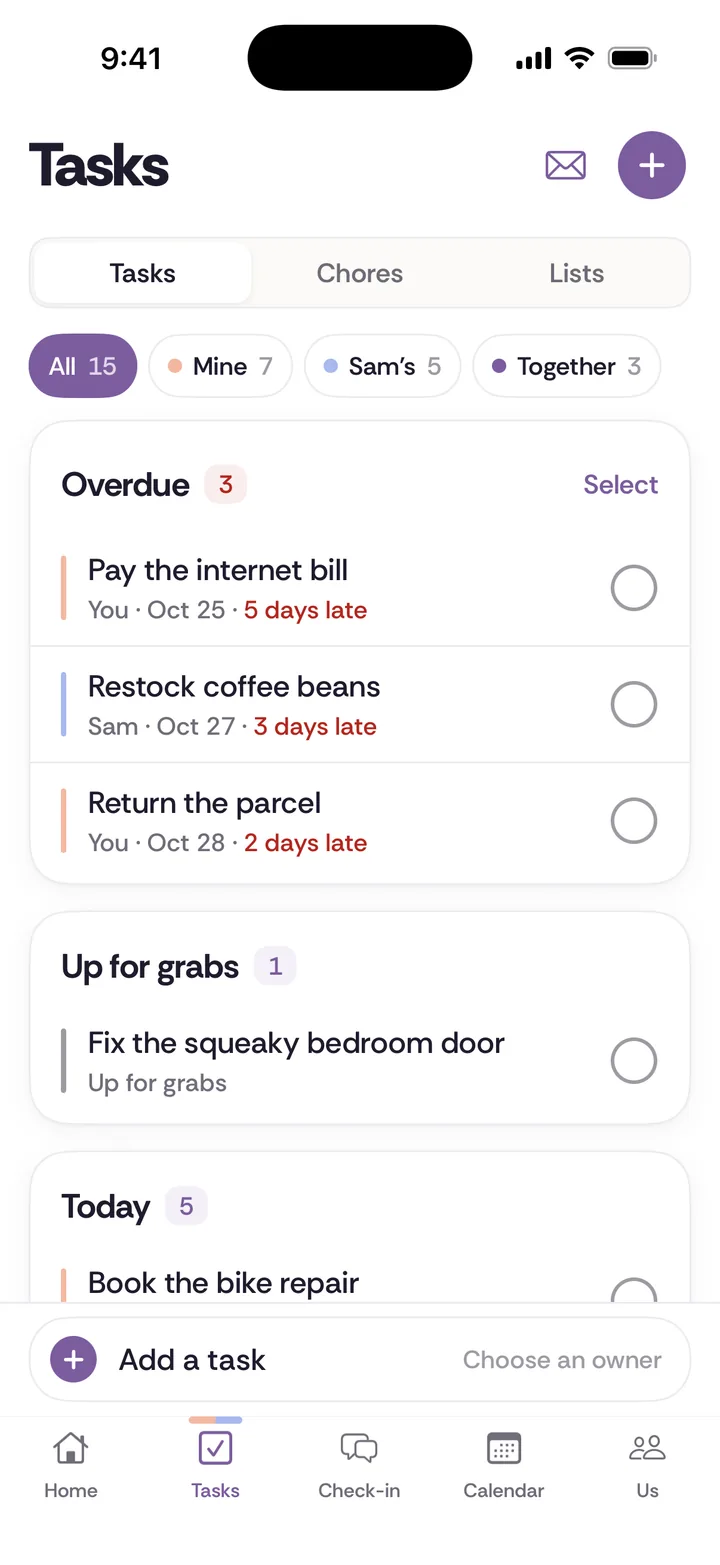
If you want reminders and repeating jobs on your phones, Tiptoe lets you assign each task and chore to you, your partner or both together, and set chores like "bottle parts sterilized" to repeat with one owner. A completed chore counts for the person it was assigned to. It's on iPhone and the web, and free for both partners for your first 30 tasks and chores. For a copy-ready weekly layout, see the chore chart for couples.