To ask your partner for help without nagging, make one specific request, attach a time to it, get a real yes or no, and then don't ask again. The 40 scripts below give you the exact words for the situations where this usually goes wrong, from a single dish in the sink to a job you are done carrying.
Whether you are asking a husband, wife, boyfriend or girlfriend, the wording works the same way. This page is about what to say in the moment. If you want to end the reminder loop altogether, by moving ownership of the job, our guide on how to stop nagging covers that, and it is the better long-term answer.
What makes a request sound like nagging?
Nagging is less about tone than about structure. A request starts to sound like nagging when it has one of these problems:
- It has no time on it. "Can you take the trash out?" means nothing without a when, so you end up asking again.
- It has no real answer. A grunt from the sofa is not a yes, and you both know it.
- It carries old business. "For once" and "like I said last week" turn one request into a review of your partner's character.
- It repeats. Once you have asked three times, the fourth ask is about the asking.
The Gottman Institute draws a similar line between complaining about a specific behavior and attacking the person, and suggests a gentle start-up: name how you feel, name the specific situation, and say what you need in positive terms. Its three-part formula is "I feel, about what, I need." Most of the scripts below use a shorter version for everyday logistics, because "I feel" can be too much for a question about the recycling.
The four rules behind every script
- One thing. Not the trash and the dishwasher and what we are doing about Saturday.
- A when. A time, a day, or an event such as "before you go to bed."
- Room for no. If no is not allowed, it is an order. Ask for a real answer and accept a counteroffer.
- Once. If you get a yes with a time, you are done. Whatever happens next is a different conversation, covered in the third group below.
Keep your voice ordinary. These words will not rescue a sigh. If you are too angry to sound ordinary, wait an hour, because a calm request later beats a tense one now.
Asking for one thing right now
Use these for a small thing with a short horizon.
- 1. "Can you empty the dishwasher before dinner? I'm starting the pasta at six."
- 2. "I need ten minutes of help with the kids' bath. Can you come up now, or in five?"
- 3. "Could you take the trash out on your way to the car? Pickup is at seven tomorrow."
- 4. "Are you free to deal with the laundry in the dryer, or should I leave it for tonight?"
- 5. "Can you take over with the baby for twenty minutes? I need to make a call and then lie down."
- 6. "Would you fold this load while we watch this? I'll put it away."
Notice that script 4 gives your partner a choice and accepts the answer. If "leave it for tonight" is not acceptable, don't offer it.
Asking ahead, for something with a deadline
Most of the words you spend on reminders can be saved by asking early and agreeing how it gets done.
- 7. "The car needs to be at the shop by Friday. Can you book it, or should I?"
- 8. "Your mom's birthday is on the 14th. Do you want to handle the present this year? I'd like not to be the one tracking it."
- 9. "The permission slip is due Wednesday. Can you sign and return it? It's on the counter."
- 10. "We have people coming Saturday at four. Can we pick now who does what, so we aren't doing it in a panic at three?"
- 11. "The rent increase letter needs an answer by the end of the month. Can you take the first look this weekend, and we'll decide together on Sunday?"
Scripts 7 and 8 also name who holds the thinking part. That matters because noticing and planning are jobs in their own right, and asking your partner to take those too is different from asking them to do a task.
When it was agreed and it hasn't happened
This is where a request usually turns into nagging. The trick is to stop repeating the request and ask about the plan.
- 12. "You said you'd call the plumber today. Is that still happening, or has something changed?"
- 13. "The trash didn't go out. Do you want to take it to the dump this weekend, or wait for next week's pickup and live with the smell?"
- 14. "I'm not going to keep reminding you about the insurance. What do you need so that it's done by Friday?"
- 15. "We agreed you'd do lunches on school days. Is that still working for you? Because it hasn't happened twice this week."
- 16. "If you can't get to it by tomorrow night, tell me by lunchtime, and we'll work out something else. If I don't hear anything, I'll assume it's handled."
- 17. "This is the third time we've talked about this. I don't want to bring it up a fourth time. What should we change about this?"
Script 16 needs you to follow through. If you say you will assume it's handled, you can't then do it yourself at midnight and be angry the next day. If this happens often and your partner seems to genuinely lose track, read when your partner forgets everything you ask.
Handing over a whole job
These replace a hundred small requests with one larger one. Use them at a calm moment, ideally not within sight of the problem.
- 18. "I don't want help with the groceries anymore. I'd like you to own them: what we need, the order, and when it comes. Would you take that on?"
- 19. "I keep the whole school calendar in my head, and I'd like to stop. Can you take the next month and tell me if you need anything from me?"
- 20. "Pick one of these three things to own completely: dinners on weeknights, the kids' laundry, or the pets. I'll stop thinking about whichever you choose."
- 21. "You said you'd do more if I told you what to do. Telling you is the part I'm trying to give up. Would you be willing to take on the planning for dinner too?"
- 22. "Let's write down what done means for the bathroom, and then I won't check it or comment on how you do it."
- 23. "I'm going to stop reminding you about this, and that's not me giving you the silent treatment. It's yours now. If it slips, it slips, and we'll talk about it on Sunday."
If you want help deciding which jobs to move, the complete chore split guide and the free worksheet list them.
When you are at your limit
These say the real thing, without the sarcasm that tends to come out instead.
- 24. "I'm tired and I'm getting short with you, and it isn't about the dishes. Can you take over the kitchen tonight and I'll explain tomorrow?"
- 25. "I've been running the house on my own for a few weeks, and I'm starting to feel resentful. I'd like to fix that before it gets worse. Can we talk for twenty minutes tomorrow night?"
- 26. "I need a night with nothing to do. Can you take Thursday, all of it, including bedtime and whatever comes up?"
- 27. "I'm not asking you to guess. I'm telling you: I need more from you at home right now, starting with mornings."
- 28. "I don't need you to apologize. I need Tuesday and Wednesday dinners to be handled by you for the next month."
If resentment has already built up, there's a longer way through in resentment over chores. And if you're not sure how to open a harder talk, read how to bring up something small.
Kids, mornings and guests
Time pressure is when reminding becomes barking. Agree in advance, then use a shorter phrase in the moment.
- 29. "Mornings are too much for me alone. Can you own shoes, bags and getting them out of the door, and I'll own breakfast and lunches?"
- 30. "When the baby wakes at night, can we agree on who goes before we go to sleep, so nobody lies there waiting?"
- 31. "Can you be the person the school calls this month? I'll send them your number today."
- 32. "My parents get here at two. Can you own the guest room and the bathroom and tell me when they're done, so I don't have to look?"
- 33. "I'm taking the kids to the party. While we're out, can you get the kitchen and floors done? That's my one ask for today."
When the result was not what you meant
Stick to what you need. Comment only if it actually matters.
- 34. "Thanks for doing the wash. The wool sweater shrinks in the dryer, so can you pull those out next time? The rest is fine."
- 35. "For lunches, the school doesn't allow nuts. Everything else is your call."
- 36. "I said 'clean the kitchen' and we meant different things. To me, it means counters and stovetop too. Can we agree on that, and then I'll leave it alone?"
- 37. "You did it differently from how I do it, and it worked. I'm going to stop telling you how."
Before saying anything, ask whether the problem is real or just a preference. A towel folded in thirds is not a problem. For a longer look, see different cleanliness standards.
When your partner says you are nagging
Three replies that don't take the bait and don't drop the point.
- 38. "You might be right about my tone, and I'm sorry for that. The dishes still need an owner, though. Can we talk about that part?"
- 39. "I don't like reminding you either. I'd love to stop. What would need to change so that I don't have to?"
- 40. "When you say I'm nagging, I hear that I should stop asking and keep doing it myself. I'm not willing to do that. So what's your suggestion?"
Script 38 uses what the Gottman Institute suggests as an answer to defensiveness, which is to take responsibility for your share of the problem. Apologizing for a tone is fair. Dropping the request isn't required.
If asking your partner for anything leads to fear, punishment or threats, none of these scripts are the right tool. Our safety page has places to turn.
Five phrases to retire, and what to say instead
- "Can you just..." "Just" tells your partner that the task is tiny and they should already have done it. Try "Can you" followed by the task and the time.
- "You never..." Your partner will find the one time they did. Say "This week, it was me each night" instead.
- "I shouldn't have to ask." That may be true, and it tells them nothing about what to do. Say "I'd like this to be yours, so that I don't have to ask."
- "Do you see this mess?" It is a trap, and your partner knows it. Say what you want done.
- "Never mind, I'll do it." This is the most expensive one. You've just taught both of you that your request had an expiry date. Say "Tell me by lunchtime if you can't."
How to stop needing these scripts
A good request is still a request, and you are still the one making it. If you're using these words daily for the same job, the next step is moving that job.
Write down the five requests you make most often. Then choose one, and use script 18 for it. Our guide on how to stop nagging walks through what happens next, and a weekly check-in gives you a set time for this, so that you can keep the rest of the week free of it.
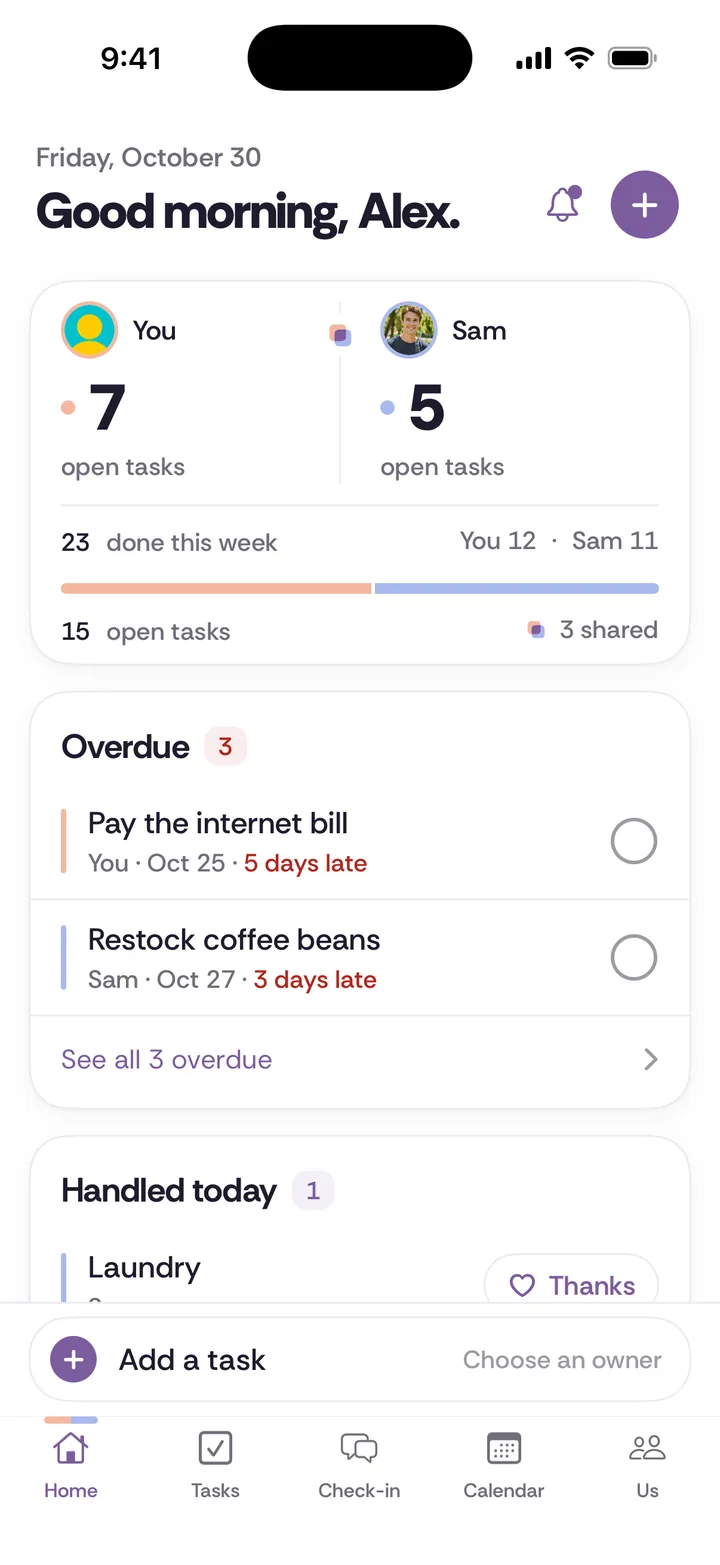
Writing it down is what removes the need to say it again. A list on the fridge with one name next to each job does that for free. Tiptoe does the same on iPhone and on the web: each chore has one owner, and you can send a nudge about an overdue item, which replaces having to say it out loud. It doesn't make anyone do anything, but it does mean the reminder is not a sentence you have to say at dinner.