If your partner forgets everything you ask, stop relying on memory, theirs or yours. Get a clear yes with a time attached, have your partner write it down themselves in a place they already look, and tie it to something that already happens, such as "when I get home" or "before I start the car". If you have done all of that and the forgetting continues, it's time to ask whether something else is going on.
Your husband, wife, boyfriend or girlfriend may truly not remember. That can be true and it can still be a real problem for you, because every forgotten thing lands on someone. This page helps you work out which kind of forgetting you are dealing with and gives you a way to stop being the backup memory for the house.
Why does your partner forget what you ask?
There are several possible reasons, and they lead to different responses.
The request never really went in. Asked from another room, while someone is on a phone, in the middle of something else. A "mm-hm" is not a yes. This is the most common and the easiest to fix.
You're asking them to remember at the wrong moment. Remembering to do something later is its own mental skill, called prospective memory. It's different from remembering facts. Someone can recall every detail of a movie and still walk past the full trash can on pickup day. The ask has to come back at the right moment, and nothing is bringing it back.
The job isn't really theirs. If you run the household, your partner may treat your requests as things to do when reminded. Your reminder has become part of the process, so they don't need to retain anything. Understanding this split between noticing and doing tends to explain a lot.
They didn't want to say no. Some forgetting is a quiet no: agreeing to something to get out of the conversation, then not doing it. A person doesn't always know that's what they are doing.
Attention or memory is genuinely under strain. The NHS lists stress, anxiety or depression, and sleeping problems among common and treatable causes of memory problems. NIMH describes trouble remembering daily tasks as a common sign of ADHD in adults. You can't diagnose this from the kitchen, and you don't need to. You just need to keep it in mind as a possibility. See also ADHD and household chores.
A quick test: what kind of forgetting is this?
Spend two weeks noticing, without saying anything about it. Ask yourself:
- Is it everything, or only some things? If your partner remembers work deadlines, the fantasy league and their mother's birthday, but not the things you ask for, then the difference isn't only memory. It may be that those things have a calendar, a boss or a personal stake. That's useful information about what would help.
- Is it new? A long-standing habit is different from a change over the last few months.
- What happens when you don't remind them? Does it get done late, or does it never happen?
- Do they remember the conversation? "Oh no, you're right, I forgot" is different from "You never asked me that."
- What's your partner's reaction when it comes up? Embarrassment, a shrug and irritation each tell you something different.
- Is it affecting them too? A person who also loses keys, misses their own appointments and forgets work things has a different picture from someone whose forgetting only hits household requests.
Six steps that work better than reminding
Step 1. Ask when you have their attention. Same room, phone down. "Have you got a second?" is enough. Don't ask while they are walking out of the door unless it's for right then.
Step 2. Get a real yes with a time.
Can you call the vet about the refill this week? What day works?
If they say "yeah, sure", follow up with "When?" That's not micromanaging. It's the part of the request that was missing.
Step 3. Have them capture it, right then. They should write it in their own phone, on their own list, while you're still in the conversation. You writing it down for them doesn't count, because you have kept the job. CHADD's guide to using a planner, written for adults with ADHD, recommends writing down tasks as they come up instead of relying on memory. That's useful for anyone.
Step 4. Tie it to a trigger. Plans in the form "when X happens, I will do Y" are called implementation intentions, and they have research behind them. A meta-analysis in Psychiatry Research found that they improved prospective memory, with a medium-sized benefit in healthy young adults. That work covers memory in general, not chores, so treat this as a sensible thing to try rather than a guarantee. Examples:
- "When I sit down in the car to go to work, I'll call the vet."
- "When I finish brushing my teeth, I'll start the dishwasher."
- "When I walk in on Tuesday night, the trash goes out before my shoes come off."
Step 5. Put cues in the physical world. Keep the form on the car keys. Put the medication next to the coffee. Leave the bag by the door. The best reminder doesn't need anyone to say anything.
Step 6. Reduce the number of one-off asks. A dozen small requests a week is a lot to carry. One regular job with a set time, such as "trash on Tuesday, every Tuesday", doesn't need to be remembered as a new thing each time. Try to convert requests into ownership. Our guide on how to stop nagging covers that handover.
How to bring it up
Pick a calm time and describe the effect on you, not their mind.
When something I ask for gets forgotten, I end up either doing it or reminding you, and then I feel like a parent, which I hate. I don't think you're doing it on purpose. Can we work out a way for this to not depend on my memory?
Then ask them directly. People who forget things often have ideas about what works, because they've been dealing with it for much longer than you have.
What actually works for you at work? Is there anything you do there that we could use at home?
Other useful lines:
When they say "you never told me":
I think I did, but I'm not interested in arguing over that. From now on, if it matters, I'll ask you to put it in your phone while we're talking. Does that work?
When they say "just remind me":
I could, but then I'm doing two jobs. I'll remind you this one time while we set something up, then it's on your list.
When you think it may be a quiet no:
You've said yes to this three times, and I wonder if you actually don't want to do it. It's fine if you don't. I'd just prefer to hear no so we can work out something else.
What should you do when it gets forgotten anyway?
It will happen. What you do next decides whether the system lasts.
Sort it first by consequence. Low stakes: the plants look thirsty, or the recycling piled up. Leave it. Higher stakes: a child's pickup, medication, a bill with a penalty. Agree in advance who the backup is, and how, so that these are covered without a scene.
Don't quietly fix it. If the forgotten job just disappears because you handled it, nothing tells your partner that it happened, and the pattern continues. If you must step in, say so: "The school form was due today, so I signed it. That one was on your list. Can we talk about what happened on Sunday?"
Don't punish it either. A cold evening doesn't teach anyone to remember. CHADD's article on how love gets lost in translation describes how frustration can turn into criticism and become a negative cycle. It's written about ADHD, but the cycle is familiar in many homes.
Look at the plan, not the person. Ask "What would have caught this?" A second cue? An earlier time? A smaller first step? If you've tried three things and nothing helped, the problem may be elsewhere.
Why being forgotten hurts, and why that's fair
It's reasonable to feel hurt, even if you're sure there's no bad intention. Being forgotten can feel like being unimportant, particularly when other things get remembered. CHADD's page on ADHD in marriages and partnerships notes that partners may read these behaviors as a lack of care or love, while the person doing the forgetting may be defending against blame. Both reactions make sense, and they can feed each other.
Say the feeling, separately from the logistics:
I know you didn't forget it to hurt me. It still felt like what I asked for didn't matter. I'd like you to know that, and then I'd like us to fix the system.
Your partner forgetting doesn't oblige you to become their memory. Compassion and limits can go together.
Specific situations
Your partner forgets things about the kids. Pickups, permission slips and pediatrician visits are the wrong place to practice. Move these onto a shared calendar with alerts for both of you, and keep the backup in place until the new setup has worked for a month or so.
Your partner forgets dates that matter to you. Put birthdays and anniversaries in a calendar. It's not less romantic. It's how most people remember anything.
Your partner says yes while looking at their phone. Ask for eye contact and a time. "I need thirty seconds of your full attention, and then you can go back to it."
You're both forgetful. Neither of you can be the backup, so external systems matter even more. Use fewer commitments, fixed days, visible lists and alerts you both receive.
It's getting worse, or it's new. A sudden or growing change is worth taking seriously. The NHS suggests seeing a GP when memory problems are affecting day-to-day life. In other words, it's reasonable to suggest your partner talk to their doctor. This page isn't medical advice, so raise it kindly and let the doctor do the assessing.
I've noticed you seem more forgetful lately, and you seem tired too. I'm not upset about it. I'm a bit worried. Would you talk to your doctor?
When is forgetting a bigger problem?
If it's been going on for years, you've tried real systems, and your partner shows no interest in fixing it, you are facing a question about willingness rather than memory. Read what to do when your partner doesn't help for how to approach that conversation. If you suspect you're being told that things never happened in order to make you doubt yourself, or you feel afraid to raise it, see our safety page.
A way to take the reminder off your plate
Choose one place where every household job lives, and make your partner responsible for checking it. It can be paper on the fridge, a note on both phones, or the free worksheet. Review it at a short weekly check-in.
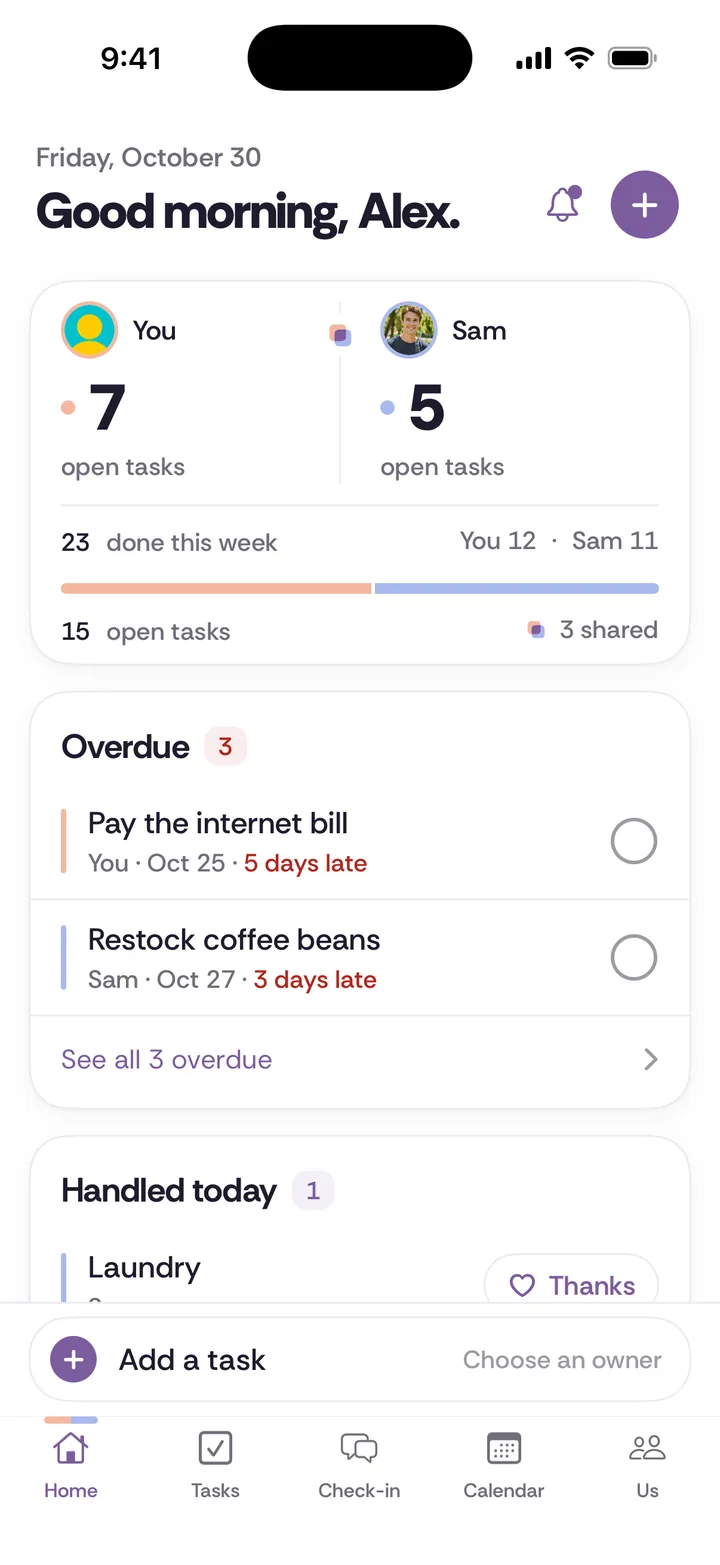
If you want the reminders to come from somewhere other than you, Tiptoe puts each chore on a repeating schedule with one owner, on iPhone and on the web. You can send a nudge about an overdue item, so nobody has to bring it up over dinner. It's free for both partners for your first 30 tasks and chores. An app won't do the remembering for anyone who isn't looking at it, so agree on when each of you will check it.