When one partner has ADHD, chores tend to work better if they are visible, specific, tied to a set time and owned by one person, rather than held in anyone's head or delivered as spoken requests. The other half of the answer is to stop the pattern in which one partner manages and the other gets managed, because that pattern can hurt both of you. This page is practical information and isn't medical advice. A diagnosis or treatment decision belongs with a qualified professional.
Whether it's your husband, wife, boyfriend or girlfriend who has ADHD, or you, the goal stays the same: two adults running a home together, with a setup that fits how each of you works. What this page says about ADHD is drawn from NIMH and CHADD.
Why can household chores be harder with ADHD?
NIMH lists trouble remembering daily tasks, disorganization and procrastination, and difficulty following instructions or finishing projects among the signs of ADHD in adults. In a diagnosis, these are more severe and frequent than in most people, and they disrupt daily life.
Housework is a stacked version of those demands. CHADD's page on marriage and partnerships lists everyday challenges that can include not remembering what was said, trouble starting tasks, underestimating how long tasks take, leaving messes and leaving household projects unfinished. It also notes that added responsibilities, such as running a home or raising a child, can add to the strain.
Reward plays a part too. In an article in CHADD's Attention magazine, psychotherapist Anita Robertson writes that routine household tasks offer little of the sense of completion others may feel, which makes them harder to start and finish. She also notes that partners can misread this as not caring, particularly when the same person can focus intensely on something high-reward.
That last point is usually where the fight begins. "You can hyperfocus on your game for four hours" is true, and it isn't evidence that the dishes are a matter of willpower.
What does the cycle look like?
Many couples describe some version of this:
- One partner forgets or leaves things unfinished.
- The other picks them up, then starts reminding and checking.
- The reminded partner feels supervised and criticized.
- The partner doing the reminding feels like a parent and grows tired and angry.
- The first partner withdraws, or tries harder for a while, and the cycle restarts.
Melissa Orlov, interviewed by CHADD, describes this as a parent-child dynamic with one person over-functioning and the other under-functioning. She stresses that the partner with ADHD isn't incapable and isn't solely responsible, and she argues the pattern has to end for the relationship to be healthy. Both partners are in it. Both can get out of it.
The CHADD page on partnerships describes the same trap from the point of view of motive. The partner without ADHD can read the behavior as a lack of care, and the partner with ADHD may deflect blame to protect their self-esteem. CHADD's suggested starting point is to recognize the disorder as separate from the person.
How to set up chores so they stand a chance
Step 1. Take stock together. Sit down with the full list of what the house needs. The chore split worksheet has a format. Each of you marks what you're good at, what you can tolerate, and what you can't seem to make happen no matter how hard you try. Be honest. That last category is useful data.
Step 2. Split by fit, not by symmetry. A fair split doesn't need to be an identical one. Ask whether big one-off jobs, such as clearing the garage or a home repair, feel easier than daily repeating ones, because the answer differs from person to person. Look at what's feasible for each of you, then check that both of you have real time off. See the guide to splitting chores fairly for more.
Step 3. Give fewer jobs, with whole ownership. A long list of little tasks is hard for anyone. Two or three whole areas, such as "pets" or "dinners on Monday and Wednesday", are easier to hold. Keep the four jobs in view (notice, plan, do, follow up), and be explicit about how each one will get done. Our four jobs guide goes through them. The owner can build a system to do the noticing, which is a legitimate way to own it.
Step 4. Make each job concrete. "Clean the kitchen" is vague. "Load the dishwasher, wipe the counter, take out the trash" is three steps with a clear end. Write the steps down where the job happens, for example on the inside of a cabinet door.
Step 5. Use the outside world, not memory. CHADD's guide to using a planner suggests writing down tasks as they come up in a "brain dump", keeping one planner in a consistent place, checking it about three times a day, and setting recurring events once so that they repeat. It also says you can use paper or a phone, whichever fits, and that it's worth building the habit a few steps at a time. Apply the same thinking at home:
- Choose one list, and keep it in one place.
- Set repeating chores once, so nobody has to re-enter them.
- Put physical cues in the way: the trash bag by the door, the medicine by the coffee.
- Leave things visible. A closed cupboard can make something disappear.
Step 6. Tie it to what already happens. "After the kids' bedtime, I do the kitchen" is easier to hold than "sometime tonight". Pick a time when the person tends to have energy. Only they can tell you when that is.
Step 7. Make starting easy. Some ideas people try: set a timer for ten minutes, put on a podcast or music that's only for chores, or do chores in the same room as your partner, who may be doing something else. There's no guarantee these will work for you. Try one at a time, drop what doesn't work and keep what does. Robertson's list of relationship pillars includes games and novelty, so feel free to change the routine when it goes stale.
Step 8. Agree on the backup, in advance. Medication, kids' pickups, bills with penalties. Set up the safety net so that a miss doesn't become an emergency: a shared calendar, autopay, a second alert. Then agree what happens with the low-stakes ones: nothing, and that's fine.
What to say
If you're the partner without ADHD:
I know this isn't about you not caring. I also can't keep being the one who tracks everything. Can we figure out what would make this work, so that I don't have to remind you and you don't have to feel managed?
Then ask real questions:
What do you do at work that helps you remember? What's the hardest part of this for you: starting, remembering, or finishing?
If you're the partner with ADHD:
I know I drop things, and I know that lands on you. I don't want you to have to manage me. Here's what I think would work, and I'd like to try it for two weeks. If I miss something, please tell me once, and I'll deal with it.
Robertson suggests repeating back what you heard before responding. It keeps everyone clear on what was actually agreed.
If you heard blame that wasn't meant:
Did that sound like blame? That isn't how I meant it. I was just asking whether the trash went out.
Robertson recommends asking whether your partner heard blame as a way to defuse defensiveness, since she writes that ADHD brains may hear blame where others don't.
If you've reached your limit:
I care about you and I know this is hard, and I'm also exhausted. I need something to change this month. Can we look at what could come off my plate, even if it's paying for it?
How much should you adapt, and where's the limit?
ADHD helps explain what's happening, but it doesn't settle who carries what. These can both be true:
- The person with ADHD is working hard against something real, and deserves respect.
- The other person's exhaustion is real too, and they are allowed to have limits.
Orlov puts it in terms of equal status: both partners get to be heard, and neither gets to be the parent. In practice, that means the partner with ADHD owns their part of the household and owns building whatever system makes that possible. The other partner stops supervising and accepts different methods.
Some good questions for checking this:
- Is the partner with ADHD working on a system, or waiting to be reminded?
- Is the other partner letting go of the method, or only of the outcome they already wanted?
- Are you both getting time off?
- Does a missed job stay with its owner, or does it quietly move?
If your partner has told you they don't intend to deal with any of this, then the ADHD isn't the only issue. See what to do when your partner doesn't help.
Note that the phrase "weaponized incompetence" can be used unfairly against people with ADHD. Repeated misses can look the same from the outside. Our page on weaponized incompetence examples has a set of checks, and our glossary entry warns against assuming intent.
Praise can work, if it's real
It may feel odd to thank a grown adult for loading a dishwasher, especially if nobody thanks you. Robertson recommends praising mundane tasks generously and avoiding comments like "it isn't that hard." She describes recognition as something that can improve focus. You don't have to accept the whole idea to see the point: a home in which someone only hears about the misses is a hard home to keep showing up in.
Keep it specific, keep it honest, and make sure it goes both ways. The person who tracks everything rarely hears thanks either.
Should your partner get evaluated?
If there's no diagnosis and you suspect ADHD, you can raise it, but it isn't your place to diagnose. CHADD suggests encouraging an evaluation or treatment from a mental health professional, and says a lack of diagnosis leaves both partners without a way to understand these behaviors. NIMH notes that it's never too late to seek a diagnosis, and that treatment for adults commonly involves medication, psychotherapy such as cognitive behavioral therapy, or both. Some adults also work with an ADHD coach.
How you raise it matters.
I read something about adult ADHD, and some of it sounded like what you've described about work and at home. I could be completely wrong, and I'm not trying to label you. Would you be willing to talk to someone about it? I'd go with you if that would help.
Then leave it there, and don't bring it up during an argument about the dishes.
Couples counseling may also help. CHADD says it can, and Robertson says it's best when the therapist or coach understands ADHD, since not all approaches are adapted for it. Ask about ADHD experience when you call.
Specific situations
Both of you have ADHD. Neither of you can be the backup. Fewer commitments, fixed routines, visible lists, and paid help where affordable are worth more here. Drop whatever doesn't really matter.
You have kids. Keep the things that can't fail on shared alerts, and don't leave them to one person's memory. Mornings can be split into two lists, each with one owner.
The partner with ADHD is the higher earner. Paid work doesn't cancel the home, and neither does a diagnosis. Look at the whole week. Paying for help with low-reward jobs may be a good use of that income.
The partner with ADHD stays at home. That role has few external deadlines and many repetitive tasks, so it may be harder than it looks. Treat that as a design problem rather than a personal failing. See splitting chores with a stay-at-home parent.
Treatment is changing or just started. Expect things to shift. Review the split together after a few months, and adjust what each of you carries.
If conflict about these things has become frightening, or if you feel controlled or threatened by either partner, it's not an ADHD or chore question. Our safety page has resources.
A setup you can use today
Start with one list, in one place, that both of you can see. A sheet on the fridge is free and visible, which matters. Add a short weekly check-in at the same time each week, so that problems wait for that slot and don't get raised in passing.
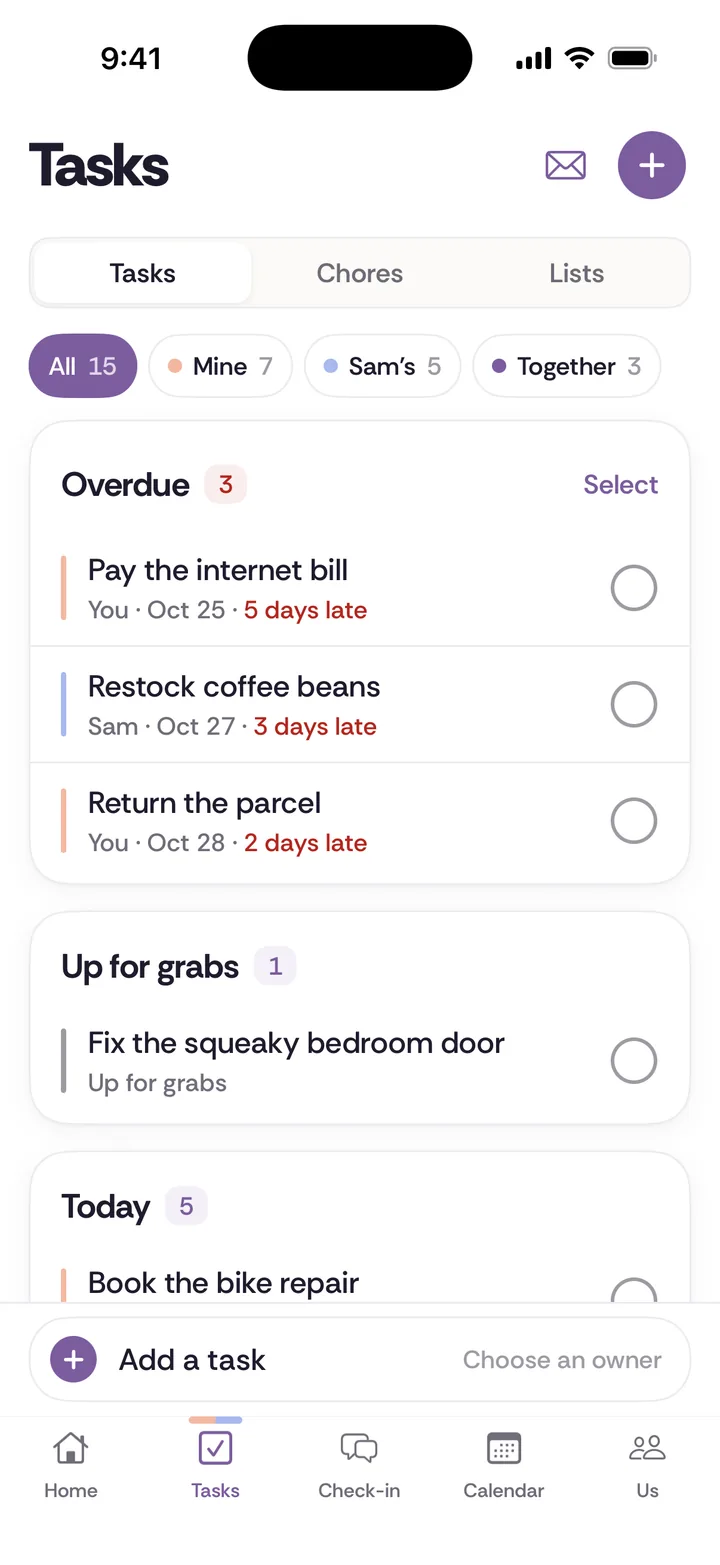
Choosing a digital version comes down to what your partner will actually look at. Tiptoe gives each chore one owner and a repeating schedule, on iPhone and on the web, and it lets you send a nudge about an overdue item and send thanks. It's free for both partners for your first 30 tasks and chores. It isn't an ADHD treatment or an ADHD-specific tool. It's one option among many, and the best system is the one the person with ADHD chooses and keeps using.