Keeping a running mental tally of chores tends to make the resentment worse, but noticing a real imbalance is not the same as keeping score, and you don't have to ignore it. The way out is to replace the tally with ownership: each job has one person's name on it, finishing it counts for that person, and you compare time off rather than points.
Advice on this topic mostly says "stop keeping score", which can sound a lot like "stop noticing that you do more." That is not what we're saying here. Whether you are the husband, wife, boyfriend or girlfriend doing the counting, or the one being counted, there is a better use for what you've noticed.
Is keeping score always bad?
No. The honest answer is more mixed than most relationship articles suggest.
A VICE piece makes the counterargument well. It argues that scorekeeping can reveal real imbalances, such as unequal household labor, and quotes psychologist Jennifer Vencill saying that some scorekeeping is normal. She describes "all-or-nothing" language as a warning sign. The same article quotes Jeremy Tyler of the University of Pennsylvania, who connects tally-keeping to feeling loved and supported.
So there's a useful distinction:
- Measuring is something you do once in a while, on purpose, together, in order to change a split. It has an end date and a decision at the end.
- Scorekeeping is something you do alone, all the time, and it's rarely shown to anyone until the moment it's used as evidence. It has no end and no decision.
Measuring tells you something. Scorekeeping tells you that you're angry, but you already knew that.
Why does a private tally make things worse?
It's inaccurate. You were there for all of your work, and only for some of your partner's. You will always remember more of what you did. Your tally isn't a lie, but it is incomplete by design.
It tends to fill with the negative. An article in Psychology Today discusses a daily diary study of 98 same-sex couples, which found that negative emotion after conflict was linked to lower ratings of what a partner was doing to maintain the relationship, and that constructive communication weakened that link. The study didn't measure scorekeeping directly, and the link to tallying is the author's own step. But it does fit what many people notice: once you're annoyed, your partner's good moves become harder to see. Vencill makes a similar point about confirmation bias in the VICE piece.
It can't be settled. There's no agreed exchange rate. How many school runs equal one tax return? Does a Saturday spent fixing the fence cancel the week you made every dinner? Without a shared unit, each person's math comes out in their own favor.
It removes the other person's chance to respond. If you've been counting for a year and haven't said anything, your partner is losing a game they don't know they're playing. Then the score comes out all at once, at the worst time, and they mostly hear an attack.
It turns thanks into a transaction. If you're counting, "thanks for doing the dishes" starts to sound like an entry. So does the favor you do hoping to be owed.
How do you know you're keeping score?
Honest signs:
- You know how many times you've done something this month.
- You do a chore and think, "That's one more."
- You hesitate to do a kind thing because it would let your partner off the hook.
- You mention what you did during a conversation about something else.
- You think "after everything I do" more than once a week.
- You use the words "always" and "never" and can back them up with examples.
How does credit by assignment replace a tally?
Instead of counting who did what, decide in advance who owns what. Once a job has an owner, nobody has to count, because the questions change.
The old question: "Who did more this week?" Nobody can answer this without a fight.
The new question: "Did the things you own get done?" That's mostly yes or no.
It works like this. The trash is yours. If it goes out on time, the job is done, and it counts for you. You don't get extra points for doing it without being asked, because it's yours. If I take it out once while you're away, I'm covering for you, and that's a small and visible favor, which you can thank me for. It doesn't quietly change whose job it is.
This also removes the "I did more this week" fight. Weeks vary. If the split of ownership is fair overall, then a bad week or a good week doesn't need settling up.
Three rules make this work:
- One owner per job. "We both do the dishes" is how scorekeeping starts, because nobody knows who's short.
- An owner holds all four jobs. Notice, plan, do and follow up. Otherwise you'll end up counting the invisible work you still hold.
- Handoffs are spoken. "Can you take Thursday?" is asked and answered. If you silently do a job that belongs to someone else, you've opened a new line in the ledger.
So how do you check whether the split is fair?
Do a one-week audit, together, and then close it.
Step 1. Agree on the week. Choose a normal one. Tell your partner you're doing this so that you can both stop keeping score, and mean it.
Step 2. Both write everything down. Include paid work, commuting, kids, planning, remembering, cooking, repairs, admin, and the emotional work of dealing with family. The chore split worksheet has categories, and the chore split calculator can help you put rough numbers on it.
Step 3. Compare time off, not task counts. For each of you, ask: in a normal week, how many hours do I have when nobody needs anything from me? This is what matters. A list of 40 small tasks and a list of 12 big ones can't be compared. Free hours can. If you want a broader view, ask who gets interrupted, who rearranges their day when something goes wrong, and who holds the mental list.
Step 4. Change something. If the gap is real, move a whole job. Our guide to splitting chores fairly can help you decide which.
Step 5. Put the list away. You can repeat this once or twice a year, or after a big change such as a new baby or a new job. Between audits, you only need to check whether owned jobs are getting done.
Why bother doing it together? It's the difference between evidence and information. A small study of 33 couples linked diverging views of the division of labor with more uncertainty about the relationship. Looking at one list together can at least put you both in the same conversation.
What to say
If you've been keeping score and want to stop:
I've noticed I've been keeping a running count in my head of what each of us does. It's making me feel bitter, and it's not fair to you, since I never showed you. I want to stop. Can we look at the actual split together and fix what's wrong with it?
If you're fed up with your partner's tally:
I hear that you feel you do more, and you may be right. I don't want to argue about who did the dishes last Tuesday. Can we spend one week writing down everything, then sort out what needs to change?
If you're tempted to say "I did it last time":
Can we decide who owns this one for good, so that we don't have to work out whose turn it is every time?
If your partner brings up old history in a current argument:
That matters, and I'd like to talk about it on Sunday. Right now, can we stay on what's happening tonight?
If your partner says "you're keeping score" when you raise an imbalance:
I'm not trying to keep score. I'm telling you that something feels off, and I'd like to look at it together. If I'm wrong about the numbers, I want to know that too.
That last one is important. "You're keeping score" can be used to shut down a fair complaint. The VICE article references an argument that telling women not to keep score can itself be sexist, since the imbalance is being asked to disappear without any change. Whoever it's aimed at, the answer is the same: being told to stop counting is fine, as long as someone is also willing to look at the work.
What about thanks and favors?
Once ownership is settled, thanks become lighter, because they no longer have to do any accounting. You can thank your partner for something they own, since finishing a boring job on a Tuesday is still worth noticing. It isn't a payment and it doesn't change anybody's share.
There's evidence it matters. In a 2022 study of 2,193 people living with a partner during the pandemic, doing more household labor and seeing the split as unfair went with lower relationship satisfaction, and those effects disappeared for people who felt appreciated by their partner. It also found that feeling appreciated buffered the costs of doing less, which is worth remembering if you feel guilty.
It also doesn't mean that gratitude cancels an unfair split. See resentment over chores if things have gone past thank-you territory.
Favors can stay real favors too. If you do your partner's job while they have the flu, that's care. You don't need to log it. If you find that you're covering the same job every week, it isn't a favor anymore, and it's time for a conversation about who owns it.
Situations where score gets kept most
Weekends and time off. "You went for a run, so I get an hour" is one of the most common tallies, especially with kids. Skip the barter and set standing time: Saturday morning is yours, Sunday morning is mine, and neither of you needs to ask.
Money versus housework. One person earns more, the other does more at home, and both of you feel your contribution is undervalued. Money and hours don't convert neatly. Compare free time instead. See splitting chores with a stay-at-home parent and our couples and money guide.
Different standards. You may be counting work that your partner doesn't think needs to be done. If they would be happy with a weekly vacuum and you vacuum daily, the extra six aren't credit you're owed unless you agreed. See different cleanliness standards.
Illness, disability, or a rough patch. An uneven share may be entirely fair for a while. Say so out loud. It's much easier to carry extra when you both know that you're doing it and how long it might last.
Your partner tracks you to control you. A record of what you've done wrong, used to punish you, or to decide what you get to do or spend, is not ordinary scorekeeping. If this sounds familiar, please see our safety page.
A simple way to stop counting
Write each recurring job on a sheet, put one name next to it, and post it where you'll both see it. Check it in a short weekly check-in, and only ask whether each job got done. That's free and enough for many homes.
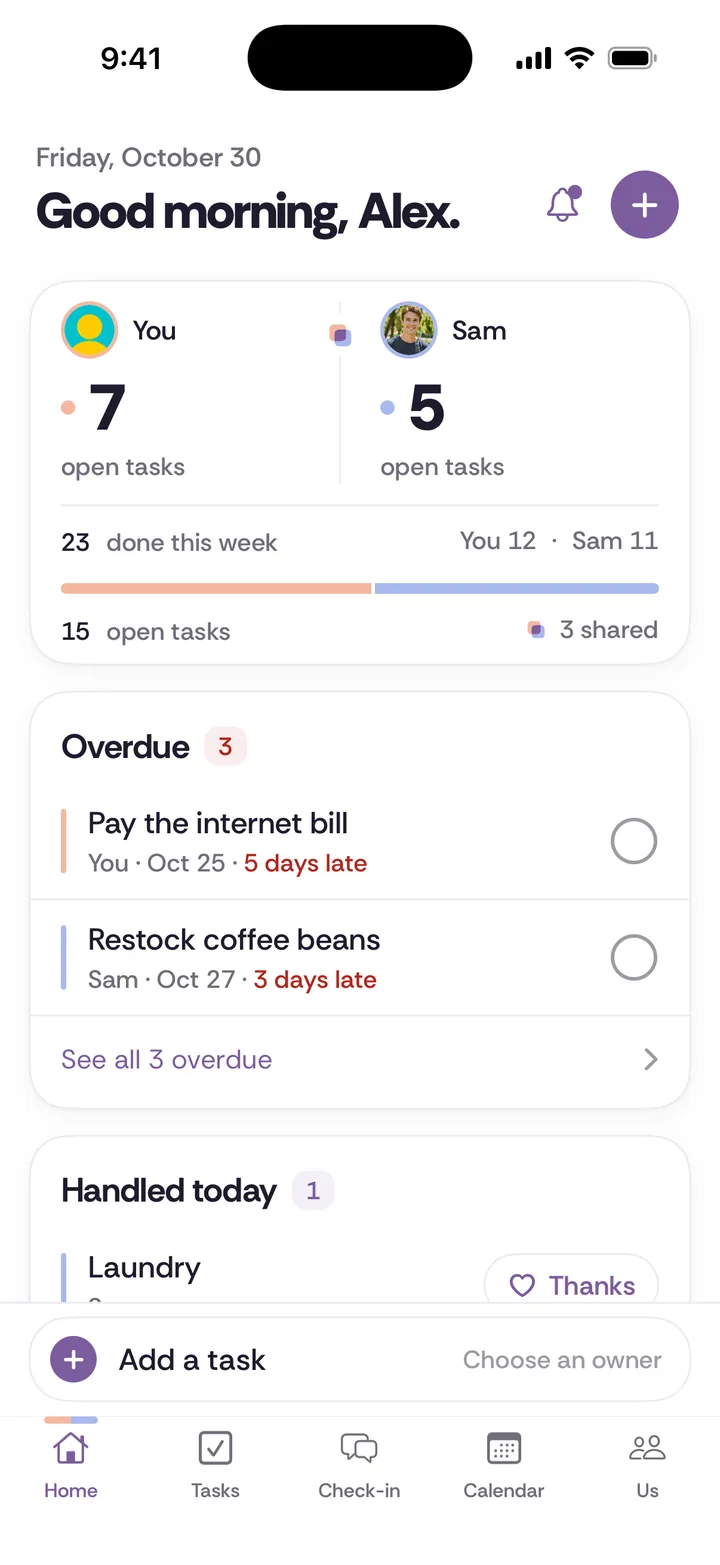
Tiptoe does the same thing on iPhone and on the web. A task or chore is assigned to You, your partner or Together, and a completed item counts for the person it was assigned to, so credit follows the agreement. It's free for both partners for your first 30 tasks and chores. If you start using any app's numbers as ammunition, you've rebuilt the scoreboard, so treat them as a memory aid.