Resentment over chores usually means the work has stopped feeling shared and you have stopped saying so. To get out of it, say the resentment out loud once, without a list of charges, then change one whole job and how you each find out about problems. Doing more chores on your own, or staying quiet to keep the peace, tends to feed it.
This applies whether it is you who feels resentful or your partner, and whether you would describe the person across from you as a husband, wife, boyfriend or girlfriend. Resentment about housework is rarely about one plate. It is a record of many small moments when you noticed, you did it, and nobody noticed that you noticed.
Why do chores create so much resentment?
Three things make chores unusually good at producing it.
The work repeats. A one-time unfairness can be argued about and forgiven. Dinner comes back tomorrow, so the same unfairness gets renewed every night.
Much of it is invisible. Your partner can see the clean kitchen, but not that you noticed the dish soap running low, or remembered the school form, or rearranged your afternoon around a delivery. These invisible jobs are also the ones hardest to mention without sounding petty.
Asking is itself a job. Having to ask keeps the person asking in charge of managing the work. The person being asked can end up feeling that they are guessing what is wanted and getting blamed for jobs they did not know they owned. Both are real, and one conversation can contain both.
Fairness as you see it matters too. In research on 389 dual-earner couples in Austria, Germany and Switzerland, wives' sense of justice in the split was linked directly to their own relationship satisfaction, and also to their husbands' satisfaction, through the conflict the husbands experienced. In that sample, one partner's sense of unfairness reached the other through conflict, even though husbands' own sense of justice was not linked to their satisfaction in the same way.
How do you know it has become resentment?
A disagreement about chores is ordinary. These signs suggest it has become something heavier:
- You keep a mental record of what your partner hasn't done, and you can recite it.
- You do a chore loudly, hoping to be seen.
- You feel a small flash of satisfaction when your partner forgets something, because it proves your point.
- You turn down help, then feel angry that no help came.
- A kind act from your partner makes you think, "So you can do it when you want to."
- You've stopped raising it, because you already know how it goes.
- You have started to think about your partner's character rather than the task.
The last one is the one to take most seriously. The Gottman Institute lists contempt among its four communication patterns to watch, with building a culture of appreciation and respect as its antidote. Eye-rolling at the dishwasher loading can be an early version of this.
The conversation: what to say and how
Step 1. Decide what you actually want before you speak. "I want you to feel bad" is an honest reaction, but it isn't a goal. Try writing down one sentence: "I want to stop being the person who remembers X." Or, "I want one evening a week when nobody needs me."
Step 2. Ask for the conversation.
I've been carrying something about how we split the house, and I'd like to talk about it without it turning into a fight. Can we take half an hour on Sunday morning?
Pick a time when neither of you is doing a chore, hungry, or about to leave. Booking it gives your partner time to prepare, and it stops the topic from arriving as an ambush.
Step 3. Open with the feeling and the stakes, not the evidence.
I've started feeling resentful about the house. I don't like how that's making me act toward you. I'd rather tell you than keep being short with you. I'm not trying to win anything. I want this to stop being a thing between us.
This follows the Gottman Institute's gentle start-up formula: how you feel, about what, and what you need.
Step 4. Give two concrete examples, then stop. Not twelve. For instance: "When the kids were sick last week, I was the one who called the school, the doctor and my boss. And on Saturday I cleaned while you watched the game. Neither of those is a crime, but that's what it looks like from here."
Step 5. Ask what it looks like from their side, and listen.
What do you see that I might be missing? Are you feeling anything like this too?
Your partner may have their own resentment: being told how to load the dishwasher, feeling that nothing is ever good enough, doing paid work nobody thanks them for. Hear it through before responding. Their resentment does not cancel yours, and yours doesn't cancel theirs.
Step 6. End with one change. A big conversation with no decision makes the next round more bitter. Choose one whole job that moves, and say so. Our guide to what to do when one partner does more can help here.
So you own dinner on Mondays and Wednesdays, including planning. I'll stop asking or checking. We'll look at it again in two weeks.
What if you are the one being resented?
Take it seriously, even if you think it's exaggerated. Being told you are resented hurts, and defending yourself is the natural response. Try this instead.
Listen before you explain. You'll have your chance to mention what you do, but the first reply decides how the rest of the conversation goes.
I didn't realize it had got this heavy. Tell me more about what the last few months have felt like.
Ask about the invisible part. Ask "What are you tracking that I don't know about?" and write the answers down. You may really have no idea, and that list is useful information.
Take a whole job without waiting to be asked. Pick one thing your partner carries, and say "This one's mine from now on." Then own it, including the noticing. Doing a one-time big clean feels good but doesn't solve anything, because next week the job goes back to your partner. Ownership rather than helping is what changes the feeling.
Don't ask for instant credit. Your partner may stay cool for a while, because the record took a long time to build up. Consistency over several weeks will do more than any apology.
Say what's true on your side, later. If you've been criticized for how you do things, or you feel unappreciated, raise it, but not as a counterattack in this conversation. Ask for your own time: "There's something on my side too. Can we talk about it on Wednesday?"
Why doesn't thank you fix it, and why does it still matter?
Thanks can't replace a fair split, and it is rarely welcome as a substitute. Still, appreciation does appear to matter a great deal. In a 2022 study in Psychological Science, researchers looked at three samples totaling 2,193 people living with a partner during the pandemic. People who did more of the household labor and saw the split as unfair were less satisfied with their relationship, and those negative effects disappeared when they felt appreciated. Feeling appreciated also buffered the costs of doing less.
So the practical reading is this: change the split, and also say what you see. Be specific. "Thanks for dealing with the furnace repair, I know that took your whole morning" lands. "Thanks for everything you do" doesn't, because it doesn't show that you know what the work was.
Thanks should go both ways, and it isn't payment. Don't use it to close a complaint.
Three common traps
Doing it yourself and saying nothing. It feels like the mature choice, and it's how resentment grows. Every silent task adds to a debt your partner doesn't know about. If you are going to do something that isn't yours, either do it freely and let it go, or say out loud that you are covering this time.
Keeping a written record to win with. A list of what the house needs is useful. A list of what your partner has failed at will end the conversation. We go further into this in keeping score in a relationship.
Raising it only when you have reached your limit. If you only speak up at the moment you are most angry, your partner learns that the topic always comes with anger, and they may start to avoid it. Raise it at a four out of ten, not a nine out of ten. A short weekly check-in makes that easier, because there is already a slot for small things. There is also advice on how to bring up something small.
Some specific situations
The resentment is years old. Don't try to settle the whole history. Say that it's been a long time, acknowledge it once, then ask to focus on what happens from this week forward. An old account can't be paid off with chores. If the history is what keeps coming up, that is a good reason to see a couples counselor.
You earn less, or don't earn. You may feel you've lost the right to complain. You haven't. Money earned and work done at home are both contributions, and time off is the fair thing to compare. See splitting chores with a stay-at-home parent.
Your partner has ADHD or depression. You can feel understanding and resentful at the same time. Both can be true. See ADHD and household chores, and remember that your limits still count.
You suspect it's bigger than chores. Sometimes the kitchen is where you argue about being alone, or about the feeling that you don't matter. Ask yourself: if the chores were split perfectly tomorrow, would I feel fine? If the answer is no, the housework is not the only thing to discuss.
When is it time to get outside help?
Get help if you've had the same talk several times with no change, if the two of you can't discuss the house without a fight, or if you've started thinking about leaving. A couples counselor can give you a structure that's hard to create alone.
If what you are facing goes beyond resentment, such as fear of your partner's reaction, threats, or control over money or where you go, please read our safety page. Relationship advice about chores is not the right tool for that.
Making it hold
Resentment fades slowly, and it fades faster when you can both see the change. Three habits help:
- One owner per job. Write it down so that no one has to keep it in their head. A list on the fridge or the free chore split worksheet is enough.
- A set time to talk. Ten minutes a week, with no more than two topics.
- Say the small thing when it's small. "I noticed I'm getting annoyed about the laundry again. Can we look at it on Sunday?"
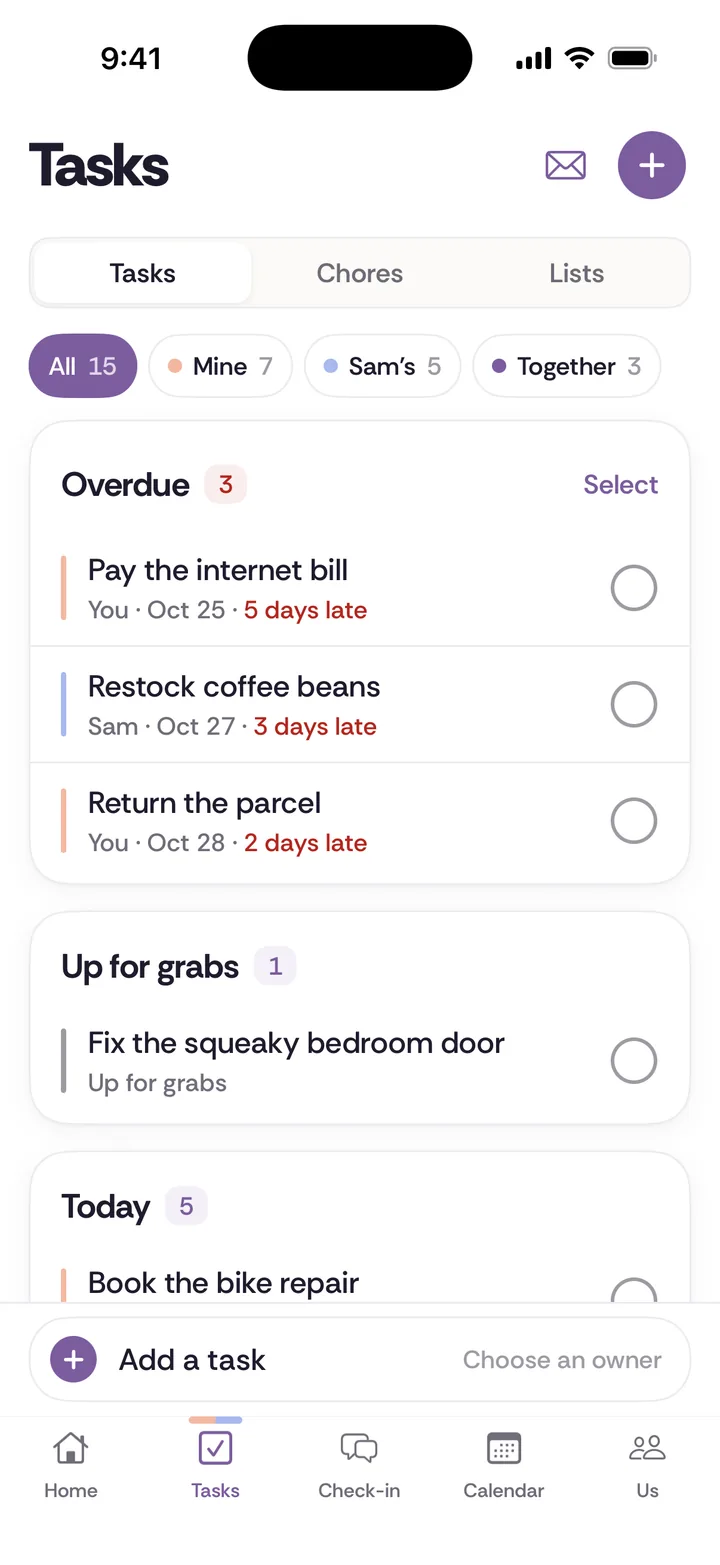
If you'd like that in one place, Tiptoe keeps chores with an owner and a schedule, lets you send thanks, and sets a weekly check-in, on iPhone or on the web. It's free for both partners for your first 30 tasks and chores. A shared list won't repair a relationship, but it can take the job of remembering off one person.