To split chores with a stay-at-home parent, treat the hours the at-home parent is caring for kids as their job and the earner's paid hours as theirs, then share what remains so that both of you get about the same real time off. During working hours, the at-home parent also handles whatever house jobs truly fit around the kids. Evenings, nights and weekends are shared, because neither of you is at work.
This is the same whether the at-home parent is a husband or a wife, a boyfriend or a girlfriend. Pew Research Center found that 18% of US parents were not working for pay in 2021, and that fathers made up 18% of stay-at-home parents. The answer also changes with the age of your children, so this page goes through each stage.
Why does this go wrong so often?
Because two fair-sounding ideas collide.
One idea: "I work all day to pay for everything. You're home, so the house is your job." There's something to this. If a home has one earner and one person at home, the at-home parent can reasonably take on more of the house.
The other idea: "Taking care of kids is a full-time job, and it doesn't stop at 5pm, so I'm working twice as long as you." There's something to this too. Caring for a toddler isn't time you can spend cleaning.
A widely shared Reddit argument reported by Newsweek shows how this plays out. A husband expected his stay-at-home wife, with a 10-year-old in school, to handle most of the housework. She expected a 50/50 split. He pointed out that he also handled money, repairs and yard work, and both said they carried the heavier mental load. Many commenters said a parent at home with a child in school should take on most of the house. A very different answer applies if there are three kids under five. The right answer depends on the actual hours. It doesn't depend on who has the better argument about the value of work.
What does the data say about how couples divide this?
Pew's 2023 analysis of marriages gives one baseline. In marriages where the husband was the sole earner, wives spent 14.1 hours a week on caregiving and 10.5 on housework, while husbands spent 4.5 and 1.4. In marriages where the wife was the sole earner, husbands spent 6.1 hours on caregiving and wives 4.1, and the difference in housework wasn't significant. These are averages, not targets, and they include couples in many situations, but they do show that the home-based share often isn't the same when the roles are reversed. You don't have to copy anyone. Use your own week.
The rule of thumb: on the clock and off the clock
Writer Zawn Villines argues for two fairness rules that match how many couples end up thinking about this: both partners get real downtime, and childcare and grocery shopping don't count as breaks. When the working partner is home, she suggests, household labor gets split evenly. We'd add a test and a caveat: the test is how many hours each of you has in a week when nobody needs you, and the caveat is that some households, especially with school-age kids, can fairly move more to the parent at home.
Here's how it works in practice:
- On the clock, earner: paid work and commute.
- On the clock, at-home parent: childcare, plus the house jobs that really fit around it.
- Off the clock, both: kids, dinner, bedtime, night wakings, weekends and whatever's left get shared.
How to split by age of kids
Newborn and baby. Keeping a tiny person alive is the whole job. Expect little else to happen during the day besides feeding, sleep and laundry for the baby. The earner should own most of the rest of the house for now: dinners, groceries, trash, cleaning. Decide on nights separately. One useful version is that the at-home parent covers weeknights, unless they're feeding at night anyway, in which case the earner takes the early morning shift. On weekends you swap or share. Sleep isn't a contest, but the person who's up at 3am needs that to be counted.
Toddlers and preschoolers. They're mobile, loud, and they undo whatever you just did. The at-home parent can handle meals for kids, kids' laundry, and a basic daily tidy. A clean kitchen at 6pm is a hopeful standard rather than a promise. The earner takes over at the door: this is often the hardest transition of the day. Say "I've got them" within ten minutes of arriving, or agree on when it happens. Split cooking dinner and bedtime.
School-age kids. Once children are in school for most of the day, the job changes. There are hours when the at-home parent isn't doing childcare. It's fair for most weekday house jobs to shift to that parent, including meals, groceries, laundry, cleaning, school admin and appointments. Time before and after school is still childcare. Evenings and weekends should still be shared, including the fun parts and the boring parts.
All kids in school, and the at-home parent stays home by choice. It's reasonable to ask what the job is now. It may be running the home and being available to the family, and this could be a good deal for both of you. Or perhaps part-time work, study or something else might happen. Agree on what you are both choosing, and revisit it each year.
A child with extra needs. Care needs, therapies, school meetings and paperwork can fill the whole week. List them. The hours are often much greater than anyone outside can see, and the split should reflect that.
Six steps to set it up
Step 1. Write down both weeks. Include paid work, commute, childcare hours, night wakings, every recurring job and the thinking jobs. The worksheet has a format. Have the earner read the at-home parent's list carefully. A working partner often can't see what's in it, and vice versa.
Step 2. Sort jobs by whether they fit around kids. Fits: laundry, kids' meals, online orders, a call at nap time. Doesn't fit: cleaning a bathroom with a toddler in it, long phone calls, big errands. Be realistic about what's possible at this particular age.
Step 3. Assign whole jobs. Every job needs one owner who holds all four parts: notice, plan, do, follow up. The earner should own some whole jobs, too. Otherwise, they're just helping with the at-home parent's list. Good ones: car, bills, weekend breakfasts, dinners on two named nights, kids' bath and bedtime, one area of the house.
Step 4. Name the mental load. This is often the hidden imbalance in a one-earner home. School forms, doctors, birthdays, clothes, what everyone's eating. The at-home parent may reasonably carry much of it, but it should be counted as work and not treated as a natural trait. See the mental load guide.
Step 5. Give each of you time off, in writing. Saturday morning is one person's, and Sunday morning is the other's. Nobody needs to ask permission, and it isn't a favor. An at-home parent can go days without being alone. The break doesn't count if you're running errands with kids in the car.
Step 6. Review every few months. Kids change quickly. Starting preschool, starting school, a new baby or a new job should all prompt a new conversation. Use a weekly check-in for small adjustments, and the chore split calculator if you want a rough check on hours.
What to say
If you're at home and you're drowning:
I know you work hard, and I'm not saying you don't. I'm with the kids from seven until you walk in, and then there's still dinner, bedtime and the kitchen. I need the evening split once you're home. Can we go through the whole week together?
If you're the earner and feel like you get no credit:
I feel like what I do at work doesn't count at home. I'm also not sure what your day looks like. Can we both write down a normal week and talk about it? I want this to be fair, and I also want to be able to rest sometimes.
If your partner says "you're home all day":
I am at home, and I'm working. Come home and watch them for a Saturday by yourself, then let's talk about what fits. I'm not trying to win. I just want you to see what the day is.
If your partner says "I'm paying for everything":
You're earning the money for our family, and I'm doing the work that lets you do that. Neither of us could do this alone. I'd like us to both feel we're on the same side.
If the kids are in school now and you've been asked to do more:
You're right that things are different now the kids are at school. Let me take on the weekday house stuff. I'd still like the evenings and weekends to be shared, and I'd like us to talk about what I do next.
If you're the earner, and you've been checked out in the evenings:
I've been treating the end of my workday as the end of everything. Starting Monday, I'll do bath and bedtime on weeknights, and I'll own dinner on Tuesdays and Thursdays.
Our guide on what to say instead of nagging has more scripts for everyday requests.
Money is part of this split
A one-earner home can quietly turn the paycheck into a position of power. It's worth discussing openly. Who can spend what without asking? Does the at-home parent have access to the accounts? Do they have their own money for personal things? What about retirement, and their ability to go back to paid work? Our couples and money guide has more on starting that conversation.
Pew also found that the reasons people stay at home differ: in 2021, 79% of stay-at-home mothers cited caring for home or family, compared with 23% of stay-at-home fathers, and 34% of stay-at-home fathers cited illness or disability. Not every at-home parent chose it in the same way, and a partner with an illness can't take on an unlimited share of the house.
If you have to ask permission to spend money, if your access to money is used to control you, or if you've been told you have no say because you don't earn, then this isn't about chores. Please see our safety page.
Common traps
The "day off" that isn't. An earner's weekend at the gym, on the golf course and on the couch means the at-home parent has been working seven days. Check the weekends first.
The handover that never happens. The earner comes home and heads to the shower, then to emails, and it's 7:30 before they've seen the kids. Agree what the first thirty minutes look like. Earners do need some time to transition, and a set time avoids a fight about it.
Treating the at-home parent as staff. Lists of errands sent during the day, comments about the state of the house. If you wouldn't say it to a colleague, don't say it to them.
Gatekeeping the kids. At-home parents become the experts, so they may correct everything: the wrong snack, the wrong pajamas, the wrong way to do bedtime. If you want your partner to take over bedtime, let them do it their way. See different cleanliness standards for how to separate real issues from preferences.
Measuring by the state of the house. Children make messes all day long. A messy house isn't evidence nothing happened. A clean house also doesn't tell you how much work it took.
Keeping it fair over time
The split that works this year probably won't work in eighteen months. Set a reminder to look at it again when something changes. If you're stuck, read what to do when one partner does more and resentment over chores.
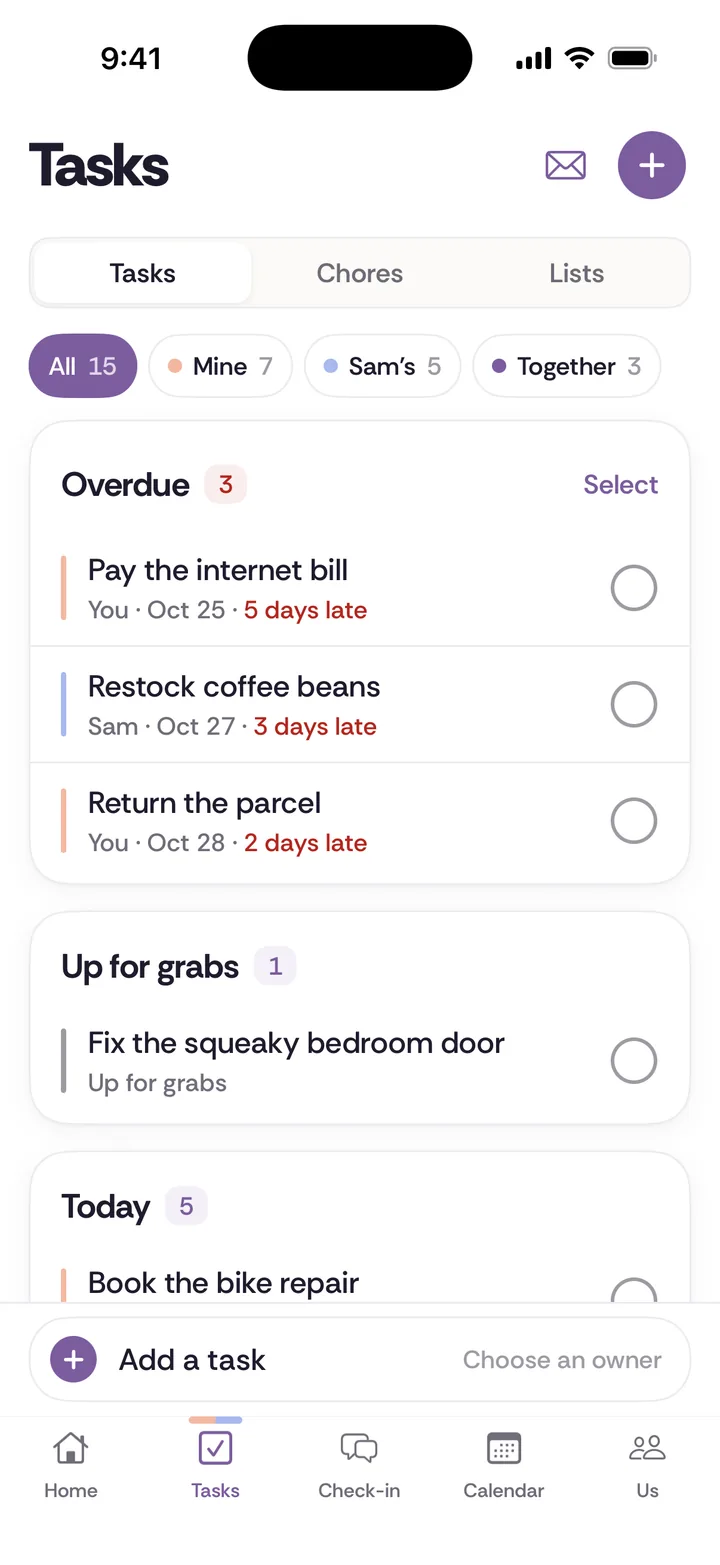
For the day-to-day, a shared note listing each job and its owner is enough, and it's free. Tiptoe does the same on iPhone and on the web: chores repeat on a schedule and have one owner, a completed item counts for the person it was assigned to, and a weekly check-in has shared topics. It's free for both partners for your first 30 tasks and chores. It can show you who owns what. Whether the split feels fair is something you'll need to talk through.