If your partner doesn't help around the house, tiptoeing around it will not change anything, and neither will another careful hint. Say the real thing once, plainly, then move a whole job to your partner rather than asking for more help. If that doesn't work after a fair attempt, you'll have learned something important, and you can make decisions based on it.
What should you do when your partner doesn't help around the house?
Stop asking for help, because help leaves the job with you. Tell your partner plainly that the split isn't working, choose one recurring job, and agree that they own all of it: noticing, planning, doing and following up. Write down what done means, stop reminding, and look at it again in two weeks. If nothing changes after a few clear attempts, ask directly whether your partner is willing, and decide what you will do based on the answer. If you feel afraid or controlled, skip the chore advice and go to the safety page.
What does stop tiptoeing actually mean here?
Tiptoeing is every small thing you do to avoid saying it. You sigh at the sink. You load the dishwasher a little louder than necessary. You say "no, it's fine" and then bring up the laundry eleven days later, in the middle of an argument about something else. You drop hints, and you hope your partner will work it out. Or you just do the job yourself because that feels easier than another conversation, and you add one more item to a list your partner has never seen.
Saying the real thing sounds like this: "I do most of the work in this house, I'm tired, and it's starting to change how I feel about you. I want to fix that." It isn't cruel, and it doesn't blame anyone's character. It's just true, and it's the sentence you have been walking around for months. Your partner cannot respond to something they've never heard, and you can't know what they would do until you've said it clearly.
The other half of not tiptoeing is listening to the real thing back. Your partner may say they feel corrected in everything they do, or that they've stopped trying because nothing is ever right, or that their paid work counts for nothing at home. They may also say they simply don't want to. All of those are more useful than another month of silence. If you need a way into a hard talk, start with how to bring up something small, and if you have already reached the bitter stage, read resentment over chores.
Why doesn't asking for help work?
Help means the job is still yours. Every chore has four jobs inside it: notice that it needs doing, plan how it will happen, do it, and follow up when something goes wrong. A partner who does anything you ask, but only when you ask, is doing one of those four. The other three remain with you, and they're the ones nobody thanks you for. That's why someone can say "I always help when you ask" and be telling the truth, while you still feel you're running the house alone. Our guide to the four jobs and the mental load explain this in more depth.
The fix is to move whole jobs. Our main guide on what to do when your partner doesn't help around the house lays out seven steps, including how to choose the first job and how to handle "just tell me what to do." While you're getting there, you'll still need to ask for things, so we wrote 40 exact scripts for what to say instead of nagging, grouped by situation. If you want the whole reminder loop gone, read how to stop nagging.
Credit works the same way. When each job has one owner, you don't need to count who did more this week. You only need to ask whether the jobs each of you owns got done. If you've been running a tally in your head, keeping score in a relationship explains how to turn it into something useful: one honest audit of the week, comparing time off rather than points, and then the list gets put away.
What is really going on: willingness, ability, standards or setup?
Most couples are fighting about the wrong thing, because the same dirty kitchen can have four different causes. If it's never been agreed, the split simply formed by default, and the fix is to have the conversation for the first time. If you disagree about what done means, your partner may honestly think the job is finished. That is a difference in cleanliness standards, and it needs a written minimum that neither of you can opt out of, plus an honest answer about who pays for anything above it.
If your partner agrees and then doesn't follow through, find out why before you repeat yourself. Some people truly lose track, which is what when your partner forgets everything you ask deals with. If ADHD is part of your home, read ADHD and household chores, which treats both partners as adults and keeps your limits in the picture. That page is practical information, and it isn't medical advice.
And sometimes a job keeps coming back because it was done badly, and doing it badly made the problem go away. People call this weaponized incompetence. It's an everyday phrase and not a clinical term, it can run in any direction, and you usually can't prove the motive. So don't try. Look at where the job ends up, and talk about that. Before you use the phrase, check your own side too. If you redo everything your partner does, you may have taught them to stop trying.
The last possibility is the plainest one: your partner may not be willing. It's better to find that out than to keep rewording the request. "I've stopped thinking this is about knowing how. Are you willing to do this or not? I can deal with a no. I can't keep working around a yes that doesn't happen."
What about when your weeks are not the same?
Fair doesn't have to mean equal lists. It means that you both get real time off, and both of you can look at the arrangement and say that it's fair. A person with a 90-minute commute, a person on night shifts and a parent with a newborn all have very different weeks. So start from the hours when nobody needs anything from you, not from a count of tasks. The chore split calculator and the chore split worksheet can give you a place to start, and how to split chores fairly goes through how to weigh the pieces.
If one of you works from home, being home isn't the same as being available. Splitting chores when one partner works from home sorts jobs by whether they truly depend on someone being there, and it counts what's done during the day. If one of you stays home with kids, childcare and paid work are both jobs, and evenings and weekends are something else again. How to split chores with a stay-at-home parent goes through the split by the age of your children.
The arrangement may also need to be uneven for a while. Illness, a depressive episode, a parent's decline or a brutal month at work can all shift what's fair. Say that out loud, and name when you'll look at it again. A temporary arrangement that both of you have named feels very different from a permanent one that nobody ever decided on.
What if you've tried everything and nothing changes?
Say it once more, without a threat you don't mean: "I've raised this a few ways and nothing has changed. I'm not going to keep raising it the same way. I need to know whether you're willing to change this, because I need to decide what I do about it." Then you have real options. You can stop doing work that belongs to your partner, with notice, and never at a child's expense. You can pay for some of it if the money is there. You can lower a standard on purpose, knowing that's what you're doing. You can see a couples counselor. And you can ask yourself what you are prepared to live with, because you're allowed to ask that.
We can't tell you what to decide, and an app can't fix a relationship. What you can do is stop spending your energy on the wording. If the request has been clear and the answer has been no for a long time, the answer is the information.
Some of what looks like a chore problem isn't one. If you're afraid of your partner's reaction, if you're punished for asking, if you have to account for money or time, or if you're threatened, none of the advice in this cluster is the right tool. Go to our safety page, which lists places to get help.
How do you keep the new split from sliding back?
Splits drift. Someone gets busy, someone gets sick, and two months later you're back where you started without anyone having decided it. Keep each job and its owner somewhere you both can see, and hand things off out loud, because "Can you take Thursday?" is a request that gets an answer, while quietly doing it yourself just moves it back. Put ten minutes on the calendar each week for a weekly check-in, so that small things have a place to go before they turn into big ones.
Thank each other for what you actually see. Be specific. Thanks don't make up for an unfair split, but they do matter. In a 2022 study of 2,193 people living with a partner, doing more of the household labor and seeing the split as unfair went with lower relationship satisfaction, and those negative effects disappeared when people felt appreciated by their partner.
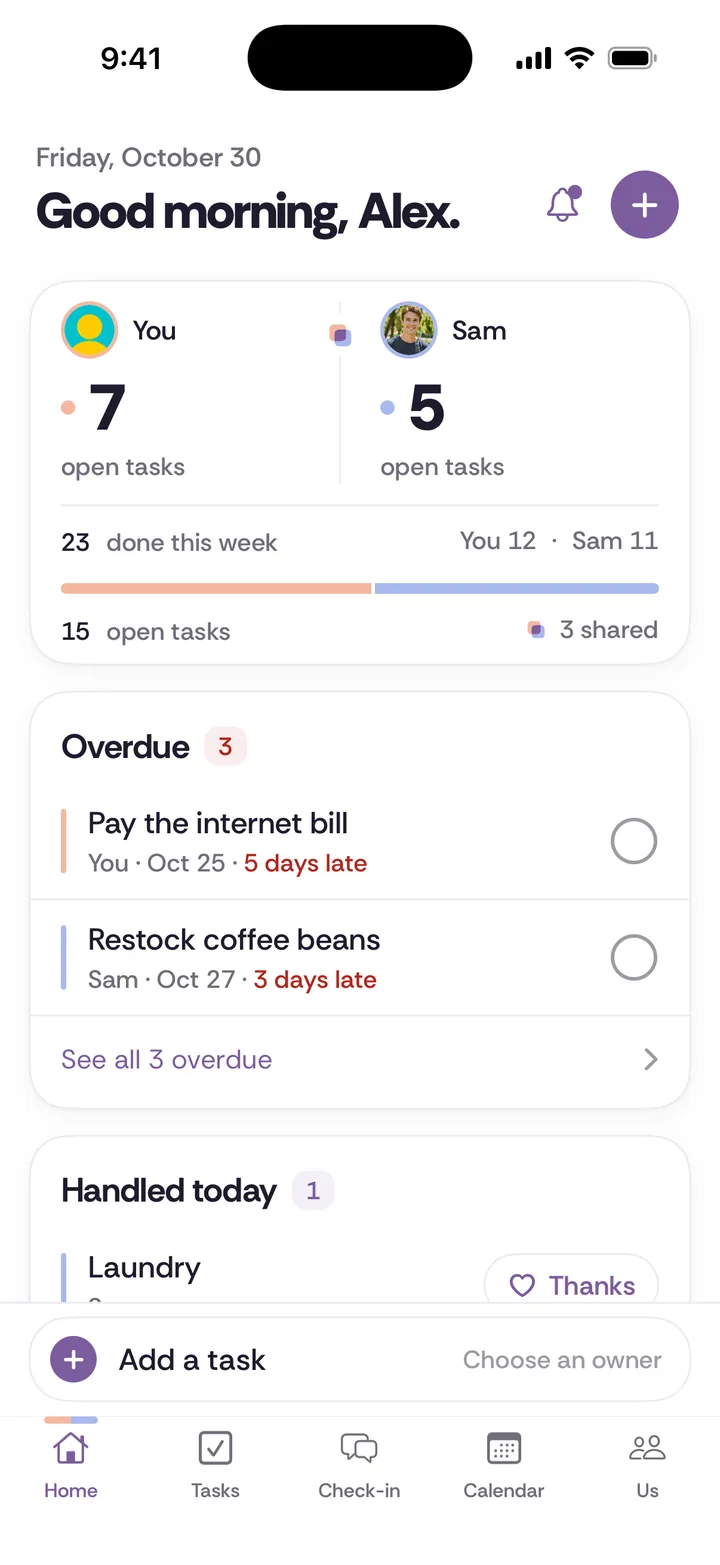
A sheet of paper on the fridge is free and can hold all of this. If you'd rather keep it on your phones, Tiptoe is a shared tasks and chores app for iPhone and the web. Chores repeat on a schedule and have one owner, a completed item counts for the person it was assigned to, and there's a weekly check-in. It's free for both partners for your first 30 tasks and chores. It keeps the agreement visible. Keeping the agreement is still up to the two of you.
Do this in the next seven days
- Write down one normal week: everything you do, including planning and remembering. Ask your partner to do the same, so you are starting from one shared picture.
- Book twenty minutes at a calm time and say the plain version: "I'm carrying more than I can keep doing, and I'm starting to resent it. I don't want more help. I want you to own one whole thing."
- Pick one recurring job together, and write down its finish line and its one owner. Agree on a backup for anything that affects safety, health or a child's day.
- Leave it alone for two weeks. No reminders, no redoing and no quiet rescues. Then ask one question: did this happen without me thinking about it? Move the next job or change the plan.
One useful rule
Make the next step clear enough that either person can explain it.
Keep the system kind and current
A planning tool can hold an agreement, but it cannot make the first agreement fair or permanent. Both partners need a real say, a way to raise a problem, and permission to change the plan when work, health, or capacity changes.
Questions couples ask
- Why doesn't my husband help unless I ask?
- Usually because you hold the noticing and planning, so nothing other than your request tells him it needs doing. The same goes for a wife, boyfriend or girlfriend. Move one whole job to them, including deciding when it happens, and stop reminding.
- Is it normal to be this angry about chores?
- Yes. Chores repeat every day, a lot of the work is invisible, and asking for help is another job on top. The anger is usually about feeling alone with the work. It's worth raising while it's still small enough to discuss calmly.
- What if my wife says I don't help but I do a lot?
- You may both be right. Write down a full week together, including planning and remembering. If your work is real but mostly done on request, offer to own one job completely. That will do more than listing what you've already done.
- Should I stop doing my boyfriend's share to make a point?
- A surprise strike usually turns into a contest. It's reasonable to tell him in advance that you'll stop doing a specific thing that belongs to him, such as his laundry, then actually stop. Never use a child's needs for this.
- Does my girlfriend have to do half if she earns less?
- Income doesn't settle it either way. Compare your whole weeks, including paid work, commuting, kids and home, and aim for similar real time off. Someone can earn less and work just as many hours.
- When should we see a couples counselor about chores?
- When you've had the same conversation several times without change, when you can't discuss the house without a fight, or when you've started thinking about leaving. If you feel afraid or controlled, use the safety page instead of couples work.