Weaponized incompetence is when someone does a job badly, or claims they can't do it, in a way that hands the job back to someone else. Common examples at home are a partner who shrinks the laundry once and is never asked again, or who says "you're just better at this" about a job they could learn.
It is an everyday phrase and not a clinical term or a diagnosis. Nobody can be tested for it, and a therapist can't assign it. It also says nothing about what is going on inside someone's head, which is why this page focuses on what you can see: a job that keeps coming back to the same person. It can show up with a husband, wife, boyfriend, girlfriend, roommate or coworker, and it runs in every direction.
Where does the term come from?
The phrase spread through social media in recent years. BetterUp's article on the topic traces it to the term "skilled incompetence", which it says first appeared in Harvard Business Review in 1986, and it describes the behavior as intentional. Thriveworks takes a softer view, saying people do it "sometimes knowingly and sometimes without realizing it." Both treat it as a pattern of behavior. Neither presents it as a disorder.
We use it the way our glossary entry does: as an informal label you can apply without claiming to know why it is happening.
Examples in everyday home life
Each example here could be innocent the first time. The pattern is what matters.
Food and groceries
- Comes home with the wrong items, says "you should do the shopping, I always get it wrong", and is not asked again.
- Cooks once, burns it, and announces "I'm no good in the kitchen" despite following complex instructions at work.
- Stands at the open fridge and asks where the butter is, in a kitchen they have used for six years.
Laundry and cleaning
- Puts a wool sweater in the dryer, the job goes back to the other person, and nobody learns how the dryer settings work.
- Cleans the bathroom so loosely that it needs doing again, then says "well, you have higher standards, so you do it."
- Asks a question about every step until it becomes faster for the other person to take over.
Kids
- Hands back a crying baby with "she wants you", without trying for more than a minute.
- Dresses the kids for school in the wrong clothes, then asks whether it would be better if their partner just did it.
- Has never made a pediatrician appointment, and asks each time which office it is and what the kids' dates of birth are.
Money and admin
- Says "I don't understand taxes" for ten years, leaving the paperwork with one person, while handling complex spreadsheets at work.
- Says "you know I'm hopeless with passwords and forms" whenever the insurance renewal arrives.
- Hires the first contractor they find, it goes badly, and all future contractors become the other person's job.
Cars, tools and outside jobs
- Says "I don't do car stuff" about a tire pressure light, a routine service or a registration renewal.
- Says "you're the handy one" about changing a filter or a smoke alarm battery, while happily following video tutorials for a hobby.
- Mows the lawn so badly once that the other person takes it over, then says "I told you I was bad at it."
- Says "I can't lift that" or "I don't know how to use the drill", when the actual answer is that they don't want to.
Examples in both directions
Most articles picture one kind of couple, usually a husband doing it to his wife. It happens that way, and research on household work gives some context for why, since one study of 32 heterosexual couples found women did more of the thinking work in 26 of them. But the behavior isn't tied to a gender or to a role. A few pairs, both sides of the same move:
- Mechanical versus domestic. "I don't do the dishwasher, you're better at it" and "I don't do the car, you're better at it" are the same sentence.
- Kids and money. "She only settles for you" and "You know I can't read a bank statement" both move a whole area onto one person for good.
- The admin of a family and the upkeep of a house. "You remember all the birthdays" and "You know how the furnace works" do the same thing.
- Same-sex couples. The same pattern can follow whoever did the job first, and it can be just as sticky.
- Work. "You're so good at the spreadsheets" and "You're so good with clients" can move tasks to a colleague in the same way.
A useful habit is to check your own list before making any accusation. Is there something you have been happily incompetent at for years, because your partner took care of it? Most people have one.
How do you tell it apart from a real skill gap?
A skill gap goes away when someone shows up to learn. Weaponized incompetence stays the same, however many times it is explained. Run these five checks, ideally over several weeks.
Does it improve with practice? Someone with a skill gap is clumsy on attempt one and better by attempt four. If attempt ten looks like attempt one, that's worth looking at.
Do they seek out the answer? A person learning something looks it up, writes it down or asks a specific question. Someone avoiding it asks you the same thing each time.
Can they learn hard things elsewhere? Picking up a complex hobby or work system doesn't prove anything, because attention and interest vary, but it does rule out "I'm not capable of learning things like this."
Where does the job end up? This is the check that matters most. After the failure, is it still theirs, with a second try, or is it yours again? Thriveworks describes the same warning sign in a different way: if someone keeps the behavior after it is pointed out, it can no longer be unintentional.
What happens if you don't step in? If you leave it alone and they sort it out, it wasn't incompetence. If nothing happens and it causes real trouble, ask the next question.
What else could it be?
Before you use the phrase, consider these, because many look identical from the outside.
- They've never been taught. Many adults did not learn to cook, clean or run a household. That is a real gap, though a fixable one.
- ADHD or another executive function difficulty. Repeated misses can have nothing to do with avoidance. See ADHD and household chores. The Tiptoe glossary also warns against assuming motive from disability or a need for support.
- Depression, illness or exhaustion. These can reduce what somebody can do, and it can happen suddenly.
- Your correction. This is the uncomfortable one. If every attempt gets redone or commented on, your partner may have stopped trying because they think they cannot win. It's sometimes called gatekeeping, and it can look exactly like incompetence from the other side. Look at different cleanliness standards.
- A different standard. They may think it went fine. Agree on what done means before deciding that anything failed.
What to say: exact words
Name the job, the pattern and the change you want. Leave out the motive, because you can't prove motive and your partner will spend the conversation denying it. Avoid using the term as an accusation, too. "That's weaponized incompetence" tends to start a debate about the phrase.
When your partner says "you're just better at it":
Maybe I am, because I've done it for years. I'd still like you to take it on. I'm fine with it taking a few tries.
When a job comes back after a bad attempt:
The sweater shrank, so here's the one thing to know: wool doesn't go in the dryer. Laundry is still yours.
When you keep getting asked the same question:
I've answered that one a few times. Can you put it somewhere you can find it? I'm going to stop being the place it's stored.
When a pattern has built up:
I've noticed that when something goes wrong with this job, it comes back to me, and it's happened with the groceries, the school forms and the dentist. I'm not saying you're doing it on purpose. I just need it to stop coming back. What would make it possible for you to hold on to it?
When your partner says "if you don't like how I do it, do it yourself":
I don't want to do it myself. That's what we are talking about. Let's agree what done means, and then how you do it is up to you.
When you are the one being accused:
Tell me which jobs you mean. I'm not sure that's what's happening, but I can see it's coming back to you, and that's the part I can change. Which one should I take fully, starting now?
For more wording, see what to say instead of nagging.
Steps that change the pattern
Step 1. Choose one job. Not "the kitchen" or "all of it", but something like "the kids' dentist appointments for the year."
Step 2. Show it once. Do one walk-through, or give one written note or a link to a video. After that, the learning is theirs.
Step 3. Write down what done means. The bathroom is done when the sink, toilet, floor and mirror are clean. That removes the option of a failure that is really a disagreement. You can also use the chore split worksheet.
Step 4. Allow the first failure. The new owner is going to get it wrong. The job remains with them. This is the moment where most handovers break down, and it's usually your hand reaching for the sponge that breaks it. Our guide to one partner doing more covers how to hold that line.
Step 5. Agree the exceptions. Medication, a child's safety, a bill with a penalty. These may need a backup, and that's reasonable. Set that up ahead of time, so that it's a plan and not a rescue.
Step 6. Review after two weeks. Did it stay with them? Did it get better? Then pick the next job, or come back to the conversation.
What if nothing changes?
If a job comes back again and again after clear agreement, ask directly:
I've stopped thinking this is about knowing how. Are you willing to do this, or do you not want to? I can deal with a no. I can't keep working around a yes that doesn't happen.
An honest no gives you something to work with. You could trade the job, outsource it or drop it. It's the fake yes that does the damage. If that conversation is impossible, you may want a counselor in the room.
Thriveworks says the behavior can become a form of emotional manipulation when it is deliberate and ongoing. If this is part of a broader pattern, if you feel afraid, or if your partner controls money or access to things you need, please go to our safety page. Chore scripts are the wrong tool for that.
Keeping the job where it belongs
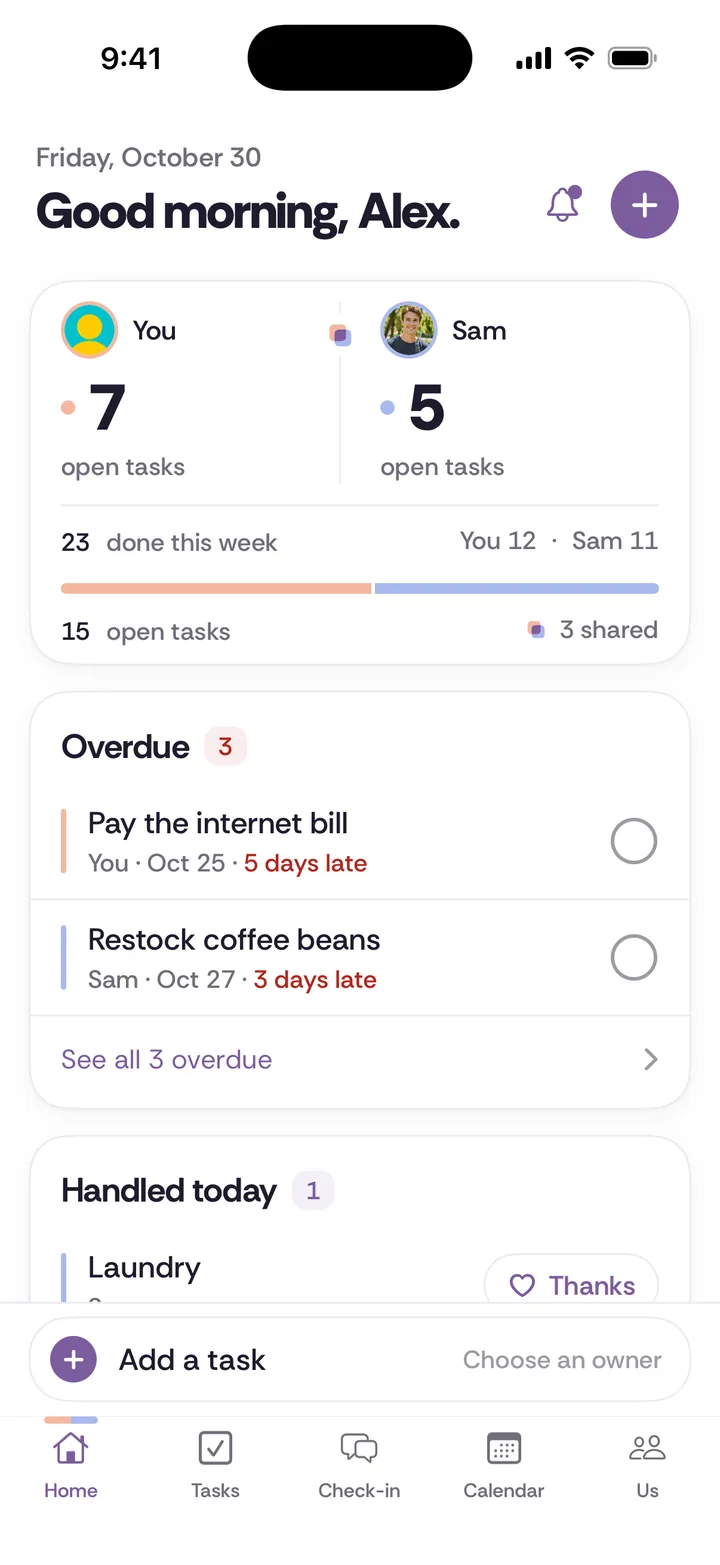
Whatever you use, one thing has to be true: everyone can see whose job it is, so it can't drift back without someone noticing. A list on the fridge with a single name beside each job does that for free. Tiptoe does it on iPhone and on the web, with one owner per chore and a repeating schedule, and if a chore's owner needs to hand it off, that's a visible step rather than a quiet return. It is free for both partners for your first 30 tasks and chores. It can't tell you why a job keeps slipping, and it won't make anyone do it.