When a couple has different cleanliness standards, neither of you has to adopt the other's. Agree on a shared minimum for shared rooms, write down what done means for each one, and decide who pays, in time or money, for anything above that line. Most fights stop being about who is right once you have a written floor, and each of you can see what happens above it.
This applies whether your husband, wife, boyfriend or girlfriend is the tidier one. There is no correct level of clean, but there are three questions you can settle: what you both need, what one of you wants, and who does the extra.
Why do couples see the same room differently?
You may each be reacting to something different. One sees crumbs. The other sees a home that's lived in. It helps to separate what's really going on.
People notice different things. One of you may be bothered by visual clutter, another by smells, sticky floors, or a full sink. "Clean" and "tidy" are separate standards. Your partner may be fine with piles of paper but particular about bathrooms, which means neither of you is "the clean one."
People learned different rules. A home where guests could drop in without warning teaches something different from a home where nobody came over. Neither is the right way to live.
Social judgment doesn't land evenly. An experiment called "Good Housekeeping, Great Expectations", as summarized here, showed people identical rooms. Men and women rated cleanliness similarly, which argues against the claim that men can't see mess. But when told that the room belonged to "Jennifer" rather than "John", people held it to a higher standard and thought visitors would be more critical. So part of what one partner feels when the house is messy may be a very real worry about being judged. It's worth asking who you think would be judged if your in-laws walked in today.
Stress changes tolerance. A sink that's fine in a calm week can be unbearable during a hard one. That's useful to know, and it is worth saying: "This week, I can't handle mess, and that's about my week."
Is one standard better than the other?
Sort what bothers you into three groups, and most of the argument goes away.
Health and safety: not negotiable. Spoiled food, mold, pests, a toddler near small objects, a blocked exit, pet waste. If this is the disagreement, one person isn't being picky. Say so plainly.
Function: worth agreeing on. You can't cook because the counters are full. You can't find your keys. You're late because there are no clean towels. These cost you real time, so they belong in the agreement.
Preference: yours to carry. Towels folded in thirds. Pillows on the bed. The dishwasher loaded in a particular way. No clutter on the table. These are legitimate wishes, but they're also yours. You can ask for them, and you can do them, but you can't require them.
Most couples find that fights about function are easy to solve, and that fights about preference are where the bitterness lives.
How to set a shared minimum
Step 1. Walk through the home together. Take twenty minutes and go room by room. In each room, each of you says the one thing that bothers you most, and the one thing you truly don't care about. You may be surprised. Your partner's top issue may be easy, and the thing you've been working hard on may not matter to anybody else.
Step 2. Write three levels. Most online advice stops at "compromise". It's more useful to define levels:
- Daily floor: what must be true each night. For example: dishes in the dishwasher or sink, food put away, nothing on the floor that someone could trip over, trash not overflowing.
- Weekly reset: floors vacuumed, bathroom cleaned, sheets changed every other week, surfaces wiped.
- Guests level: what happens before people come over, with an agreed lead time. Not every visit needs it, and you can decide which ones do.
Step 3. Define done for each room in words. This takes the guessing out.
- Kitchen, done: counters clear and wiped, stovetop wiped, dishes washed or loaded, sink empty.
- Bathroom, done: toilet, sink and mirror clean, floor swept, towels hung up.
- Living room, done: no dishes, blankets folded or in a basket, toys in the bin.
Step 4. Assign owners. A standard without an owner turns into another reason for the person who cares most to do it. The complete chore split and our free worksheet can help. Make sure you assign the whole job, including noticing when it needs doing, because that's the part that wears people out.
Step 5. Agree on what happens above the floor. This is the part most couples skip, and it matters most. Choose among these:
- The person who wants more does more, freely, and doesn't keep track of it.
- You pay for it. A cleaner every two weeks can end a whole argument, if the budget allows. See our couples and money guide for that conversation.
- You make it your own space. One of you has a room, desk or closet at your own standard, and the other doesn't touch or comment.
- You drop it on purpose, and agree you aren't going to mention it again.
Step 6. Review after a month. Standards that sound fine in a meeting may not work on a Wednesday. Change the wording rather than arguing again.
What if the person with the higher standard ends up doing everything?
That's the usual result, and it is unfair if it is left alone. The person who is bothered first ends up doing the work, again and again. The other person never needs to notice anything, because the bar never gets low enough for them to see it.
This is why the floor matters. If the floor says dishes are done each night, and Thursday is yours, the Thursday dishes are yours, whether or not they bother you. You can't opt out of the floor by not caring.
Above the floor, the higher-standard partner does own the extra. That can be hard to accept. Try this version:
I'm happy to keep the counters nicer than you need, because I care about that. But the agreed stuff isn't extra, and I'm not doing your share because I noticed it first.
What if you are the more relaxed partner?
Being comfortable with more mess doesn't mean you're doing something wrong, and it doesn't mean you can ignore the question. A few things to try:
- Ask what it does for them. "What does the messy counter do to your day?" gets better answers than "Why do you care so much?" You might hear that clutter makes it hard to relax or to focus.
- Learn their top three. If there are three things that matter most to your partner, do these first. You don't have to agree with them. You're just choosing where your effort makes the biggest difference.
- Ask for a finish line. It's fair to want the job to end. "Tell me what done looks like, and when it's done I'd like to be left alone" is a reasonable request.
- Speak up if it's about capacity. If mess is piling up because you are exhausted, depressed or struggling to get started, say so. That's a different conversation. If attention is a factor, see ADHD and household chores.
What if you are the tidier partner?
- Stop redoing the work. Redoing a job says it doesn't count, and over time it teaches your partner not to try. This pattern is called gatekeeping, and it's a common way to end up carrying everything.
- Comment only against the written standard. "The stovetop is part of the kitchen on our list" is fine. "That's not how I do it" is not.
- Name your top three, not your top thirty. If everything matters, your partner can't tell what does.
- Check whether this is really about the mess. If you're angry about the towels, ask yourself if you're also angry about being alone with the work. If so, say that instead. Our page on resentment over chores can help.
What to say: exact words
To open the topic:
I don't think either of us is wrong about how clean the house should be. But it's causing friction, and I'd like us to agree on a minimum so that we don't keep having this argument. Can we walk through the house this weekend?
When your partner says "it's fine":
It's fine for you, and I believe you. It isn't for me. I'm not trying to change your mind, I'm trying to find a level we can both live with.
When your partner says "you're obsessed":
I might care more than most people. Let's sort it out: which of these is about health, which ones get in our way, and which ones are just me? I'll own the ones that are just me.
When your partner says "if it bothers you, clean it":
I'll do what's extra for me. But the things we both agreed on belong to whoever owns them. Thursday's kitchen isn't mine just because I noticed it.
When the mess is really getting to you this week:
It's a stressful week, and I'm finding the mess harder than usual. That's not on you. Could we do a fifteen-minute reset tonight, together?
When you have to raise a health issue:
This isn't about standards. The food in the fridge has gone off, and I'm worried about the kids getting sick. Can we deal with it tonight?
Situations people actually have
You're moving in together. Do the walk-through before you move or in the first week. Ask how often each of you changes sheets, and how you handle shoes at the door. Autostraddle's advice column on different cleaning standards before marriage argues for sorting this out early, and that's good advice even if you've been together for years.
You work from home. The person who sits in the mess all day will be more affected by it. That's a reason to talk about it, not a reason for that person to clean it. See splitting chores when one of you works from home.
You have small kids. You can't expect a toy-free floor by 3pm. Set the floor for after bedtime and name one room that's kept clear for adults. Lower everything else for now, and write down that it's temporary.
You have guests coming. Put the guest level on a calendar with an owner for each room. Agree on which visits count. If your mother-in-law is one of them, the person whose mother it is can reasonably own more of the preparation.
One of you is sensitive to clutter and the other is a collector. Clear surfaces are often where this breaks down. Agree on shared surfaces and give collections a home with a limit: this shelf, this closet, this bin.
Is this a dealbreaker?
Sometimes, although usually not because of the mess itself. Differences in standards are normal. What turns them into a dealbreaker is more often one of these: one partner refuses to discuss it, one partner is carrying the household, one partner uses it to belittle the other, or the disagreement is about health and it isn't being taken seriously.
If you feel watched, criticized or punished in your own home, if you're afraid when something is out of place, or if cleaning is being used to control you, it's not about standards. Please read our safety page.
Keeping the agreement visible
Put the room definitions on paper, stick them inside a cupboard door, and name an owner for each day. That's free, and it's enough for many couples. Bring it up at a short weekly check-in only when something isn't working.
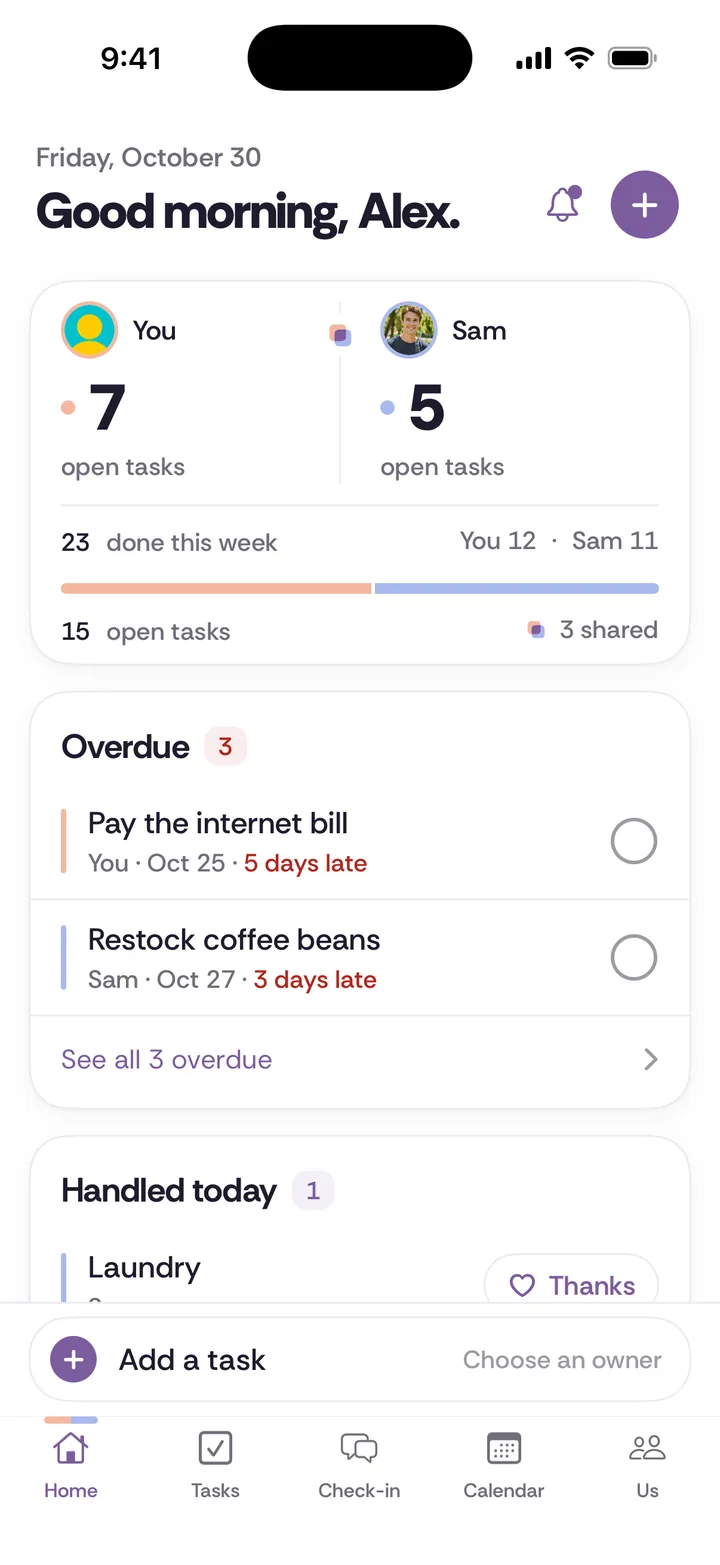
If you want this on your phones, Tiptoe lets you set repeating chores with one owner, on iPhone or on the web. It's free for both partners for your first 30 tasks and chores. It can't tell you how clean your home ought to be. That's for the two of you to decide.