When one partner works from home, split chores across the whole week as if you both had a job, because you do. Working hours are off limits by default, and any daytime jobs the home-based partner takes on are agreed in advance and count toward their share. Being home isn't the same as being available.
That applies whether it's your husband, wife, boyfriend or girlfriend at the home desk. The usual fight has two sides: the partner at home feels they've turned into the default house manager, and the partner in the office feels they come back to a home where somebody was there all day and nothing got done. Both complaints have something in them. The fix is to separate what the location makes easy from what it doesn't.
What actually changes when one of you works from home?
Three things change, and most couples only discuss the first.
Some jobs get easier for the person at home. Moving wet clothes to the dryer takes two minutes between calls. Letting in a repair person is possible if the appointment doesn't clash. Starting the slow cooker is simple. These are real advantages and it's fair to use them.
A commute may disappear. If one of you doesn't commute, that person has those hours back, and that's the most honest argument for an unequal split. An hour a day saved is five hours a week, and it can reasonably go toward the household.
The other partner stops seeing the work. The person at home gets interrupted by the doorbell, the dog and the plumber. The partner at the office sees only the state of the kitchen at 6pm. Neither can see the other's day.
There isn't a lot of solid research on this exact setup. One analysis of UK household panel data from 1991 to 2012, circulated as a preprint, found that men and women who teleworked spent more time on domestic tasks, and that chores such as cooking and cleaning were more likely to be shared with a partner. Women reported being happier when they or their spouse teleworked, and both men and women reported being happier when specific chores were shared. That work predates the pandemic-era increase in remote work, and it doesn't settle how much a home-based partner should do. It does suggest that remote work can open the door to more sharing, depending on what you do with it.
Sort your jobs into three groups
Here's a practical way to split them. Write down all your household jobs (the worksheet helps) and label each one.
Location jobs: these have to happen during the day, in the home. Deliveries, repair visits, a sick kid who has to be picked up at noon, meter readers, the dog's lunchtime walk. Location makes the home-based partner the obvious candidate, but not automatically the right one.
Break jobs: small tasks that can happen between work blocks and benefit from someone being around. Switching a load of laundry, emptying the dishwasher, putting a chicken in to thaw, signing for a package. They usually take under ten minutes.
Anytime jobs: these don't care where you are. Meal planning, booking appointments, paying bills, grocery orders, tidying up, cleaning a bathroom, school forms. There's no good reason for these to go to the person at home by default. This is the group where drift happens, because they tend to slide to whoever is nearest.
Six steps to a fair split
Step 1. Write both work weeks down. Include hours, meetings, how interruptible each of you actually is and how long the commute takes. A nurse with a 45-minute commute and a home-based accountant in tax season both have real constraints, and these can vary a lot from month to month.
Step 2. Define working hours and treat them as real. During work time, the home-based partner has the same right to focus as somebody in an office. A daily list that arrives by text at 10am is a sign that's slipping.
Step 3. Assign location and break jobs by agreement, with a limit. For example: "I'll handle deliveries and two laundry switches a day, and I'll let in repair people if they don't clash with calls. Everything else gets booked when we can both manage it, or you take the morning off once in a while." A limit protects the job and the partnership. If a repair window of 8am to noon is a real problem for the person at home, it's a real problem, so the other partner might have to take that one.
Step 4. Split anytime jobs by the rest of the week. Once break and location jobs are assigned, split what's left so that you both get similar time off. If the commuting partner is out of the house 11 hours a day and the home-based partner 8, an uneven split might be fair. The chore split calculator can help you work it out. So can our guide to splitting chores fairly.
Step 5. Count the daytime work. Those two laundry switches are part of someone's share. If they aren't written down, the office partner won't know, and the home partner gets no credit for it.
Step 6. Review in a month, and whenever work changes. A new project, a hybrid schedule, a new commute. Add a line to your weekly check-in: is the daytime stuff still fine for you?
A worked example
Here's how this could look for a couple without kids, where one person is home five days and the other commutes 45 minutes each way.
Home-based partner owns:
- Deliveries and repair visits, up to one morning a month.
- Dishwasher, unloaded and reloaded by end of day.
- Laundry, all of it, since it fits between calls.
- Dinner on Monday, Tuesday and Wednesday, including planning.
Commuting partner owns:
- Grocery order, including planning and putting it away.
- Dinner on Thursday, Friday and one weekend night.
- Bathrooms and floors, on Saturday morning.
- Bills, car and renewals, which can be done on a train or at lunch.
Both: one weekend reset of up to an hour, and an agreement that neither of you sends household tasks during work time except for real emergencies.
That split isn't right for everyone. It just shows that the home-based partner may do somewhat more, for a stated reason, and that the commuting partner still owns whole jobs from start to finish. For more on what ownership should include, see the four jobs guide.
What about kids?
Working from home doesn't mean you're providing childcare. A person on a video call with a three-year-old in the room is doing two jobs badly. The two of you need to decide who is responsible for kids during working hours, and if the answer is "the person at home", that's a much bigger job and needs to be reflected in everything else.
Specifically, agree on:
- Pickups and after-school hours. If the home-based partner handles them, then 3pm to 6pm isn't work time, and the work has to go somewhere else, or those hours count heavily toward their share of the home.
- Sick days. Don't automatically send the sick kid to the person who's home. Take turns, or decide by whose day has fewer immovable items, checked that morning. Our couples calendar guide can help with seeing that in one place.
- School calls. Put both numbers on the list and take turns as the first contact.
- Summers and school closings. Plan these ahead of time. They hit the home-based partner first by default.
If one of you is at home without paid work, the arrangement is different. See how to split chores with a stay-at-home parent.
What to say
If you work from home and it's sliding onto you:
Since I've been at home, I've picked up a lot of the small daily stuff, and I think we've both started treating me as the person who runs the house. I'm happy to do more of what really fits around my job. I'd like us to agree what that is, because I'm also working all day.
If you commute and you want to raise it without blaming:
I come home and I can't tell what your day was like. I don't assume you were free. Could we write down what makes sense for you to do while you're home, and what I should own, so that neither of us is guessing?
When a text arrives during your working day:
I'm in meetings until four. I'll see to it then, or if it can't wait, can you call them?
When your partner says "but you're home all day":
I'm home, and I'm at work. Let's think of what you'd expect if I were in an office, and then let's add what really fits around my day.
When you know you've been doing less than you could:
I do have more time than I've been using. I no longer commute. I'll take on dinners three nights a week, including planning them.
Common traps
Treating "I was here" as being on duty. The contractor needed letting in, so the person at home lost a morning's focus. Count that as a real cost.
Using the home office as an excuse. It cuts both ways. If you take back your commute time and use none of it for the home, your partner has a fair point. Say what you're doing with those hours.
The state of the house at 6pm. The person at home lives in the mess and eats lunch there. They may want it cleaner than their partner does, or they may be more used to it. If there's a difference in standards, see different cleanliness standards. But keep in mind that the kitchen at 6pm reflects both breakfasts and everyone's lunch.
The home-based partner doing it all, then resenting it. It can feel easier to just do it. A month later, it's your job, and nobody decided that. Our page on what to do when one partner does more covers what to do next, and if resentment has already built, read resentment over chores.
Being the one who's always asked. "Can you just" at 11am is a work interruption. Use one list and one time for requests. Our scripts for asking without nagging apply in both directions.
What if you both work from home?
The same logic applies, but you can see each other's days, which is useful and also risky. Decide who gets the quiet room, who deals with the door on which day, and when lunch is shared or not. Two people in one kitchen at noon can create a surprising amount of friction and dishes. Assign the midday reset to one person, or alternate by day. Remember that whoever's day has more calls may need to be off-duty that day.
If you're hybrid, make your split fit the schedule. For example, whoever is at home on a given day owns that day's break jobs, while anytime jobs stay with one owner regardless. If your schedule changes, change the list. Don't let it drift.
How to keep it visible
The biggest problem in this arrangement is that neither of you can see the other's work. So put all of it in one place: a note in a shared app, a sheet on the fridge, or a weekly five minutes when each of you says what you handled during the day.
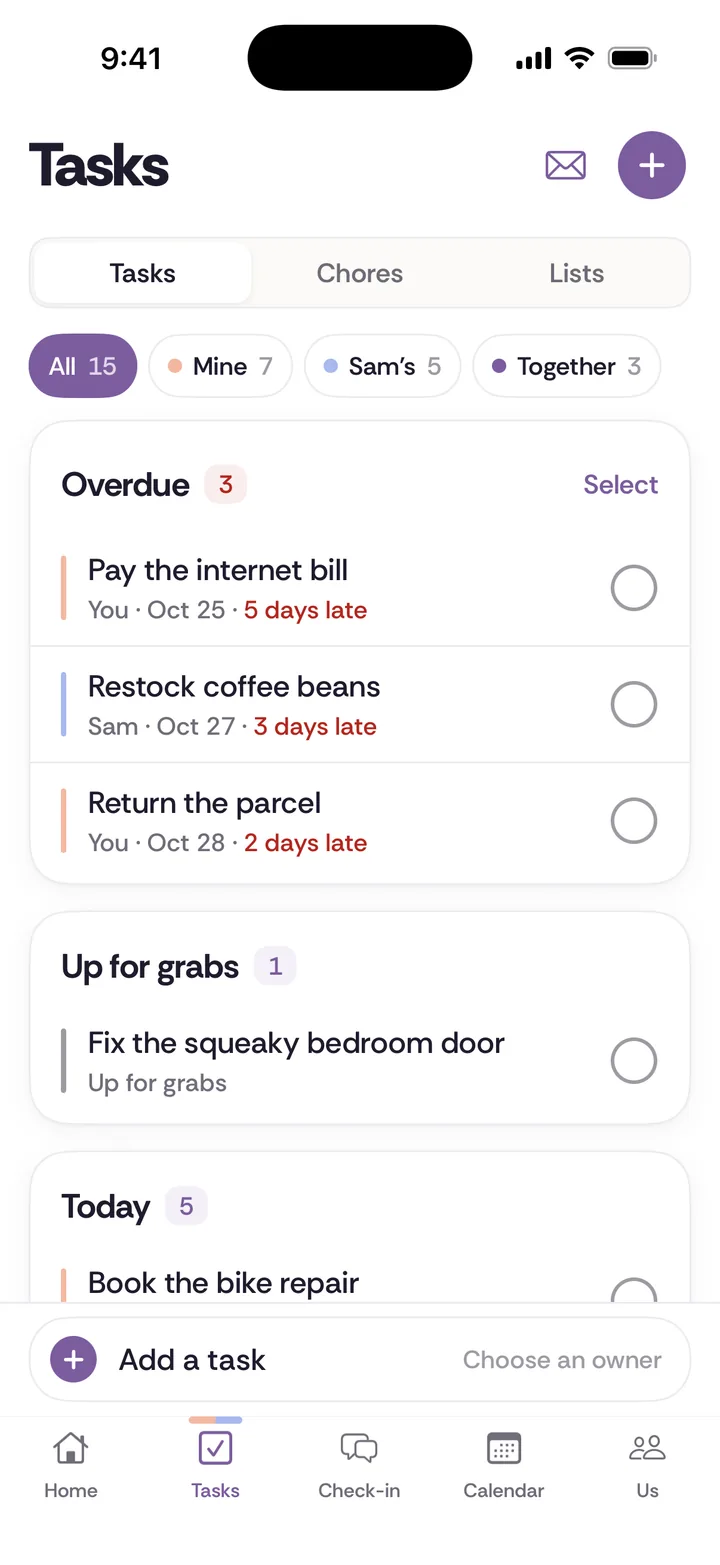
Tiptoe can hold it too, on iPhone or on the web, with each chore on a repeating schedule and one owner, so daytime jobs are on the list with the name of the person who owns them. It's free for both partners for your first 30 tasks and chores. It won't stop an interruption at 11am. That's a conversation you'll still need to have, but having everything in one list makes it a shorter one.