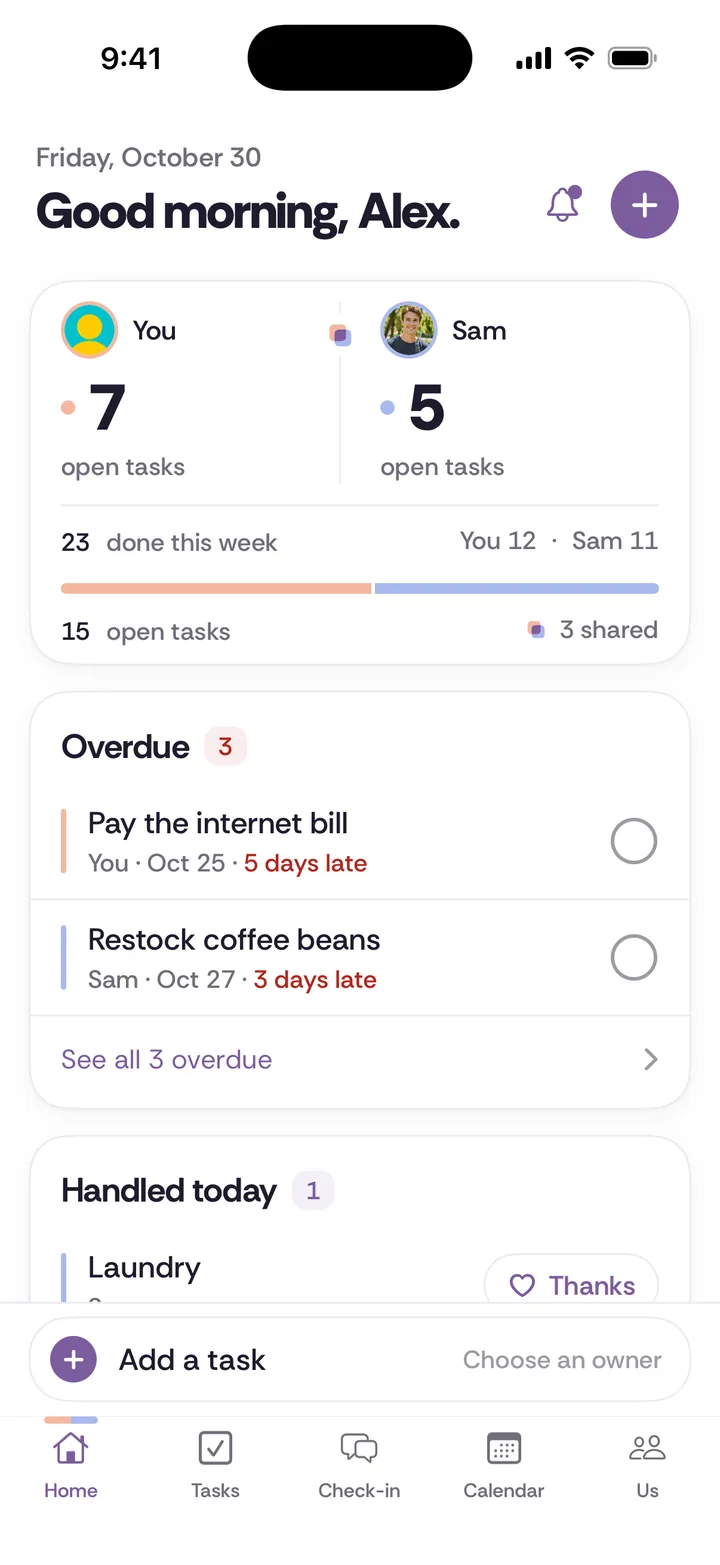
Stop asking your partner for help and move one whole job to them instead. Pick the chore that costs you the most, agree that your partner owns all of it (noticing, planning, doing and following up), write down what finished looks like, and stop covering for it.
That works for the most common version of this problem, where the split was never really agreed. Whether you are searching "my husband doesn't help around the house", "my wife doesn't help", "my boyfriend doesn't help with chores" or "my girlfriend doesn't help", the steps are the same, because the pattern is about how the work is organized. If your partner still refuses after a plain conversation, you have a different problem from a chore problem, and this page covers that too.
Why does asking for help keep failing?
Because "help" means the job still belongs to you. Your partner can say yes every time and you still have to spot the need, decide what should happen, ask, and check that it happened.
Every chore has four jobs inside it:
- Notice: we are nearly out of dishwasher tablets.
- Plan: add them to the order that goes in on Thursday, and check nothing else is missing.
- Do: put the order in, carry the bags in, load the machine.
- Follow up: the delivery came without the tablets, so get them another way before Friday.
Most help covers only the third job. That is why you can have a partner who takes out the trash whenever asked and still feel like you run the house alone. You do run it. Our guide to the four jobs inside the mental load goes deeper on this.
There is research behind the distinction. Sociologist Allison Daminger interviewed 70 people in 35 couples about the thinking side of household work, and JSTOR Daily's summary of her study reports that anticipating needs and monitoring results were the parts most unevenly shared in the heterosexual couples she studied, while decisions were more even. The sample was middle and upper-middle class, so it does not describe every home, but it matches what many people mean when they say "I have to think of everything."
Which situation are you actually in?
The advice online treats this as one problem. It is at least five, and each needs a different move.
You never agreed on anything. The split formed by default. One of you moved in first, or was home more during a baby's first months, and it stuck. The sign: neither of you can remember a conversation where this was decided. The move: have that conversation for the first time, using the steps below.
Your partner does the doing and nothing else. They will do anything on a list, but only if there is a list, and you wrote it. The sign: they say "just tell me what to do" and mean it kindly. The move: hand over whole jobs, starting with one.
You disagree about what done means. They think the kitchen is clean. You think it is not. The sign: they did the job, and you are still upset. The move: agree on a finish line before anything else. Different cleanliness standards has the wording.
Your partner agrees, then it doesn't happen. The sign: you have had the same conversation five times with friendly results and no change. The move: find out why before you repeat it. See when your partner forgets everything you ask, and if ADHD is part of your household, ADHD and household chores.
Your partner says no. Not "later", but some version of "that is your job" or "I don't care if it is done." The sign: there is no plan your partner will accept. The move: chore tactics will not settle this, so skip to the section on what to do when they won't change.
What to do this week: seven steps
Step 1. Write down one ordinary week. Keep a note on your phone for seven days, and include the invisible parts: booked the dentist, noticed the kid's shoes are too small, took out the trash, replied to the school. You are building an accurate picture of the week. You are not building a case.
Step 2. Ask your partner to do the same. You will both find things the other missed. Your partner may be handling the car, the taxes or the 6am school run in a way that does not register with you. A small study of 33 couples found that partners whose views of the split diverged more also reported more uncertainty about the relationship, which is one more reason to start from one shared list rather than two private ones. The chore split worksheet gives you a format.
Step 3. Choose one job with a real cost. Choose something that recurs and something you currently carry in your head. Good first jobs: school lunches, the grocery order, kids' laundry, dinner on three named nights, pet care, trash and recycling. Bad first jobs: "the kitchen" or "more around the house."
Step 4. Raise it at a neutral time. Not while you are scrubbing the pan they left. Pick a calm moment, ideally one you both agreed to, and say something like the script below.
I'm carrying more of the house than I can keep doing, and I'm starting to feel resentful, which I don't want. I don't want more help. I want you to own one whole thing, so I don't have to think about it at all. Can we look at the list together and pick one?
Step 5. Define the whole job out loud. For the grocery order, that might be: "Every week, check what we're low on, plan with whatever's on the calendar, order by Thursday night, put it away, fix what went wrong. Done means we don't run out of the 10 things on this list." Write it down.
Step 6. Hand it over and leave it alone. This is the hard one. If you remind them, or quietly do it yourself when it is late, the job comes straight back to you. Agree on one exception: anything that affects safety, health or a child's day has a fallback you both know about. Otherwise, a late grocery order is allowed to be late.
Step 7. Review in two weeks. Fifteen minutes, one question: did this job happen without me thinking about it? If yes, pick another one. If no, ask what got in the way and change the plan. A short weekly check-in gives this a regular slot, so it doesn't have to be an event.
What to say when your partner pushes back
"Just tell me what to do."
I know you mean that well. But telling you is the part I'm trying to stop doing. I'd like you to own dinner on Tuesdays and Thursdays, including deciding what we're having.
"I do plenty around here."
You do, and I want the list to show it. Let's put everything down, yours and mine, and see what it looks like. Then let's talk.
"You're too picky. Nothing I do is good enough."
That's fair sometimes. So let's write down what done means for this one job, and after that, how you do it is up to you. I won't redo it.
Then keep that promise. If you redo the job, you have told your partner that their work doesn't count.
"I work all day."
I know. Let's count paid work too, and commute and kid time, and look at the whole week. What I want is for both of us to get real time off.
"Fine, whatever." Followed by nothing.
I don't think "whatever" is a yes. Is there a version of this you would actually agree to? I'd rather hear no now than find out on Thursday.
How do you tell if the split is really unfair?
Compare time off, not chore counts. Ask how many hours each of you has in a normal week when nobody needs anything from you. One person doing fewer but larger jobs may be fine. One person with no time off is not, even if the task lists look equal.
Then look at what happens when something goes wrong. If the kid is sick, the car breaks down or the babysitter cancels, who rearranges their day? That person holds the follow-up job, and it rarely appears on a list.
If you want a number to start the conversation, the chore split calculator can give you one. Treat the result as a place to begin. Our guide to splitting chores fairly covers the rest.
Specific households, specific first moves
Both of you work full time, no kids. Try two or three whole areas each. For example: one owns food, one owns laundry and bathrooms, and you split the remaining jobs by what each of you minds least. With no kids, the fastest gain is usually removing the reminders.
New baby. Sleep and feeding will take over everything. Hand everything that doesn't require the person feeding the baby to the partner with more free hands: groceries, meals, washing bottles, pediatric appointments, laundry. Write it as temporary and set a date to look at it again, so that this month's arrangement does not become permanent by accident.
One partner works from home. Being home does not mean being available. Splitting chores when one partner works from home has a way to split them.
One partner stays home with kids. Paid work and home work both count, and evenings and weekends are a separate question. See how to split chores with a stay-at-home parent.
You just moved in together. You have the best chance you will ever get. Agree on it now, while nothing is a habit. Put a date on the calendar to review it after six weeks.
One partner has a disability, illness or depression. Their share may really be smaller for now, and that can be a fair split. Say so plainly, then discuss what the other partner needs to keep going, such as paying for some of the work or lowering a standard.
What if your partner still won't change?
Name it directly, once, without a threat you don't mean.
I've asked for this a few different ways, and nothing has changed. I'm not going to keep raising it the same way. I need to know whether you're willing to change this. If you're not, I need to decide what I do about it.
Then you have real options:
- Stop doing their part of the shared work. Not as punishment, and only where it won't hurt a child. If you've been washing their clothes, you can stop and say so in advance.
- Pay for some of it. A cleaner every two weeks, groceries delivered, or a laundry service. It costs money, and it can be cheaper than the argument.
- Lower the standard on purpose. Some work only exists because one of you wants it. Dropping it is a legitimate choice, as long as you both know that's what happened.
- See a couples counselor. A neutral third person can help when the same conversation has been going in circles for a long time.
- Decide what you can live with. You don't owe yourself a fast answer, but you are allowed to ask the question.
If your partner's reaction to these conversations frightens you, if you are punished for asking, or if you are being controlled through money, the kids or threats, this isn't a chore problem. Skip the chore advice and read our safety page instead.
How to keep the new split from drifting back
Splits drift. Someone gets busy at work, someone gets sick, and two months later you are back where you began. Three things help:
- Make it visible. Keep the list where both of you can see it, with an owner for each job.
- Hand off out loud. "I can't do Thursday, can you take it?" is a real request that needs an answer. Quietly doing your partner's job is a silent transfer, and it is how the old split comes back.
- Say thanks without treating it as payment. In one 2022 study of 2,193 people, doing more of the household work and seeing it as unfair went with lower relationship satisfaction, but those effects disappeared when people felt appreciated by their partner. That does not mean a thank-you replaces a fair split. It means both matter.
How to do this with or without an app
A paper list on the fridge works. So does a shared note. Write each job, its owner and what done means, and look at it together once a week. The free worksheet is enough to start.
If you would rather not keep the list by hand, Tiptoe lets you assign each chore to one owner on a repeating schedule, on iPhone or on the web, and a completed chore counts for the person it was assigned to. It is free for both partners for your first 30 tasks and chores. It keeps the agreement visible, but your partner still has to keep it.