A chore chart for couples works when every line names one owner and one whole job, not a task to "help" with. Copy the weekly chart below that matches your household, swap in your own names, and agree what "done" means for each line before you put it on the fridge or in a shared app.
Most charts fail for one reason: they list the doing and leave out the noticing, planning and following up. "Laundry: Sam" still leaves someone else noticing the hamper is full, buying detergent and chasing the lost sock. The charts here are written as whole jobs, so the person on the line owns all four parts. Whether you call the other person your husband, wife, boyfriend or girlfriend, the same rule applies: one name per job, and that person can make ordinary decisions about it without checking in.
How do you make a chore chart for couples?
Step 1. List everything once. Walk through the house and the week together and write down every repeating job, including the invisible ones like booking appointments and keeping the grocery list current. Our complete list of household chores and the chores by frequency list will save you the blank page.
Step 2. Turn tasks into whole jobs. Group small tasks that belong together. "Dishes, wipe counters, run dishwasher, empty dishwasher, buy dish soap" becomes one job: kitchen after dinner. The owner notices, plans, does and follows up. The four jobs in every chore explains why this matters more than splitting individual tasks.
Step 3. Pick the shape of your week. Most couples need three layers: daily resets, a weekly rhythm, and a short monthly list. The charts below use all three.
Step 4. Assign by fit, then check the total. Give each job to the person whose schedule, skills or tolerance suits it. Then step back and ask whether the total feels fair to both of you. The chore split calculator can help you see the hours if you disagree.
Step 5. Write the "done" line. One short sentence per job. "Kitchen after dinner: counters clear, dishwasher running, sink empty by 9pm." This prevents most arguments about whether a job was really finished.
Step 6. Set a review date. Four weeks out, put 20 minutes on the calendar to adjust. A chart that never changes stops matching your life.
Research backs the talking part more than the chart itself. A Families and Work Institute study of dual-earner couples found satisfaction with the split was driven mainly by whether couples discussed it when they moved in together, and was lowest where partners stayed silent. The chart is the record of that conversation, not a replacement for it.
Chart 1: Two people, both working full time, no kids
This is for a couple in an apartment or small house, both out of the house or working similar hours. The aim is low daily effort and no single person becoming the default.
Daily - Partner A: kitchen after dinner (counters clear, dishwasher running, sink empty by bedtime) - Partner B: cooks or orders dinner on Monday, Wednesday, Friday - Partner A: cooks or orders dinner on Tuesday, Thursday - Whoever cooks does not do the kitchen that night; the other person does - Both: own dishes and mugs go in the dishwasher, not the sink
Weekly - Monday, Partner B: meal plan and grocery list for the week, order placed or shop booked - Wednesday, Partner A: bins and recycling out, bins back in the next day - Thursday, Partner B: laundry for both, washed, dried and put away by Sunday - Saturday, Partner A: bathroom (toilet, sink, mirror, shower, towels swapped) - Saturday, Partner B: floors (vacuum all rooms, mop kitchen and bathroom) - Sunday, Partner A: bedding changed every other week, plus tidy of shared surfaces - Sunday, Together: 15-minute look at the week ahead and the calendar
Monthly - Partner A: bills and subscriptions checked, anything odd raised - Partner B: fridge clear-out and wipe - Partner A: household supplies restock (soap, paper goods, bin bags) - Partner B: one deeper job from a rotating list (oven, windows, under the bed)
Why it works: each person owns a full job end to end, and the cook/cleaner swap stops one person ending up with both every night.
Chart 2: House with a yard and a pet
More space means more maintenance and more small decisions about the house itself. The trick is to give the outside and the animal clear owners so they are not "everyone's job".
Daily - Partner A: dog morning walk and breakfast, water bowl refilled - Partner B: dog evening walk and dinner - Partner B: kitchen after dinner - Partner A: dinner on weeknights, or a clear "we're ordering" call by 5pm - Both: a 10-minute reset of the main living room before bed
Weekly - Monday, Partner A: grocery and pet supply list, order placed - Tuesday, Partner B: bins and recycling out and back - Wednesday, Partner A: laundry for both, put away by Friday - Saturday, Partner B: lawn, garden and outside (mow, sweep path, check gutters after storms) - Saturday, Partner A: bathrooms - Sunday, Partner B: floors, including pet hair on furniture - Sunday, Together: calendar look and plan for any house project
Monthly - Partner A: vet, flea and worm treatments, pet insurance and records - Partner B: house maintenance list (filters, smoke alarms, anything dripping or squeaking), calls tradespeople when needed - Partner A: bills and subscriptions - Partner B: car or bike servicing and registration dates
Why it works: the pet is split by time of day, so nobody wonders whether the dog was fed, and the house maintenance job includes calling the plumber, not just noticing the leak.
Chart 3: Working parents with school-age kids
With children the hardest jobs are often not chores at all. Permission slips, birthday gifts, sports schedules, doctor visits and the school email inbox are where uneven loads hide. This chart treats them as named jobs. For more on that hidden layer, see working parents and the mental load.
Daily - Partner A: mornings (kids up, breakfast, bags packed, out the door) - Partner B: after school (pickup or handoff with carer, snacks, homework check) - Partner B: dinner on Monday, Tuesday, Wednesday - Partner A: dinner on Thursday, Friday - Partner A: kitchen after dinner on the nights B cooks, and the reverse - Partner A: bedtime for one child, Partner B for the other, swapping each week - Kids: own dishes to the sink, clothes in the hamper, school bag by the door
Weekly - Sunday, Partner B: meal plan and grocery order for the week - Sunday, Partner A: school inbox and calendar (forms signed, events added, money sent) - Tuesday, Partner A: bins and recycling - Wednesday, Partner B: kids' laundry - Thursday, Partner A: adults' laundry and bedding - Saturday, Partner B: bathrooms - Saturday, Partner A: floors and the kids' rooms with the kids - Saturday, Partner B: activities (driving, kit, snack rota, coach messages)
Monthly - Partner A: doctor, dentist and other appointments for the kids, booked and attended or covered - Partner B: birthday parties, gifts and thank-you notes - Partner A: clothes and shoe sizes checked, buying what is needed - Partner B: bills, childcare payments and school fees - Together: plan for the next school break and who takes which days off
Why it works: the school inbox, appointments and activities each have one owner, so the person who notices is also the person who acts.
Chart 4: One partner travels or works shifts
When one person is away several nights a week, a fixed day-by-day chart breaks quickly. Split by "when home" and "always" instead.
Daily, when both are home - Partner A (the one who travels or works shifts): dinner and kitchen on their days off - Partner B: kitchen on nights A cooks, and the reverse - Both: 10-minute evening reset
Daily, when Partner A is away - Partner B: everything daily, with the expectation that standards drop a little and that's fine
Owned no matter where you are - Partner A: bills, subscriptions, insurance and anything done online or by phone - Partner A: grocery list and online grocery order, placed from wherever they are - Partner A: booking appointments, travel and tradespeople - Partner A: birthday and holiday gifts and cards - Partner B: laundry - Partner B: bins and recycling
On return days - Partner A: one visible job within 24 hours of getting home (bathrooms, floors, or a big shop), chosen in advance - Partner A: the first evening's dinner, or ordering it
Monthly - Partner A: car, home maintenance calls, filters - Partner B: one deeper clean from the rotating list - Together: look at the next month's travel or shift pattern and adjust the chart
Why it works: the person who is often away takes the jobs that can be done from a phone, which are usually the noticing and planning jobs, so the person at home is not doing all four parts of everything. For the wider question of fairness when hours differ, see how to divide chores when one partner works more.
What should a chore chart for couples include?
Every line on a good chart has four things:
- The job name, as a whole job ("kitchen after dinner", not "wash pans")
- One owner, or "Together" if you genuinely do it side by side
- When, either a day or a trigger ("when the hamper is full")
- What done means, in one sentence
Leave out points, stars and scores. Credit should follow assignment: if a job is on your line and you did it, it counts for you. Counting every small act back and forth leads to the arguments in keeping score in a relationship, and it rewards whoever is better at being seen.
What do you say to start using one?
If you are raising it for the first time, keep it about the system, not the person.
I've noticed we keep having the same small arguments about who does what. I don't think either of us is trying to dodge things. I think nothing is written down. Can we spend half an hour on Sunday making a chart, and try it for a month?
If your partner says "I already do loads":
I believe you, and I want that to show. Part of the point is that what you do gets written down and counted, not just what I do.
If your partner says "we don't need a chart":
Maybe not forever. I'd like to try it for four weeks and then decide together whether to keep it.
If a job on the chart is missed:
The bins were yours this week and they didn't go out. Do you want to keep that job, or swap it for something that fits your week better?
That last one is better than doing it yourself in silence. Quietly picking up missed jobs teaches both of you that the chart is optional. For more phrasing like this, see what to say instead of nagging.
Why do chore charts stop working?
Nobody owns the chart itself. Someone has to notice it's out of date. Make "update the chart" a job on the monthly list.
The jobs are too small. If the chart has 40 lines of five-minute tasks, the planning still falls on whoever wrote it. Merge them into whole jobs.
The split was never agreed, only announced. If one person wrote the chart and handed it over, the other person will treat it as a request. Make it together, even if it takes longer.
Standards differ. If one of you thinks "bathroom clean" means a wipe of the sink and the other means grout, write it down. Our guide to different cleanliness standards covers how to agree on a level.
Life changed and the chart didn't. New job, new shift pattern, new baby, a parent who needs care. Any of these is a reason to redo the chart, not just to "help more". If you have a baby on the way, see splitting chores after a baby.
It became a scoreboard. If the chart is mostly used to prove a point, stop and have the underlying conversation first. Our guide on how to split chores fairly walks through it.
Paper chart, shared note or app?
Any of these works if both of you look at it.
- Paper on the fridge. Free, visible, and hard to ignore. Weak point: it can't remind anyone, and it can't be checked from work.
- A shared note or document. Free and easy to edit. Weak point: easy to forget, and it doesn't track whether things got done.
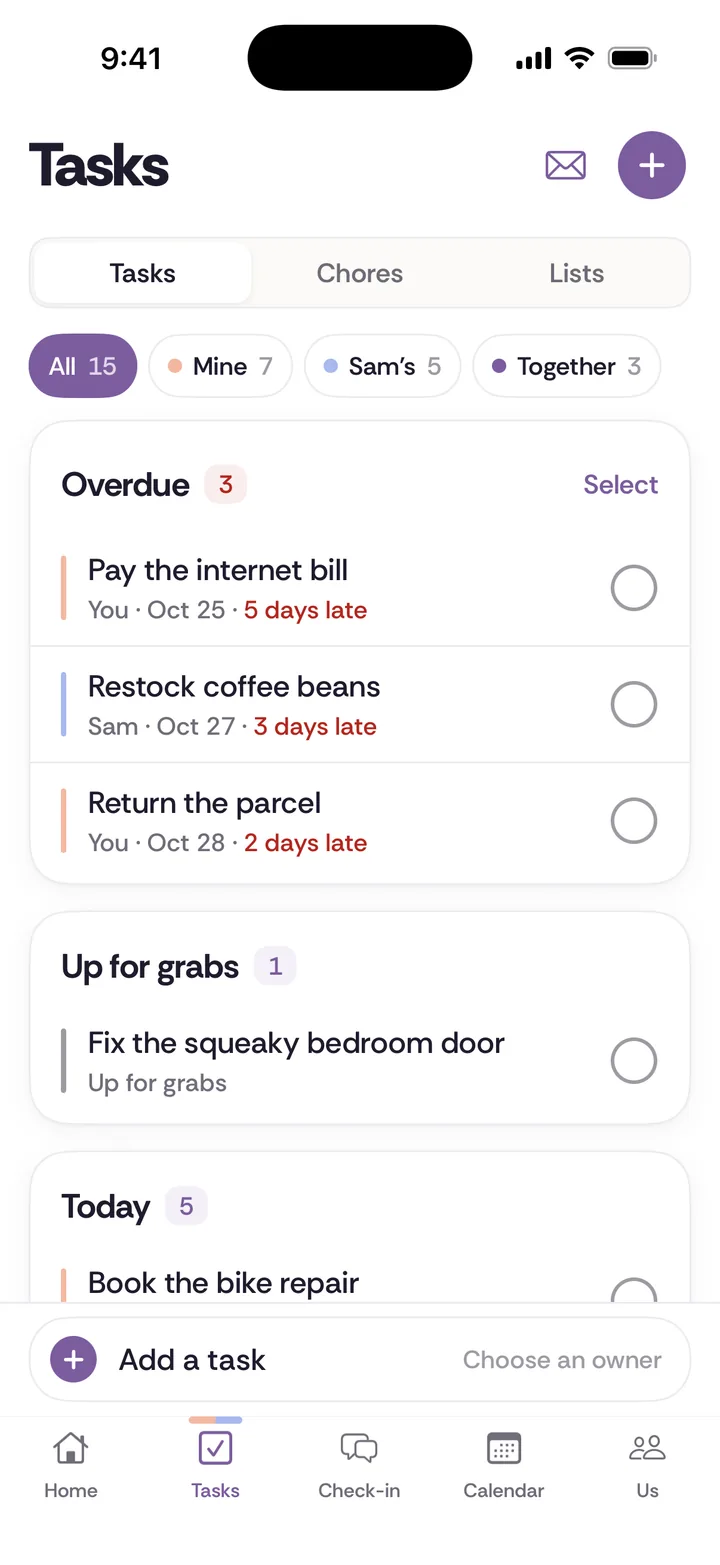
- A shared app. Can remind the owner, repeat jobs automatically and show what's done.
If you want the app version, Tiptoe lets you set chores that repeat on a schedule with one owner, and a completed chore counts for the person it was assigned to. It works on iPhone and on the web, and it's free for both partners for your first 30 tasks and chores. A printed chart and a monthly review do the same job for nothing.
Whichever you pick, put the review on the calendar. A weekly check-in of ten minutes is enough to catch a job that isn't working before it turns into a fight.