The mental load for working parents is the noticing, planning and following up that keeps children and a home running, carried on top of a paid job and often thought about during it. It gets lighter when each parent owns whole jobs from the first "we need to" to the final check, not when one parent asks and the other helps.
That is true whether the parent carrying most of it is a working mom or a working dad, and whether you would call the person next to you your husband, wife or partner. The research below shows a clear pattern in many families, but this page is about your household: who holds which jobs now, and how to move some of them so that both of you can do your paid work without a second shift running in your head.
What the mental load looks like on a workday
The mental load is easiest to see as a list of small interruptions. Take a household where both parents work full time and the children are 4 and 8. On one ordinary Tuesday, one parent might:
- Read a school email at 7:40 about picture day on Thursday and remember that the good shirt is in the wash.
- Notice during a 10:00 meeting that the 4-year-old's daycare bag had no spare clothes left.
- Spend part of lunch finding a dentist appointment that doesn't clash with soccer.
- See a birthday party invitation in a group chat, check the calendar, reply, and add "buy present" to a mental list.
- Realize at 3:30 that nobody has said who is doing pickup, and send the message.
- Decide on the drive home what dinner will be, because the chicken has to be used by tomorrow.
None of these takes long. Each one breaks attention, and each one belongs to someone only because that person noticed it first. The other parent may do a lot of the visible work that evening: bath time, dishes, packing lunches. Both parents worked hard. Only one of them also ran the operation.
For more lists like this, see our mental load examples, and for a definition you can send to someone, our glossary entry on the mental load.
What research says about working parents and the mental load
Three findings are useful here, because they explain why the problem survives good intentions.
The thinking work is uneven, and partners see it differently. A study by researchers at the University of Bath and the University of Melbourne, published in the Journal of Marriage and Family, analysed responses from 3,000 US parents. Mothers reported handling 71% of mental load tasks, compared with 45% for fathers. The same study found that parents often overestimate their own contributions, fathers more than mothers, and that fathers were more likely to see the load as equally shared.
A bigger paycheck does not make it go away. In a follow-up study of more than 2,000 US parents in heterosexual couples, the same research group found that mothers who work and earn more still do more than their share of the mental load. The authors also found that fathers who earned more took on more of the thinking work. The authors write that the mental load tends to "stick" regardless of employment or earnings: earning more can help reduce hands-on housework, but the job of remembering tends to stay with whoever already holds it.
Different parts of the job land on different people. Sociologist Allison Daminger's interviews with 35 couples, summarized by JSTOR Daily, split this thinking work into anticipating, identifying options, deciding and monitoring. In her sample, the person who did the anticipating and monitoring was often not the person who made the final decision. Picking the daycare can feel shared when only one parent did the research and the follow-up.
These studies describe averages across many households, mostly mother and father couples. In your home the pattern may be reversed, shared, or split by area. Plenty of dads carry the school, the medical appointments or the family calendar. The useful question is not "which gender does more" but "which of us is the default for each job, and did we choose that."
Why it feels heavier when you both work
When one parent is home full time, the household management is at least partly visible as their work. When both parents have jobs, the mental load has no hours. It travels to the office in your head and comes back home with you.
A qualitative study of working mothers during the pandemic, based on narrative interviews with 12 mothers across Europe, described paid and unpaid work merging into "split" and "never-ending" shifts, with self-care usually the first thing dropped. The study is small and was not designed to measure how common this is, but the description will be familiar to many working parents of any gender: you are never fully at work and never fully off.
Three things make it worse in two-job households:
- Every handoff needs a message. Pickup, sick days and late meetings all need a decision, and someone has to start the conversation.
- Work calendars change late. The parent whose job is more flexible tends to absorb the changes, and then the planning that comes with them.
- The default parent gets the call. Schools, doctors and other parents learn quickly who answers. After a few months, that parent is the contact for everything.
The four jobs inside every family task
Every household task has four parts. We go into this in detail in our guide to the four jobs of the mental load, but here is the short version with family examples.
- Notice. See that the 8-year-old has outgrown his shoes, that the permission slip is due Friday, that the daycare is closed the Monday after next.
- Plan. Work out when you'll buy shoes, who signs the slip, and what you'll do with a 4-year-old on a closed Monday.
- Do. Go to the shoe shop, sign the slip, take the day off or book the sitter.
- Follow up. Check the slip actually went back, return the shoes that rub, confirm with the sitter the night before.
Most arguments about the mental load in working families happen because the "do" part is shared and the other three aren't. One parent says "I do half the pickups." The other parent thinks "I decide who does pickup, I notice when the schedule changes, and I'm the one the school calls when it goes wrong." Both are telling the truth.
How to share the mental load as working parents, step by step
Step 1. Write down the jobs, by area, not by chore. Use areas like school, daycare, medical, food, kids' activities, birthdays and gifts, home repairs, money, and family travel. Under each, write what is involved. Our list of household chores and the free chore split worksheet can save you from starting with a blank page.
Step 2. Each mark who notices, who plans, who does, and who follows up today. Do it separately, then compare. Expect differences. The Bath study above suggests that both of you may rate your own share higher than the other one would. That isn't lying. Each person sees their own effort better.
Step 3. Talk about the gaps, not the totals. Avoid an argument about whose list is longer. Start with the area where your two answers differ most.
I put school down as mostly mine for noticing and following up, and you put it as shared. Can we look at that one together? I'm not trying to score points. I want to understand what you see that I'm missing, and tell you what I'm carrying.
Step 4. Move whole areas, not tasks. "You do the dentist" means one partner still remembers the six-month check, chases the reminder card and puts it in the calendar. "You own medical" means all four jobs: appointments, forms, prescriptions, the call to the pediatrician, the follow-up. This is the difference between helping and owning, and it's the core of our guide on how to split chores fairly.
Step 5. Hand over the knowledge once, then step back. The person giving up an area tells the other one what they know: the portal login, which doctor the kids like, the date the school forms usually arrive. Then they stop checking.
Here's everything I know about the school. From today it's yours. If something gets missed, I'd rather we talk about it on Sunday than have me start tracking it again.
Step 6. Make it visible to both of you. Write each area and its owner somewhere you both see daily. If the owner is only in one person's head, the old default comes back within a month.
Step 7. Look at it again in two weeks. Ask what is working and what fell through. Change the split if one area turned out much bigger than expected.
Areas that work well to hand off in two-job families
Some areas are easier to move because they have clear edges. Good first candidates:
- School communication. One parent reads every school email, fills every form and adds every date to the shared calendar. Both parents can still be on the mailing list. One is responsible.
- Medical and dental. All appointments, all forms, all prescriptions, and the decision about whether the cough needs a doctor.
- Kids' activities. Sign-ups, fees, kit, schedules, carpools.
- Birthdays and gifts. Including the other kids' parties: replying, buying presents, wrapping, driving.
- Weeknight dinners. Including deciding what to cook and keeping the ingredients in. See our guide to a shared grocery list if the shopping half is the sticking point.
Ownership doesn't have to mean 50/50 by count. If one parent works longer or less flexible hours, our guide on how to divide chores when one works more covers that, and chores for dual-income couples covers households where both jobs are demanding.
Plan the sick day before anyone is sick
The sick-day call is the single biggest mental load moment in many working households. A feverish child at 6:30 a.m. turns into a fast negotiation about whose job matters more that day. Decide the rule in advance instead.
Options that households use:
- Alternate by day of the week. One parent covers Monday to Wednesday, the other Thursday and Friday, based on which days each job is harder to leave.
- Alternate by turn. Whoever stayed home last time is second in line this time.
- Split the day. One parent takes the morning, the other the afternoon, which works if both jobs allow some flexibility.
- Name a backup. A grandparent, neighbor or paid sitter for days when neither of you can step away.
Write the rule down. Then the morning conversation becomes "It's Tuesday, so it's me," not a debate when you're both tired.
What to say if you are carrying most of it
Whether you're a mom or a dad in this position, the hardest part is often asking without sounding like you're accusing. Try this:
I've realized I'm the default for almost everything to do with the kids: school, doctors, parties, pickup changes. I don't think either of us chose that. It just happened. It's making it hard for me to concentrate at work and to relax at home. Can we pick two areas you take over completely?
If you've said similar things before without much changing, name one specific job and one specific date. "Can you own the school forms starting this week" is easier to agree to and easier to check than "I need more help." Our guide on what to say instead of nagging has more wording.
What to say if you've been the one helping
If you're the parent who does a lot but has rarely been the one to notice or plan, the most useful move is to take something over completely and not ask how to do it.
I think I've been waiting to be asked, and that means you have to do the asking. I'd like to take school and medical. Tell me what I need to know once, and then I'll handle them, including the stuff I'd usually miss.
Then make one mistake and own it without being rescued. If a form goes in late, you're the one who calls the school. That is what ownership looks like, and it is what lets the other parent actually stop thinking about it.
Common traps for working parents
"Just tell me what to do." It sounds generous. It keeps one parent as the manager. Swap it for "Which areas can I own?"
Ownership with supervision. If the parent who handed over medical still checks every appointment, the load hasn't moved. Agree on what "done" means, then leave the method alone.
Counting tasks. Ten small chores against one big project is not a fair comparison. Keeping score turns the conversation into a courtroom. See keeping score in a relationship.
Splitting by default skill. "You're better at remembering" usually means "you've had more practice." The other parent can get the practice too.
Keep the system running week to week
A split that works in October may not survive December. Schedules change, a parent starts a new job, a child starts a new school. A short weekly look at the coming week is the simplest way to stop the mental load drifting back to one person. Our guide to a weekly household meeting gives a 30-minute agenda, and our list of check-in questions about chores helps when you want to talk about how the split feels, not just what's on the calendar.
The free version is a shared calendar plus a single note or paper list with each area and the owner's name next to it. Review it on Sunday evening.
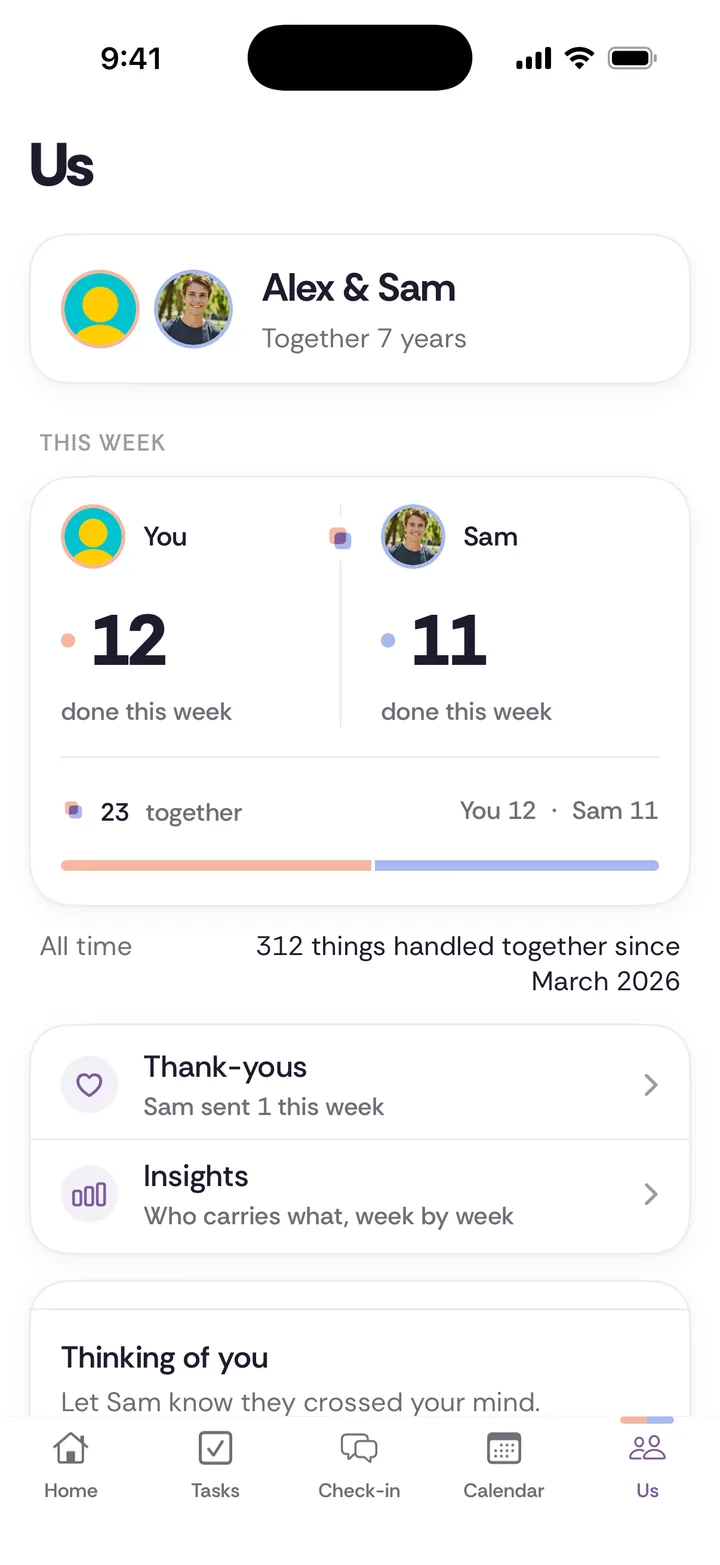
If you'd like that in one place, Tiptoe gives every recurring chore a named owner and a schedule, keeps a shared calendar, lets you nudge each other about overdue items, and sets a weekly check-in where either of you can add topics during the week. It works on iPhone and on the web, and it's free for both partners for your first 30 tasks and chores. An app can hold the list. The two of you still decide who owns what.
Specific households
Both parents work in offices with fixed hours. Pickup and sick days are the pressure points. Agree on the sick-day rule first, then split areas by which parent's commute is closer to school or daycare.
One parent works from home. That parent often becomes the default for deliveries, sick days and school calls, even when their job is just as demanding. See chores when one partner works from home.
One parent works shifts or travels. Give the travelling or shift-working parent areas that can be done on their own time, such as activity sign-ups, money, or online ordering, rather than areas tied to a fixed time of day.
You've just had a baby or gone back to work after leave. The parent who was on leave usually comes back holding everything. Rebuild the split from scratch before the first week back. See splitting chores with a new baby.
A dad is the default parent. Everything on this page applies the same way. The research describes an average. Your household is the one that matters.