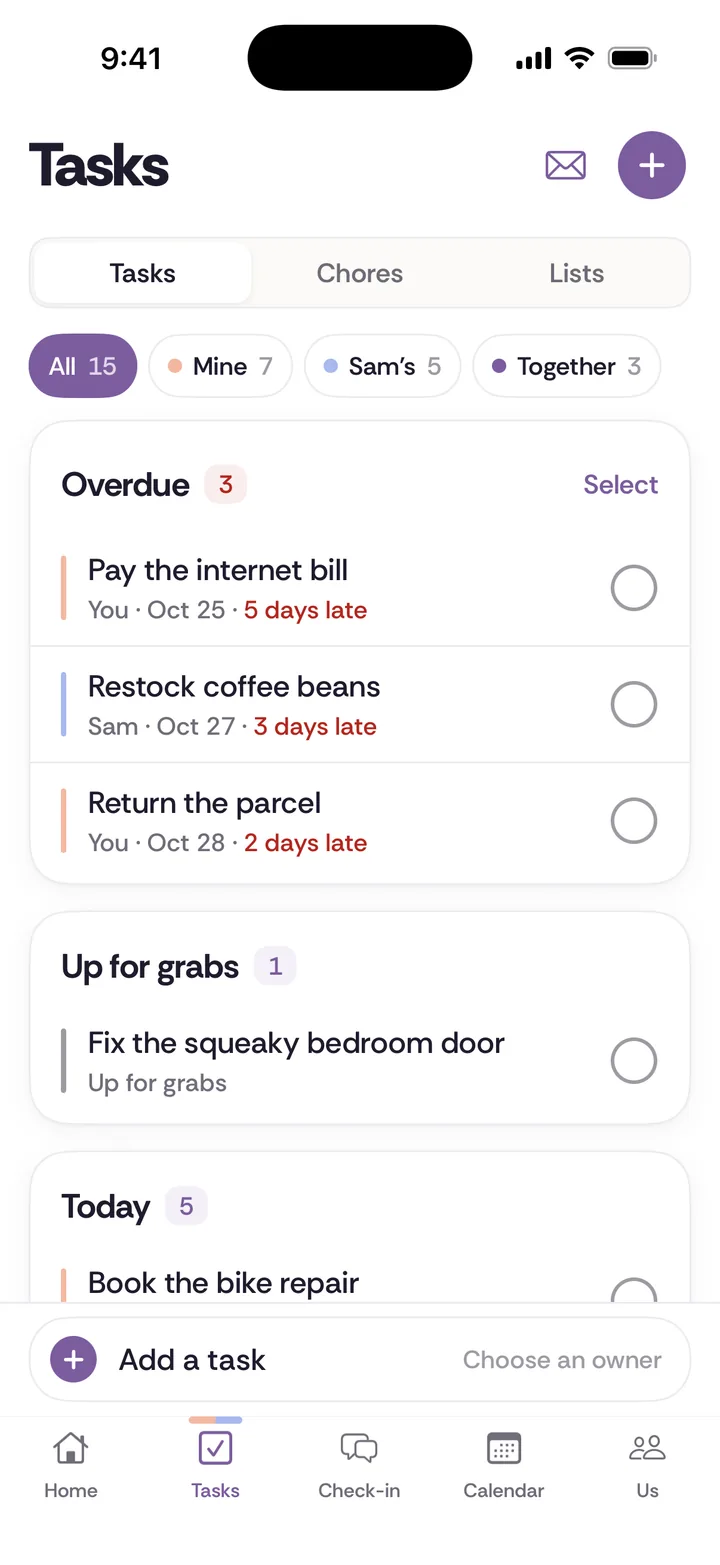
Dual-income couples split chores best by giving each partner whole jobs with clear owners, deciding in advance who covers the unplanned things (sick days, deliveries, late meetings), and cutting or paying for what neither of you has time to do. Splitting task by task, or "whoever has time", usually means the partner who notices first ends up doing most of it.
When both of you work, there's no default person with spare hours, so the split has to be designed rather than assumed. That's true whether you'd describe your setup as a husband and wife both in full-time jobs, two girlfriends with demanding careers, or a boyfriend on shifts and a partner on a nine-to-five. The rest of this guide is the design: what to own, how to handle the gaps between two jobs, and what to say when it slips.
Why is the chore split harder when you both work?
Three reasons.
The work at home doesn't shrink to fit. Two paid jobs don't make dinner, laundry or the school calendar any smaller. They just leave less time for them, and the jobs compete with work email for the same evening hours.
Old patterns fill the gap. Without a plan, couples drift into whatever they grew up with. A Families and Work Institute study of dual-earner couples found that different-sex couples were more likely to split tasks along stereotypical roles and less likely to discuss the division in advance, while same-sex couples were more likely to share chores equally and to talk about how to divide them. Satisfaction with the split was driven mainly by whether couples discussed it when they first moved in together, and was lowest where partners stayed silent.
Even balanced earners don't always split the home evenly. Pew Research Center looked at marriages where husband and wife each earn 40% to 60% of the couple's income. In those marriages, wives averaged 4.6 hours a week on housework and husbands about 2, wives averaged 6.9 hours caring for household members and husbands about 5, and husbands had more leisure time, 25.2 hours a week compared with 21.6. Equal pay checks didn't produce equal home work on their own.
None of this means your household is uneven. It means that if you don't decide, the default probably isn't 50/50.
Does it matter to couples?
Yes. In a 2016 Pew Research Center analysis, 56% of married U.S. adults said sharing household chores is "very important" to a successful marriage. INSEAD professor Jennifer Petriglieri, who studies dual-career couples, writes in TED Ideas that tensions almost always stem from a lack of clarity rather than a lack of equity. That's the useful part: you don't need a perfect split, you need a clear one.
The dual-income split, step by step
Step 1. Make the list together, including the invisible jobs. Write every repeating job, from bins to booking the boiler service to keeping the grocery list current. Petriglieri's advice is to list every logistics task together, because partners tend to underestimate their own share and overlook the other's. Use our list of household chores as a starting point.
Step 2. Cut and outsource first. Before dividing anything, ask what you could stop doing or pay for. Ironing, home-cooked dinners every weeknight, a spotless car, hosting every holiday. Two incomes often means less time and some money, so a cleaner every other week or a grocery delivery subscription can be a better use of both than another argument. Cut what neither of you actually cares about.
Step 3. Group the rest into whole jobs. "Laundry" means noticing the hamper, washing, drying, folding, putting away and buying detergent. One person owns all of it. The four jobs in every chore explains why splitting the doing without the noticing and planning leaves one partner as the manager.
Step 4. Split by time of day, not just by task. This is the most useful trick for two working people. One partner owns mornings, the other owns evenings. Or one owns weeknight dinners and the other owns weekend cooking. Time blocks map onto work calendars, so each person knows exactly when they are on.
Step 5. Assign the interruptions. This is where dual-income couples most often fall apart. Decide in advance:
- Who takes the first sick day when a child is ill, and who takes the second
- Who waits in for deliveries and tradespeople, or how you take turns
- Who leaves work for a school call
- What happens when one of you has a late meeting on your evening
One simple rule is alternation: you took the last one, I take this one. Another is calendar-based: whoever has the lighter day covers. Pick one and write it down.
Step 6. Check the total and agree it's fair. Not equal task count but similar total work and similar free time. If one of you works more hours, see how to divide chores when one partner works more. The chore split calculator can help if you see it differently.
Step 7. Review every few weeks. Work changes. Projects end, seasons get busy, someone gets promoted. Ten minutes on a Sunday is enough to catch drift.
A sample split for two full-time workers
Here's one way it can look for a couple without kids, both working office hours. Copy it and change the names.
- Partner A owns mornings: coffee and breakfast, dishwasher emptied, bins out on bin day
- Partner B owns evenings: dinner Monday to Thursday, kitchen cleared on the nights A cooks
- Partner A owns Friday and weekend food: Friday dinner, Saturday shop, Sunday cook for Monday and Tuesday
- Partner B owns laundry: both people's clothes, towels and bedding, put away
- Partner A owns money admin: bills, subscriptions, insurance renewals
- Partner B owns bookings: doctor, dentist, car, haircuts, tradespeople
- Partner A owns bathrooms, Partner B owns floors, both on Saturday morning
- Together: 15-minute Sunday calendar look, and one big job a month
And one way it can look for working parents with a child in daycare:
- Partner A owns mornings: child up, dressed, fed, at daycare
- Partner B owns pickup and early evening: pickup, dinner, bath
- Bedtime alternates by night, so both stay practiced
- Partner A owns daycare admin: forms, fees, spare clothes, messages from staff
- Partner B owns health: appointments, vaccinations, medicine stocked
- First sick day goes to whoever has the lighter calendar that day; the second goes to the other partner
- Partner A owns groceries and meal plan, Partner B owns laundry
- Cleaner every other week; weekends split into two halves so each parent gets one protected half-day
For copy-ready weekly charts covering four household types, see the chore chart for couples. For more on the hidden admin layer that comes with kids, see working parents and the mental load.
What to say to set this up
Start with the system, not the score.
We both work, and I don't think either of us has a spare hour. Right now we split things by whoever notices, and that's me more often than I'd like. Can we sit down on Sunday and give each job a name?
If your partner agrees but wants to keep it loose:
I'm happy for it to be flexible day to day. I'd just like each job to have someone whose job it is, so neither of us has to keep checking.
If the conversation turns into "but I do so much":
You do. I want that written down too. I think we'll both be surprised by what the other one does.
When one of you drops something:
The car service was yours and it's overdue now. Can you book it this week, or would you rather swap it for something else?
Say it once, plainly, then let the owner handle it. Reminding someone over and over turns you back into the manager. Our guide to stop nagging has more phrasing.
What about the jobs neither of you wants?
Every household has two or three of them. Cleaning the oven, sorting the paperwork pile, calling the insurance company, scrubbing the shower. Left unassigned, they fall to whoever cracks first, which is usually the person with the lower tolerance for mess or delay. That's not a fair way to decide.
Three ways to handle them:
- Rotate monthly. The disliked job goes on the chart with an owner for this month and the other name for next month.
- Trade. One of you takes a job you both dislike in exchange for dropping one the other dislikes more. "I'll do the shower if you take the insurance calls."
- Pay or drop. If neither of you will do it on time, it's a candidate for a cleaner, a service, or a lower standard.
Write down which method you chose next to each job. The point is that "nobody wants it" gets a name, so it stops being a quiet test of who gives in first.
Common traps for two-career households
Work always wins. If every late meeting automatically pushes the home job onto the other partner, the person with the more flexible employer becomes the default. Treat your home jobs like work commitments: if you can't do one, hand it back with notice.
"Helping" instead of owning. "Tell me what you need" sounds generous but leaves the asker doing the planning. Offer a whole job instead: "I'll take groceries from now on, list and all."
Splitting the visible half. Couples sometimes divide cooking and cleaning evenly and forget gifts, school forms and calling the plumber. These invisible jobs often land on one person without anyone deciding.
One partner's standards set the bar. If you disagree about how clean is clean enough, agree a level before you split. See different cleanliness standards.
Never revisiting. A split that worked before a promotion, a move or a new baby may not work after. If a child is coming, read splitting chores after a baby before the birth.
What if you already do this and it still feels uneven?
Run the count. Take one week and write down every job each of you did, including admin and on-call time. Then compare to what you agreed. Usually one of three things is happening: a job you thought had an owner doesn't, the owner is doing the task but not the planning, or the work itself has grown. Each has a different fix, which what to do when one partner does more walks through.
If the topic has become a source of real hurt rather than logistics, our guide on resentment over chores is a better place to start.
Keeping the system running
A list with names on the fridge, plus a ten-minute Sunday look at the calendar, is free and enough for many dual-income couples. A short weekly check-in gives you a set place to raise anything that slipped, so it doesn't come out at 9pm over the sink.
If you'd rather run it from your phones, Tiptoe lets you assign each task and chore to you, your partner or both together, set chores to repeat with one owner, nudge about an overdue item, and keep shared topics for a weekly check-in. It's on iPhone and the web, and free for both partners for your first 30 tasks and chores.