When one partner works more hours, divide chores by total workload rather than by chore count: add up paid work, commuting and home work for each of you, then aim for roughly similar free time. The partner with fewer paid hours usually takes more of the home jobs, but not all of them, and the partner who works more should still own whole jobs, especially the planning ones that can be done from anywhere.
This is one of the most common chore arguments, and both sides usually have a point. One person says "I work 55 hours a week." The other says "I also work, and then I do everything else." Whether it's a husband working late shifts and a wife working part time, or a girlfriend in a demanding job and a boyfriend with a shorter week, the fix is the same: count all the work, agree what fair means, and give each person whole jobs that fit their week.
Is it fair for the partner who works less to do more chores?
Often yes, up to a point. A Psych Central article on two-paycheck couples recommends aiming for equity rather than equality, and suggests that the person working fewer hours could take on more of the household tasks. INSEAD professor Jennifer Petriglieri, writing in TED Ideas about dual-career couples, describes couples who assign proportionally more tasks to a partner with a less demanding career, and argues that tension usually comes from a lack of clarity rather than a lack of equity.
The government's time-use data shows how much time is in play. In the 2025 American Time Use Survey, among adults living with children under 18, those who were not employed averaged 3.1 hours a day of household activities, compared with 1.7 hours for employed adults.
The catch is the phrase "up to a point". Fewer paid hours is not the same as free hours. A partner who works 25 hours and does every school pickup, every sick day and every appointment may have less real downtime than the partner working 50. That is why you count everything, not just the job contract.
Step 1. Count a real week, both of you
Use last week, not a typical week you imagine. For each person write down:
- Paid work hours, including the evening emails
- Commute and work travel
- Home jobs: cooking, cleaning, laundry, shopping, bins, yard
- Care: kids, pets, a parent who needs help
- Admin: bills, booking, forms, school email, gifts, planning
- On-call time: being the person the school phones, waiting in for a delivery
Then add each column up. The chore split calculator does the arithmetic for you, or use a sheet of paper.
Be honest about two things that are easy to miss. First, the admin row. Noticing, planning and following up take real time even when they happen in bits. The four jobs in every chore explains why. Second, on-call time. Being the person who can't commit to a 4pm meeting because pickup might fall through is a cost, even if no chore is happening.
Step 2. Decide what fair means for you
There's no single right answer, so pick one out loud. Three common definitions:
- Equal free time. Total work (paid plus home) is about the same for each, so both get similar evenings and weekends. This is the most common target.
- Proportional to hours. If one person works 50 hours and the other 30, the home work splits in the opposite direction. Simple, but it can ignore how draining each job is.
- Temporary imbalance with an end date. One partner is in a residency, a startup's first year or a busy season. The other carries more on purpose for a set period, with a date to revisit.
Whatever you choose, say it in one sentence and both agree to it. "We're aiming for roughly equal free time" settles a lot of arguments in advance, because you have a shared test to check against.
Step 3. Give the long-hours partner whole jobs that fit their week
The usual mistake is to give the person who works more "help when you can". That leaves the other partner managing every job and handing out pieces. Instead, the long-hours partner should own a few complete jobs, start to finish.
Jobs that suit someone with long or unpredictable hours:
- Bills and money admin. Can be done at lunch or on a train.
- Online grocery order. The partner at home keeps a running list; the long-hours partner checks it, plans the meals and places the order every Sunday.
- Appointments and bookings. Doctor, dentist, car service, haircuts for the kids. Phone calls and forms that can happen in a work break.
- Gifts and cards. Birthdays, holidays, teachers.
- Weekend batch jobs. Saturday morning floors and bathrooms, or a Sunday cook for the week.
- One recurring evening. A fixed night every week where they handle dinner and bedtime, protected on their work calendar like a meeting.
Jobs that usually suit the partner with more hours at home:
- Daily kitchen and dinner on most weeknights
- School runs and after-school
- Laundry
- Anything that needs someone physically there during the day
Notice what this does. The planning jobs, which are the ones most likely to land silently on the person at home, move to the person who is out more. That keeps the mental load from piling on one side even when the doing is uneven.
Step 4. Agree what happens on heavy weeks
Long hours are rarely steady. Write down the rule before the busy week, not during it.
On weeks when you're working past 8 most nights, I'll cover dinner and kitchen. You keep the online order, bills and Saturday floors. If you can't do Saturday, tell me by Thursday and we'll pay for a cleaner or skip it.
The "tell me by Thursday" part matters. The hardest part for the partner at home is often not doing more but finding out late. A clear deadline for handing a job back turns a surprise into a plan.
Step 5. Protect both people's downtime
Equal free time only works if free time actually happens. Two practical rules:
- The partner who works more gets a real landing time. For example, the first 20 minutes after walking in are theirs, no handovers.
- The partner at home gets protected hours too. For example, Saturday afternoon is theirs, and the other partner owns everything at home during that window, including the kids.
Without the second rule, the person at home ends up "off" only when everyone else is asleep.
Step 6. Review in four weeks
Put a date on the calendar. Look at the counts again. Ask two questions:
- Does each of us have roughly the free time we agreed?
- Is either of us doing jobs we thought the other owned?
A short weekly check-in catches small problems sooner, but the four-week review is where you change the split itself.
What to say if you're the one working more
I know my hours mean you're carrying more at home. I don't want that to turn into you running everything. Can I take bills, the grocery order and Saturday mornings as mine, start to finish, so you're not managing them?
If you've been saying "I'm too tired" a lot:
I've been using work as a reason not to do anything at home. That isn't fair to you. Let's figure out what I can own even on bad weeks.
What to avoid saying: "I earn more, so I shouldn't have to." Income and hours are different things, and research suggests they don't settle the question on their own. A Families and Work Institute study found income and work hours predicted who took on which roles in different-sex dual-earner couples but mattered less in same-sex couples, which suggests habit and expectation are doing much of the work. Satisfaction depended mainly on whether couples discussed the split.
What to say if you're the one at home more
I agree I should do more of the daily stuff, since I'm home more. What I can't keep doing is all the planning too. Could you own the grocery order and the kids' appointments, including remembering them?
If your partner says "but you have more time":
I have more hours at home, but a lot of them are pickups, the school calling and waiting in for things. Can we write down last week and look at it together?
If you want your hours to count:
I'd like the things I do to show up as mine, not as me helping out with the house. Can we put names on the jobs?
For more on how to phrase a request without it landing as criticism, see what to say instead of nagging.
Three households, three different splits
A nurse on three 12-hour shifts and a partner working 40 hours, Monday to Friday. The nurse works fewer total hours but on unpredictable days and with brutal recovery. Split: on shift days, the other partner covers dinner and kitchen. On the nurse's four days off, the nurse owns dinner, laundry, groceries and one weekday school pickup. Bills and appointments go to the partner with the steady schedule because they can make calls in office hours.
A lawyer working 60 hours and a teacher working 45 with marking at home. The teacher's evenings during term are not free. Split: they pay for a cleaner every other week, the lawyer owns the grocery order, bills, gifts and Sunday batch cooking, and the teacher owns weekday dinners and laundry. In school holidays the teacher takes more, by agreement, and the lawyer keeps the planning jobs all year.
One partner at 50 hours, the other at 20 hours with two young kids. The partner at 20 hours does more home work, by a lot, and that's fair on hours. But the long-hours partner owns bedtime two nights a week, all of Saturday morning, the online order and every medical appointment, booked and attended or covered. That last one is the job that most often falls through the cracks. If one of you is home full time, see our guide to the stay-at-home parent chore split.
What if the person working more does almost nothing at home?
Start with the count from Step 1. Numbers on paper make it a shared problem instead of a complaint. Then name the gap plainly, once.
I added up last week. Including work and everything at home, I did about 62 hours and you did about 55. I want us closer to even. Which two jobs would you take on?
If talking hasn't helped over a few months, read what to do when one partner does more and, if it helps, our guide on resentment over chores. If the conversation itself feels unsafe, or you're afraid of your partner's reaction, please read our safety page.
Keeping the split visible
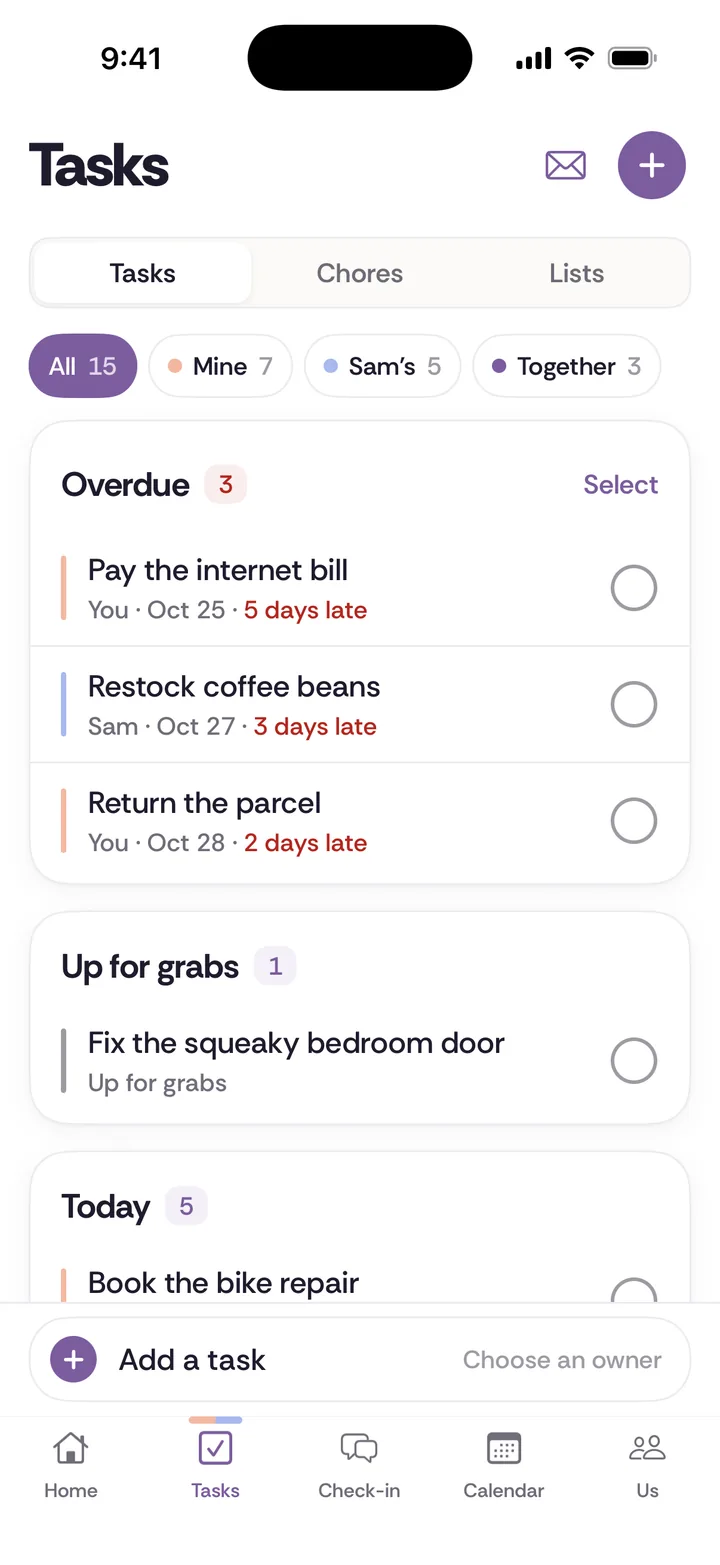
Whatever you agree, write the owners down so the agreement survives a busy month. A list on the fridge with names next to whole jobs is free and works well. If you want the jobs to repeat and remind the owner automatically, Tiptoe assigns every task and chore to you, your partner or both together, and a completed item counts for the person it was assigned to, so the long-hours partner's jobs show up as theirs. It's on iPhone and the web, free for both partners for your first 30 tasks and chores.
For the full method of turning a list into owned jobs, see how to split chores fairly, or start with a ready-made weekly chore chart.