Mental load examples include noticing the milk is low before it runs out, remembering the dentist is due, researching which daycare has an opening, working out what to give your partner's mother, and checking that the repair actually fixed the leak. The mental load is the noticing, planning, deciding and checking behind a household's work, and it can sit with anyone, whether that is a husband, wife, boyfriend or girlfriend.
Definitions rarely help, because the work is hard to see until you have examples. Below are 50, organized by area. Each describes a real piece of attention rather than a task like "do the laundry". As you read, try asking of each one: who in my home holds this, and do they know they hold it?
What counts as mental load?
Sociologist Allison Daminger's 2019 paper describes cognitive labor as anticipating needs, identifying options for filling them, making decisions and monitoring progress. Tiptoe puts it in plainer terms as four jobs inside every chore: notice, plan, do and follow up. The mental load is mostly the first, second and fourth of those. A simple test: if you could do the task in five minutes, but you have been carrying it around in your head for two weeks, that carrying is the load.
Food and groceries
- Noticing you are almost out of coffee, and adding it to the list before the morning you run out.
- Deciding what is for dinner on a Tuesday when one of you has a late meeting.
- Remembering that the chicken in the fridge has to be cooked by tomorrow.
- Knowing who will not eat what, including guests, and planning around it.
- Thinking on Thursday about what you will need for Sunday lunch at your place.
Cleaning and laundry
- Noticing the towels have not been washed in a while.
- Keeping track of which clothes are dry-clean only, and picking them up.
- Knowing the work shirts will run out on Wednesday, so a load has to go on Tuesday night.
- Noticing that the house needs tidying because people are coming over.
- Remembering when the sheets were last changed.
Scheduling and the calendar
- Keeping both people's plans in your head, so you can answer "are we free Saturday?"
- Remembering to book the dentist before the next opening is months away.
- Spotting that two commitments overlap next week, and working out who gives way.
- Remembering the car has to be in the shop on Friday, and arranging the ride home.
- Looking ahead to a work trip, and working out what has to shift while one of you is gone.
Children
- Knowing the size of each child's shoes, and noticing when they are getting tight.
- Reading the school email so someone knows it is pajama day on Friday.
- Remembering the permission slip is due, and where the pen and the form are.
- Finding out which camps have sign-ups opening, and when.
- Noticing that a child has been quiet since the weekend, and making time to ask about it.
Pets and plants
- Noticing the dog's flea medicine is due this week.
- Keeping track of the vet appointment and where the vaccination record is.
- Arranging who looks after the cat during a trip.
- Remembering how much food is left and reordering before the bag runs out.
- Knowing which plant gets water and which one you killed last year by overwatering.
Money and paperwork
- Noticing the car insurance renews next month, and comparing before it does.
- Keeping track of which subscription is charging you for something you stopped using.
- Knowing whether you can afford the trip, and what would have to give.
- Knowing where the passports are, and when they expire.
- Collecting everything needed for taxes as the year goes on, and not in April.
Home maintenance
- Noticing the dishwasher has started to leave a film on the glasses.
- Remembering when the furnace filter was last changed.
- Researching who to call about the damp patch, reading the reviews, and getting a quote.
- Being home for the repair person, or working out who will be.
- Checking that the drip actually stopped a week after the plumber left.
Family, friends and social life
- Remembering a birthday in time to do something about it.
- Working out what your partner's mother would actually like, and buying it.
- Keeping up with the group chat so you both know what is expected at the reunion.
- Noticing that you have not seen your friends in months, and suggesting a date.
- Remembering who hosted last time, and whether it is your turn.
Health
- Knowing when each person's annual checkup was and is next due.
- Refilling a prescription before the last pill, including one that needs a doctor's sign-off.
- Remembering which doctor said what, and asking the follow-up question.
- Keeping track of an older parent's appointments and medications.
- Noticing that your partner has seemed run down, and thinking about what to take off their plate.
Trips, holidays and the future
- Booking flights before the price rises, and checking the leave dates with both employers.
- Packing in your head, days before, for yourself and everyone else.
- Thinking in November about where you will spend Christmas, and telling both families.
- Working out who will cover the school's week off in February.
- Making sure that a future plan, such as moving house or having a baby, has a next step.
What does the mental load look like across one ordinary day?
This is an illustration we wrote to show how the examples add up, not a real person's account. Picture one partner on a regular Tuesday.
- 7:10 a.m. Sees the milk is nearly gone. Adds it to the list. Notes there is no dinner plan yet.
- 8:30 a.m. Reads a message about Friday's early school pickup. Works out that it clashes with a meeting, and that the other partner may be free.
- 11:00 a.m. Remembers mid-meeting that the car insurance renews soon. Sets a reminder to compare prices.
- 1:15 p.m. Sees a birthday coming up on a shared calendar. Thinks about a gift during lunch, and orders it, allowing for delivery time.
- 4:45 p.m. Moves the chicken from freezer to fridge in their mind, then remembers that it has not been done, and changes the dinner plan.
- 9:30 p.m. On the way to bed, sees that the sheets need changing, the dog's medicine is due and tomorrow is trash day.
None of this looks like work from across the room. No single item took more than a few minutes. But all of it took attention, some of it interrupted something else, and at the end of the day none of it shows. It is also why a person can feel tired after an evening when it looks as though nothing much happened.
Now imagine that same Tuesday with the groceries, the school logistics and the insurance each owned by a different person. There would be fewer items in any one head. That is the realistic goal: not zero mental load, but a load that both people can see and have agreed to hold.
What do these examples have in common?
Look back at the list and notice three things.
Each one is small. Nobody would call a single item a burden, and that is why it is hard to talk about. The weight comes from how many there are and how they never quite finish.
Each one is someone's by default. Nobody decided that one partner would know the shoe sizes. It tends to build up from who noticed first, and then who keeps noticing. That is why the first useful question is rarely "who does this" but "did we ever choose this?"
It is hard to see from outside. If the fridge is always full and the appointments are always made, the system looks as though it runs itself.
What the research shows is that this work tends to follow a pattern. In a 2023 survey of 3,000 U.S. parents, 83% of mothers and 37% of fathers said they were mostly the one keeping track of the family calendar, while 52% of mothers and 69% of fathers said they mostly notice when something like a dishwasher or faucet needs repair. Both parents can honestly claim the same job, and those numbers come from individual parents, not matched couples. Your household may look nothing like this. Our household chores statistics summary sets out what the figures can and cannot tell you.
What does the same job look like when it is shared?
Sharing the mental load does not mean that one partner gives instructions more politely. It means the other person holds the thinking. Compare these three cases.
Dentist appointments
- Held by one person: "Can you book your own dentist appointment? It has been a year. Here is the number."
- Moved completely: One partner owns health appointments for both adults. They know when each is due, book them, reschedule them and tell the other when they are. The other partner does not think about it again.
Weeknight dinner
- Held by one person: "I can cook on Tuesday. What should I make? Do we have what I need?"
- Moved completely: Tuesday's dinner belongs to one partner from the meal choice through the shopping to the cleanup. If it turns out to be eggs on toast, it was still their call.
The school email
- Held by one person: One parent reads it and forwards the relevant part with instructions.
- Moved completely: One parent owns school logistics for the term. They read every email, put things on the calendar and pack whatever is needed. If something is missed, they deal with it.
That is the difference between helping and whole-job ownership. Helping means the task moved. Ownership means the thinking moved too.
How do you use these examples at home?
Step 1. Do a one-week inventory. Go through this list and mark who holds each item. Add your own. Both of you do it separately, then compare. Differences are useful information and are not an accusation.
Step 2. Choose one area, not all of it. One whole area big enough to matter, such as "groceries", "kids' school logistics" or "health appointments."
Step 3. Move all of it. Hand over the notice, plan, do and follow up, and include whatever is in your head, such as who eats what and which store has it.
Step 4. Leave room for it to go differently. The first few weeks may be messier, and a different way of doing it is not necessarily wrong. Agree what must not be dropped, such as an allergy, and let the rest be the owner's call.
Step 5. Review once. Use your weekly check-in to ask: did the new owner notice it, plan it and finish it without being prompted? If not, what would need to change?
If you are not sure how to begin the conversation, we have written out how to explain the mental load, word for word. If you wonder whether this is your situation at all, try the self-check on uneven mental load. The glossary entry on the mental load has a short definition you can share.
Where can you keep all of this outside your head?
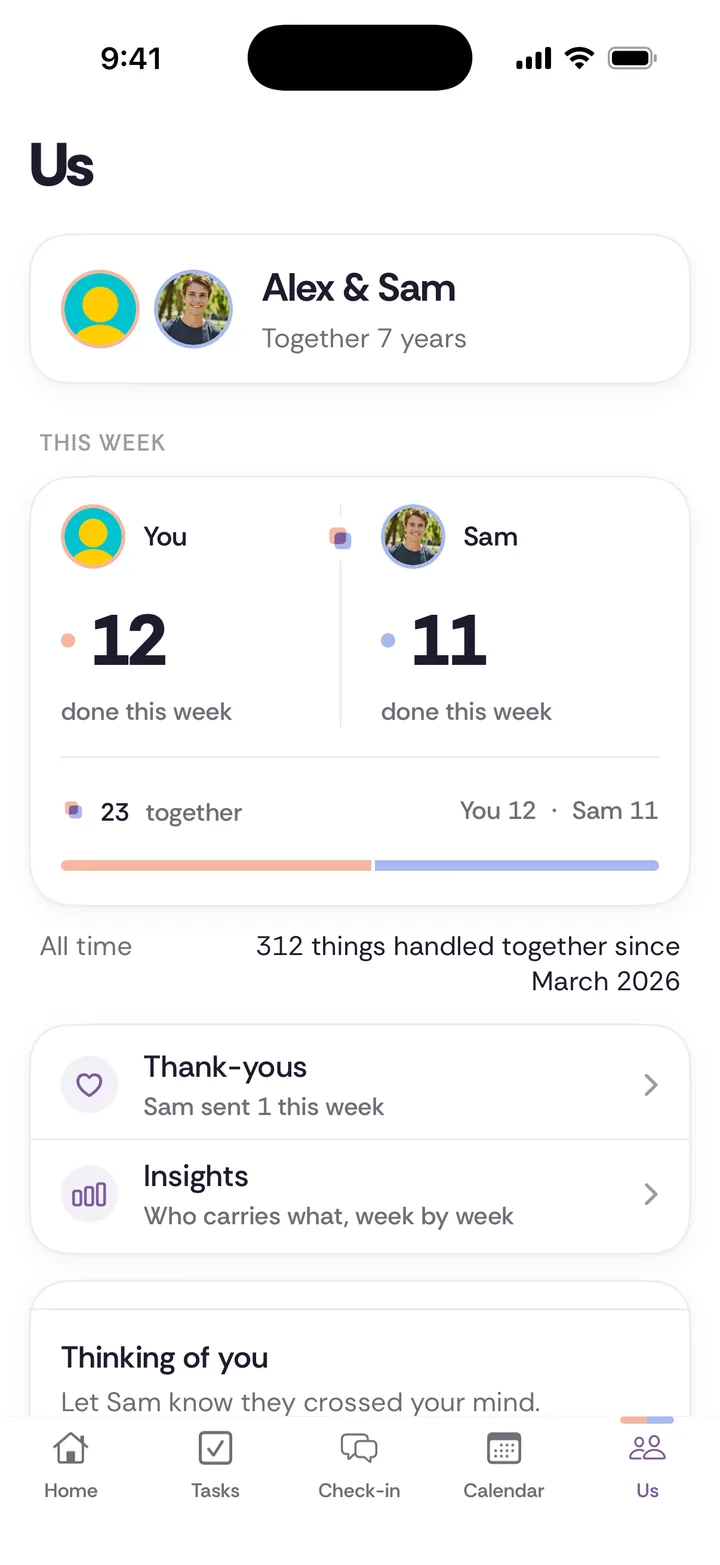
Any shared place will do, as long as both of you check it. A notebook on the counter, a shared note or a printed worksheet all work. The point is that the list has an owner for each thing, and is not stored only in one person's memory. Tiptoe is one free option, on iPhone and web: tasks are assigned to you, your partner or both of you, and chores repeat on a schedule with one owner.