You are probably carrying more of the mental load if your home's plans, supplies and dates depend on you remembering them, if things stop when you stop, and if jobs you hand off come back to you for instructions. The 30 questions below let you check against what actually happened in the last two weeks, and they work whether you are the wife, husband, girlfriend or boyfriend in the relationship.
This is not a diagnosis, a score of your relationship or a validated scientific test. We wrote it as a practical way to turn a vague feeling into something you can point to. Many checklists focus on how you feel, such as tired or foggy. Those feelings can come from many causes. This one asks what you did.
How do you take the self-check?
Think about the last two weeks, not your household in general. For each question, write Y if the answer is mostly you, N if it is mostly your partner or shared, and "?" if you truly do not know. Do not count what you think should be true. Ideally, your partner takes it separately, and you compare afterward.
Section A: Noticing
- Are you usually the first to notice that a staple such as toilet paper, coffee or dish soap is running out?
- Do you know roughly what is in the fridge right now without looking?
- Did you notice the last thing that broke, leaked or started making a noise?
- Do you know when the sheets were last changed?
- Do you know which of your household's clothes or shoes are worn out or too small?
- Could you say which bills or renewals are coming up in the next month?
Section B: Planning and deciding
- Did you decide most of the dinners in the last two weeks?
- Did you do the research for the last thing you bought together, such as a mattress, phone plan or daycare?
- When your partner has made the final choice on something, did you first do the work to narrow the options?
- Do people, such as relatives, friends or the school, contact you first about plans?
- Did you plan the last trip or weekend away, including what to pack?
- Do you hold the calendar in your head, so that you are asked "are we free on the 14th"?
Section C: Doing the asking
- Does your partner often ask you "what do you need me to do?"
- When your partner does a job, did you usually have to ask or remind them first?
- Have you stopped asking about something because it felt easier to do it yourself?
- In the last two weeks, did you rewrite a list, a message or a set of instructions so someone else could finish a task?
- If you ask your partner to do a job, do you then have to tell them where things are or how it is done?
Section D: Following up
- After a repair or appointment, are you the one who checks whether it worked?
- Do you check whether a form, payment or sign-up went through, even when someone else handled it?
- When a job you handed off gets dropped, is it you who notices it?
- Do you restock, reorder or rebook after a job is finished?
- Are you the one who remembers the next appointment after this one?
Section E: If you stepped away
- If you were away for a week with no phone, would you need to write instructions before you left?
- Would a birthday, a bill or a school deadline be missed if you did not mention it?
- Would your partner know the name of your child's doctor, your landlord or your vet, and how to reach them?
- Would your partner know what your pet eats, what your child's allergies are, or where the spare key is?
Section F: How it feels
These matter, but they have many possible causes. Consider them last.
- Do you lie in bed thinking about a list of things at home?
- Do you feel interrupted at work by things you have to remember for home?
- When someone says "you should have just asked," does your stomach drop a little?
- Does your partner seem honestly surprised when you say how much you are holding?
How do you read your answers?
We have not attached a score, because no number on this list has been tested against anything. A cut-off would be invented. Read for patterns instead.
Most of Sections A and D are Y. You notice and you follow up. These are often the invisible ends of a chore, and they are the hardest parts to see. Your partner might do plenty of the doing and honestly have no idea this exists.
Most of Section C is Y. You are acting as the manager. Your partner may do a lot of what you ask, but you are still planning the work and assigning it. This often gets described as a helpful partner, and it can still be tiring for you.
Most of Section E is Y. Your home depends on one person's memory. Even if you do not mind, that is fragile, and it would cause real trouble if you were ill or away.
Many answers are "?". That is useful too. If you do not know who holds something, it might be your partner. Ask, and do not assume.
Mostly N. You may have a fair split, or you may be the partner who is not carrying it. If your partner has said that they feel otherwise, ask them to answer it as well, and compare. The point is to learn what you may not have been able to see.
Why do partners answer these so differently?
Two people can look at the same home and honestly describe it differently. That has been measured, though in general populations and not in your home. In Pew Research Center's October 2020 survey, 59% of women in opposite-sex couples said they do more household chores, while 20% of men said they do more and 34% said their partner does. In a 2023 survey of 3,000 U.S. parents, both mothers and fathers overestimated their share of cognitive work relative to their own task-by-task answers, and fathers did so more than mothers.
A plausible reason, and we offer it as our reading rather than a finding, is that nobody can see what they did not notice. You cannot count work you never knew was happening. So a partner can honestly say "we split things pretty evenly" and mean it, because they are comparing only the parts they can see. This is why a list works better than a debate. You can both look at it. Our data summary has more of these numbers and their limits.
It works in every direction, too. In the same parent survey, more fathers than mothers said they were mostly the ones noticing when something like a faucet needs repair. A partner who handles the car, the taxes or the mortgage may also be holding a load that the other person cannot see. Our guide to one partner doing more covers this from both sides.
Is it the mental load, or something else?
A high count on this list can come from a few different situations, and each needs something different.
- Nobody chose this. It just built up over time, and neither of you noticed. This is common, and a conversation about ownership may be all you need.
- Standards gap. You see a job as necessary and your partner does not. Talk about the standard first, or you may just hand over a job that your partner thinks is unnecessary. The guide to splitting chores fairly helps here.
- Skills gap. Your partner truly does not know how to do it. Allow time for them to learn, and do not take it back the first time something goes wrong.
- Follow-through gap. The job has been agreed and understood but it does not reliably get done. Be specific about that, and agree what happens next.
- Holding on. You may like things done your way, and handing them off feels risky. That is normal, and worth an honest look. Ownership means the other person gets to do it their way, within what you agreed.
- Pretending not to know how. People sometimes call this weaponized incompetence. It is worth assuming good faith first, and it is also fine to name the pattern if it keeps repeating.
If what you are noticing is not about chores at all, for instance if you are afraid to raise this, or your partner controls money or access to people, or there are threats, a chore list is the wrong tool. Please look at our safety page, which lists resources.
If these questions have you noticing poor sleep, low mood or trouble getting through your day, consider speaking to a doctor or mental health professional. Those deserve attention on their own, regardless of who does the dishes. Tiptoe is not therapy or a medical service.
What do you do after the self-check?
Step 1. Pick the three items that bother you most. Not all of them. Three real examples are far more useful than thirty.
Step 2. Compare with your partner. Say what you did and why you did it. Words you can use: "I did this list about who holds what at home. Would you do it too, then we can compare? I am not trying to prove anything. I want us both to see the same picture."
Step 3. Name one area to move. Pick one big enough to matter, such as weeknight dinners, school logistics or appointments, and agree that it moves whole: notice, plan, do and follow up. The four jobs guide explains each part, and the mental load examples help you describe what you hold.
Step 4. Stop doing that job, on purpose. This is the hard part. If you keep quietly checking on it, the mental load stays with you. Tell your partner what cannot be missed, such as an allergy, and let the rest go.
Step 5. Review after one week. Ask three things. Did the new owner notice it? Did they plan and finish it without a prompt? What did you each find hard? Use a weekly check-in if you have one.
If you do not know how to start, we have written out exactly what to say and how to bring up something small without it turning into a fight.
Where should you record this?
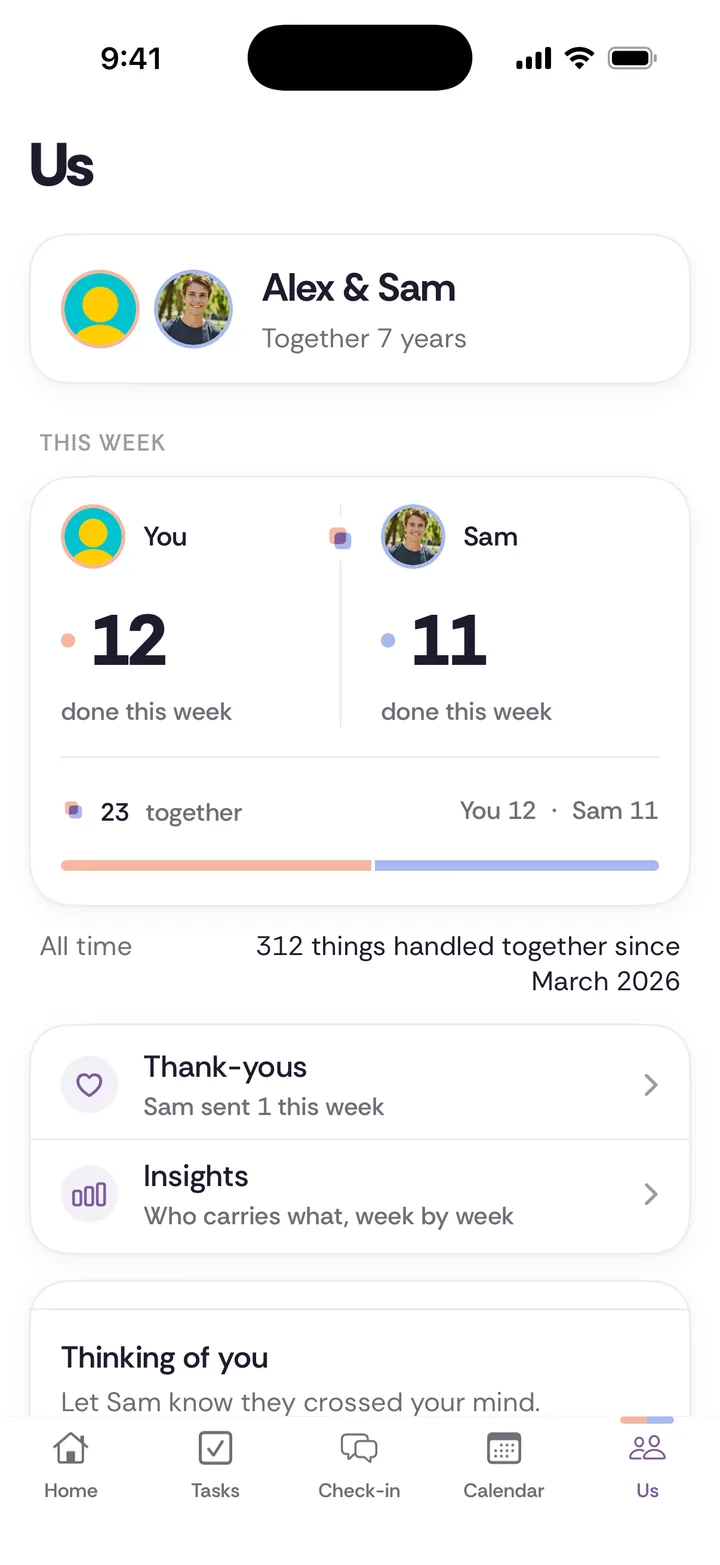
Paper works. Write down each area and one name next to it, and stick it on the fridge. A chore split worksheet can give you the headings. If you would prefer something that repeats and reminds you, Tiptoe is a free app for iPhone and web, in which chores have one owner and a completed item counts for the person it was assigned to.