To explain the mental load to your husband, wife, boyfriend or girlfriend, skip the definition and walk through one real job from last week: "You got the groceries, and thank you. Before that, I noticed we were low, planned the meals and wrote the list. I want to hand you all of that for one area, not just the shopping." That sentence does most of the work, and everything below helps you get to it and respond to what comes next.
Many guides stop at the idea of having a talk and using "I" statements. That is fine as far as it goes, but it does not help when your partner says "just tell me what to do." So this page gives you words for the moment you actually have to say it. Change them until they sound like you.
Why do explanations of the mental load fail?
Explanations tend to fail for three reasons, and none has to do with how clearly you understand the idea.
- It starts as a total. "I do everything" gets an answer of "that is not true", and then you are debating a number. One real example is much harder to dispute.
- It starts when you are already upset. The moment you notice the dishwasher is still full is the worst moment. Wait for a calmer one.
- It ends with no change. A partner can understand the concept perfectly and nothing changes on Tuesday. The goal of the talk is one moved job, not one agreed definition.
Before you say anything: three things to prepare
Choose one job, not the whole household. Pick something you carry that your partner may not know about, and write down its parts. The four jobs are a good template: notice, plan, do and follow up. Here is what that might look like with the kids' dentist appointments: notice they are due, find a date that fits school, make the call, remember the forms, take them or arrange who will, book the next one.
Choose a time. Ask ahead, and do not start at bedtime or during a chore. "Can we take 20 minutes on Sunday morning? It is about how we run the house. Nothing is wrong, I just want to change one thing." If you have a weekly check-in, add it as a topic.
Know what you are asking for. Decide which whole job you want to hand over. If you cannot name it, the talk will end with a promise to help out more, and that often leaves you as the manager.
The first conversation, word for word
Here are four parts. It should take about ten minutes.
Part 1: Say what this is and what it is not.
"I want to talk about how we run things at home. I am not saying you do not do enough, and I am not keeping score. There is one kind of work that I do not think you can see, and I would like you to be able to."
Part 2: Walk through one real example.
"Take Thursday's dinner. You cooked, and it was good. Before that, I noticed we were out of rice, worked out that you would be home first, checked the fridge, bought what was missing and texted you the plan. That took maybe twenty minutes in total, but it was in the back of my mind all day. Then it starts again for Friday."
Part 3: Say what it costs, using your own experience.
"I have a list running in my head all the time. When we sit down at night, part of me is still thinking about the permission slip and the car insurance. I would like to put some of that down."
Part 4: Ask for one whole job.
"So here is what I am asking. Could you take over all of weeknight dinners on Monday through Wednesday? I mean the whole thing: deciding what we eat, checking what we have, shopping and cooking. I will stop thinking about it, which is really the point. Which job would you prefer to take, if not that one?"
Then stop talking. Let them answer.
One-line explanations you can borrow
If you want a single line to get the idea across, one of these may work.
- "It is the difference between doing the shopping and knowing we need to shop."
- "You are asking me what needs doing. That question is the job I want to hand you."
- "Imagine you had a project at work and you were the only one who had the project plan. That is how it can feel at home."
- "Doing a task takes ten minutes. Remembering it might take two weeks."
- "I do not want more help. I want fewer things in my head."
The project-manager comparison is a common one, including in this guide from Paired. It tends to work well for someone who runs projects at work, because they know what the difference is between a person who is assigned a task and a person responsible for making sure it all happens.
What to say to the five replies you will probably hear
"Just tell me what to do."
It is a generous offer, and it is worth saying that first.
"Thank you, I know you mean that. The trouble is that telling you is the part that wears me out. Working out what needs doing is the job. I would like you to own this one so that I do not have to think about it, and it is okay if you do it differently from me."
"But I do lots of things too."
This one might well be true. Your partner may hold things you do not see.
"You do. I am not saying otherwise, and I probably do not see all of it. Can we each write down what we hold, including the thinking part? I would like to see yours too."
Then do that. A chore split worksheet gives you a page to fill in, and the list of household chores gives you a list to start from. Ask them to fill in their half separately.
"Why didn't you say something sooner?"
Often this comes from surprise, not attack. Answer it directly.
"It built up slowly, and I did not see it myself for a long time. I am saying it now. What can we change this week?"
"You are too picky. Nobody could do it to your standards."
There could be something in this, and it is worth taking seriously.
"You may be right about some of it. Let us agree on what done means for this job, and everything beyond that is your call. If you do it another way, I will leave it alone. I just need the essentials to happen, like the allergy being remembered."
And then keep to that. Going back to redo the job takes it back.
"This is just a thing from the internet."
Do not go and find articles to win the point. You may not need the term at all.
"We do not need to call it anything. I am telling you what my week is like, and I am asking you to take over dinners. Can we talk about that?"
If they ask where the idea comes from, sociologists have studied it. Our data summary has the sources, including where the data falls short. Use it for reference, not as ammunition, since an average does not describe your home.
What if you only have a text message?
Sometimes a text is a better first step than a tense talk, because no one is put on the spot. Keep it short and ask for a time.
"Can we take 20 minutes on Sunday to talk about how we split things at home? Nothing is wrong. I would like to hand you one whole job so that it comes off my mind. Have a think about which one you would want."
What should the partner hearing this say?
If you are the one being told, or if your partner has sent you this page, the words you pick in the next minute really matter. Try these.
- "Tell me more about what that is like."
- "What am I not seeing?"
- "Which job would take the most off your mind if I owned all of it?"
- "I am going to get some of this wrong at first. Tell me what cannot be missed, and let me work out the rest."
Try not to open with your own list, even though you may have one. There will be time for it, and you should say it later in the same talk. Also avoid "just remind me", since reminding is the work in question.
After the talk: the handoff that makes it stick
A good talk changes nothing unless the job actually moves. Here is how.
Step 1. Name the job and its edges. "Weeknight dinners Monday through Wednesday, including planning, shopping and cleanup."
Step 2. Empty your head into theirs. Tell them what you know once: who will not eat what, where the good rice is, what time things need to be ready. Write it down.
Step 3. Agree on what done means. One or two sentences. "Food on the table by 7, kitchen clear before bed."
Step 4. Stop. Do not check the fridge. Do not ask if they have thought about Wednesday. If dinner is eggs, dinner is eggs. If it is really a problem, you can raise it at the review. The more you check, the longer you stay the manager.
Step 5. Review after one week. Ask: "Did you notice what was needed, plan it and finish it without me saying anything? What was hard? What should change?" The guide to whole-job ownership goes further.
What if nothing changes?
Say what happened, once, with no extra heat. This approach is covered in how to stop nagging and how to bring up something small.
"We agreed you would own dinners. Last week I ended up planning two of the three. What got in the way? Do you still want this job, or should we choose a different one?"
Three possible outcomes are all more useful than silence. It might be a skills gap, and they need time. It might be a disagreement about the standard. Or the agreement may not hold, and you need to look at the whole picture, perhaps with a counselor who works with couples. Saying the thing plainly, instead of tiptoeing around it, is how you find out which it is.
If you are not raising this because you are afraid of how your partner might react, or if your partner responds with threats or control, then this is not a chore conversation and a script is not what you need. Please go to our safety page.
Where should the agreement live?
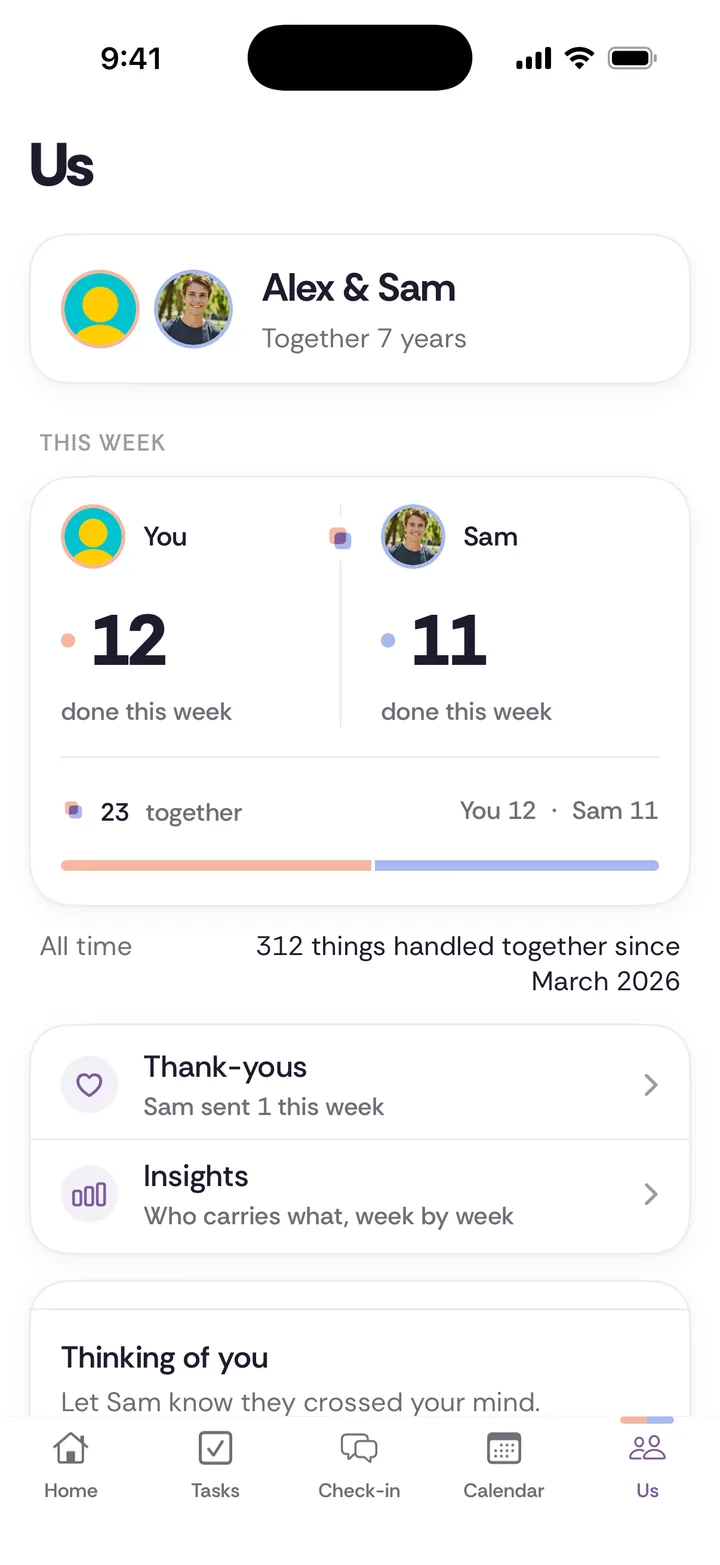
Write it where you can both see it. A note on the fridge works as well as anything. If you want the owner, schedule and thanks in one place, Tiptoe is a free shared app for iPhone and web where each chore has one owner, and either of you can add a topic to the weekly check-in as things come up.