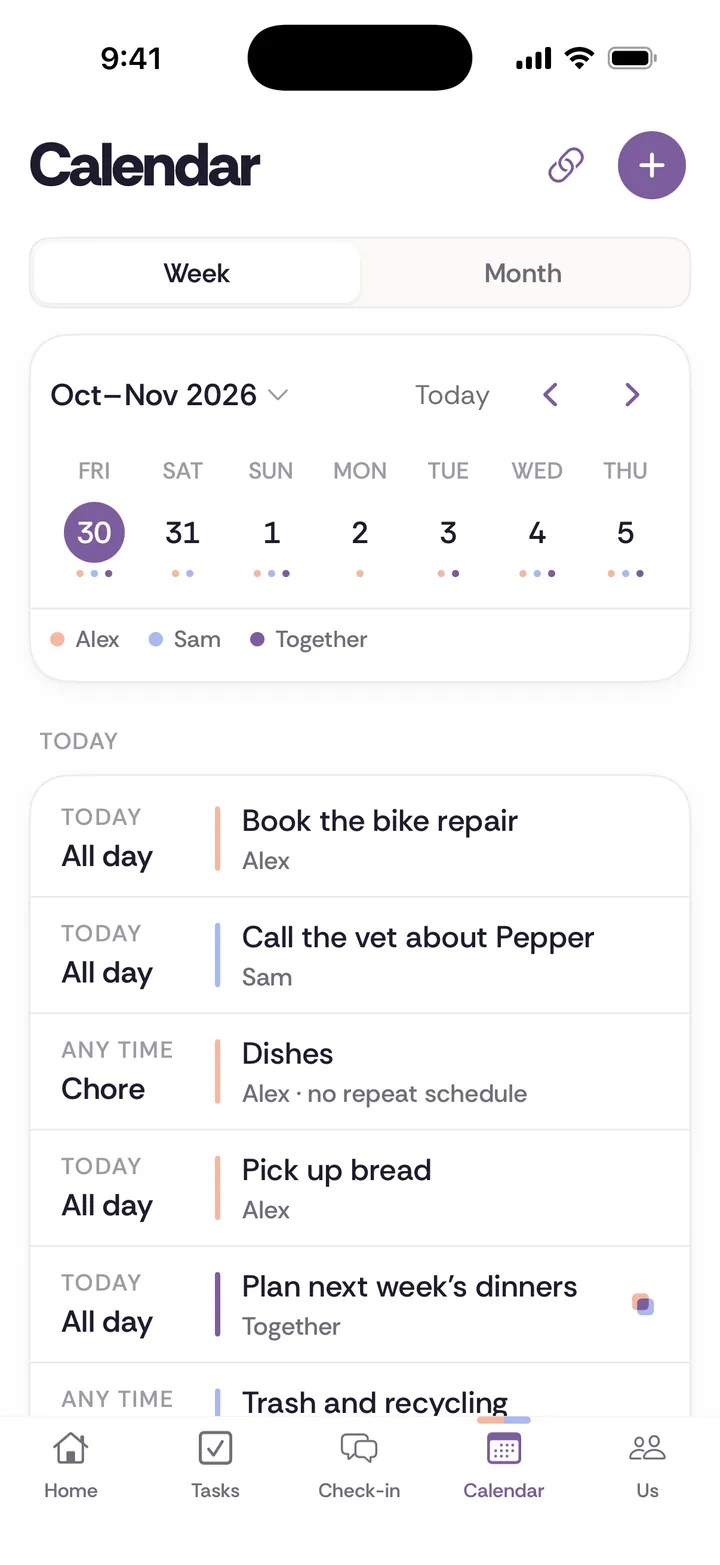
To make time for date night with busy schedules, put a recurring slot on the shared calendar before the weeks fill up, decide who plans each date, and lower the bar so a short evening at home counts. Treat the slot like a work meeting: if something clashes, move the date to another night that week rather than cancelling it.
Most couples don't lack the wish to spend time together. They lack a system, and the planning falls to whoever notices first that it's been a while. This page gives you that system, a menu of dates sized for the time you actually have, and specific fixes for shift work, travel, small children and two demanding jobs. It applies whether you're planning with a husband, wife, boyfriend or girlfriend.
Does regular date night actually matter?
The best-known data comes from the National Marriage Project and the Wheatley Institute's Date Night Opportunity report, based on a 2022 YouGov survey of 2,000 married US adults aged 18 to 55. It asked how often people go on "date nights where you have a chance to talk, catch up, and do something fun with your spouse."
- 52% said they never go on date nights or do so only a few times a year. 48% had date nights once or twice a month or more.
- 83% of wives and 84% of husbands with regular date nights said they were very happy in their marriages, compared with 68% of wives and 70% of husbands without them.
Two caveats from the report itself are worth knowing. It's a snapshot at one point in time, so the authors write that they "cannot make any firm causal connection" between date nights and relationship quality. Happier couples may simply go on more dates. And the survey covered married, heterosexual couples, so it says nothing directly about other couples. The authors suspect the two reinforce each other, which is a reasonable working assumption: time together helps, and it's easier to make time when things are good.
Notice also how the survey defined a date: a chance to talk, catch up and do something fun. Not a restaurant, not a babysitter, not a set length.
Why date night keeps falling off the calendar
Date night is a household job like any other, and it has the same four parts: noticing it's been too long, planning it, doing it, and following up. Our guide to the four jobs of the mental load explains the idea.
When date night slips, it's usually because one of those jobs has no owner:
- Nobody notices. Weeks go by, and only one partner feels the gap.
- Nobody plans. Both of you would happily go out, but neither has picked the night, booked the sitter or chosen the place.
- The plan collapses on the day. A late meeting or a sick child wipes it out, and nobody reschedules.
- Nobody follows up. There's no "when's the next one," so the next one depends on someone noticing again.
The fix isn't more enthusiasm. It's giving each job to someone.
How to make time for date night: a step-by-step system
Step 1. Pick the frequency you can actually keep. Weekly is lovely and unrealistic for many parents of young children. Every other week, or once a month for a longer date, is better than a weekly plan you abandon in a month. Agree on it out loud.
Step 2. Put recurring slots on the shared calendar today. Choose the same evening, such as every other Thursday, and add it as a repeating event for the next three months. A slot that's already there gets protected. A date you'll "find time for" gets eaten. Our couples calendar hub has more on running one calendar between two people.
Step 3. Alternate who plans. The planner for each date owns all of it: choosing what to do, booking anything that needs booking, arranging childcare, and telling the other person what to wear and when to be ready. The other partner just shows up. Alternating means neither of you becomes the permanent social director, and each of you gets dates you didn't have to think about.
Step 4. Book childcare as a recurring job. If you need a sitter, the planner books them when the date goes on the calendar, not the day before. If you trade childcare with friends, set up a standing swap: you take their kids one Saturday a month, they take yours another.
Step 5. Decide your reschedule rule. "We move it, we don't cancel it" is a good one. If Thursday falls through, the planner proposes another evening that week before the end of the day.
Step 6. Book the next one before this one ends. At the end of each date, confirm who plans the next one. That single sentence does the follow-up job.
What to say to suggest it
If date nights have lapsed and you want to raise it without it sounding like a complaint:
I miss having time that's just us, not logistics. Could we put a date every other Thursday on the calendar and take turns planning? It doesn't need to be fancy. Even an hour on the sofa with the phones away would count.
If your partner hesitates, ask what makes it hard. Exhaustion, money and childcare are all solvable problems once they're named. Our hub on couples communication has more on raising things directly instead of tiptoeing around them.
A date menu sized for your schedule
Agree on a short menu so the planner isn't starting from nothing. Group options by the time you actually have.
30 to 60 minutes, at home
- Coffee on the porch or balcony before anyone else is up.
- A takeout dinner after the kids are in bed, eaten at the table with the phones in another room.
- One episode of a show you only watch together, plus a walk round the block.
- A card game or a puzzle with a drink.
90 minutes to 2 hours
- A lunch date on a day you both work from home, or meet halfway between offices.
- Cook something new together, with one person choosing the recipe and the other doing the shopping.
- A walk to a café or bar you've never tried.
- An early evening class: climbing, pottery, a cooking class.
Half a day or more
- A day trip somewhere neither of you has been.
- A long hike, a museum and a late lunch.
- A night away, with grandparents or a trusted sitter covering.
The Date Night Opportunity report points to research suggesting that couples who do novel activities that are fun or active tend to report higher relationship quality, and suggests choosing activities that balance both partners' interests rather than always doing what one person prefers. So rotate: a few familiar favorites, and now and then something new. Alternating planners does the balancing for you.
If you're stuck for ideas, try Tiptoe's date night idea generator, or browse our date nights hub.
Keep logistics out of the date
The quickest way to ruin a date is to spend it on the car insurance and whose turn it is to do bath time. The Date Night Opportunity report notes that some marriage experts recommend keeping conflicts and problems off-limits during time set aside for fun, and setting aside separate time to deal with issues.
The simplest way to do that is to give logistics their own time. A short weekly household meeting handles the calendar, the food and the bills, so the date doesn't have to. If something does come up on the date, try:
Good point. Can we put it on Sunday's list and leave it there for tonight?
Specific situations
You both have demanding jobs
Evenings are unpredictable, so mornings or lunchtimes are often more reliable. A standing Friday breakfast before work survives late meetings better than a Thursday dinner. If your weeks are tight on chores too, see chores for dual-income couples.
You have young children
The planner role matters more here, because childcare is the hardest part to arrange. Home dates after bedtime count. So does a weekend walk while a grandparent takes the kids to the park. If one parent carries most of the family planning already, don't add date night to their pile. See our guide to the mental load for working parents.
You have a new baby
Lower the bar further. Twenty minutes together without the baby monitor in your hands, a coffee while the baby naps, a short walk with the stroller. Talk about something other than the baby for some of it. See splitting chores with a new baby.
One of you works shifts or nights
Find the overlap. If one of you finishes at 7 a.m., a breakfast date can be the evening equivalent. Put the shift schedule on the shared calendar and plan dates around it a month ahead, not a week ahead.
One of you travels for work
Schedule the date for the evening after the travelling partner gets home, with the home partner planning it. During the trip, a video call at a set time with the same takeout in both places is a date too.
Money is tight
Most of the at-home menu costs almost nothing. Agree on a monthly date budget so neither of you has to ask whether something is too expensive. For the bigger money conversation, see our couples money hub.
Date nights feel forced or awkward
That's common after a long gap. Start with something with a built-in activity, like a walk, a game or a class, rather than two hours of face-to-face conversation. The report's survey defined a date as a chance to talk, catch up and have fun together, and doing something side by side is often an easier way into talking than sitting across a table. If dates feel tense because of an unresolved issue, the report also notes that some couples may benefit from working on underlying problems with a counselor first.
Common mistakes
Waiting for a free evening. Busy couples don't get free evenings. They get evenings they protected in advance.
Saving it for a big night out. If every date has to involve a sitter and a reservation, you'll go a few times a year. Mix small and big.
One person always planning. It becomes another job on their list, and it stops feeling like a gift.
Cancelling instead of moving. Each cancellation makes the next one easier.
Keep it on the calendar
The free method is a recurring event on a shared calendar, a note listing your date menu, and the rule that whoever plans this date names the next planner before you get home.
If you'd like it in one place with the rest of your shared life, Tiptoe's calendar shows both partners' plans and key dates such as birthdays and anniversaries alongside dated tasks, so "book the sitter for Thursday" can sit on the calendar with an owner. It works on iPhone and on the web, and it's free for both partners for your first 30 tasks and chores. It can remind you. You still have to put the phones down when you get there.