To split chores when moving in together, write down every recurring job in your first week, compare how each of you grew up doing them, give each person whole areas rather than single tasks, agree what done means, and review after seven days. Do this early, because whoever does a job in the first weeks with your boyfriend, girlfriend, husband or wife tends to become the person who does it.
Most advice on this is written for roommates, and it comes down to a rotating chart. Couples have a different problem. You are not only cleaning a shared space, you are also working out how to run a life together, and many of the jobs, such as a parent's birthday or the car insurance renewal, never show up on a chart. Here is what to do instead.
Why does the first month matter so much?
It matters because defaults set quickly. In the first week, one of you buys the dish soap, because it had run out and they were at the store. Now they know the brand, where it is kept and when it runs low. By the second month, it is theirs. Nobody decided that.
None of this is anyone's fault. It is what happens when two people are busy, kind and trying not to make a big deal of things. The trouble comes later, when one person realizes that they have been the household manager for a year. Spending an hour on this in week one is far easier than having that conversation after a year. Our first 30 days guide sets out the whole month, and this page goes deep on the chores part.
Before you move: the 30-minute conversation
Have this before the boxes, or at least before the first full week. It does not need to be formal. A walk or a long car drive works well.
Ask each other:
- "How were chores handled in the house you grew up in? What do you want to keep, and what do you never want to repeat?"
- "What do you need clean in order to relax? What do you honestly not notice?"
- "Which jobs do you actually not mind? Which do you hate?"
- "What is your worst habit in a shared home?"
- "What do you do when you are stressed: clean everything, or leave everything?"
- "How do you want me to tell you when something is bothering you?"
You are not after the perfect answers. You want to find out where you differ before it comes up over a wet towel.
How do you split the chores? Six steps
Step 1. Make the list in your first week. Walk through the home, room by room, and write down what it will need. Then add the jobs that do not live in a room: bills, groceries, the calendar, your two families. The full list of household chores saves you from starting with a blank page, and the daily, weekly and monthly list shows you how often each one comes up.
Step 2. Mark the invisible parts. Each job has four parts: notice, plan, do and follow up. Taking out the trash is quick. Knowing the pickup day, buying bags and bringing the bins back is the rest of it.
Step 3. Claim what you do not mind. Go through and each take what you prefer. People do not all hate the same things, and you might be lucky. One of you may find ironing relaxing, and the other may be happy to clean a bathroom.
Step 4. Group into whole areas. Do not leave it as a list of scattered tasks. "Laundry" as a whole area with one owner works much better than one person washing and the other folding, unless that is what you both prefer.
Step 5. Divide the jobs nobody wants. Use the fairest method you can both accept: alternate by week, take one each, or pay for it if the budget allows. It is fine to do a job together, like Saturday-morning bathrooms, as long as you both know that is the plan.
Step 6. Agree what done means for the top three. Choose the three jobs most likely to cause friction, and say what done means in one sentence.
- "Dishes done means the sink is empty and the counter is wiped, by bedtime."
- "Bathroom done means toilet, sink and shower, weekly, and a clean towel."
- "Laundry done means it is put away, not on the chair."
What does the first week look like, day by day?
If you want a plan to follow, here is one. It assumes that you moved in over a weekend.
- Moving day: Do not try to solve chores. Find the bedding, chargers, toiletries and something easy to eat. Decide who is calling about the internet.
- Day 2: Walk around with a notebook and write down every job that you can see. Ask where the trash goes and on which day.
- Day 3: Add the jobs you cannot see: rent, bills, groceries, the calendar, birthdays, repairs and whoever deals with the landlord.
- Day 4: Each mark the jobs you do not mind, then group them into areas.
- Day 5: Agree on owners, and what done means for your top three. Put the list on the fridge.
- Days 6 to 7: Start living with it. If one of you is tempted to do the other's job, leave it for now, and bring it up at the review.
- Day 8: Sit down for fifteen minutes and go through what actually happened. Change one thing.
You will get some of this wrong, and that is expected. A first version that is written down and reviewed is more useful than a perfect one you never get around to. Keep it light, and order food.
A sample split for two people
Here is one example, not a recommendation, for two people working similar hours with no children. Change it freely.
Partner A owns:
- Groceries, including the weekly list and restocking
- Cooking Monday through Wednesday
- Laundry for shared items such as sheets and towels
- Bills, and checking that autopay ran
- The shared calendar and the appointments you both need
Partner B owns:
- Cooking Thursday through Saturday
- Bathrooms and floors
- Trash and recycling, including the pickup schedule
- Home maintenance: dealing with the landlord, filters, light bulbs and alarms
- Plants or pets
Together or by turns:
- Whoever did not cook does the dishes
- Each of you does your own personal laundry
- Sunday dinner is takeout or whatever is left
- Each of you handles your own family's birthdays, with the other's help when asked
The partner who cares about their own family's traditions should own them. One partner can easily end up remembering both sides of the family, so naming it now can prevent that.
What if your standards are different?
This will almost certainly come up. One of you sees a mess, and the other sees a room. Neither of you is wrong, since standards come from the homes you grew up in. Try these in order.
Agree a shared minimum. What is the standard you can both live with? "Kitchen is clear before bed" could be the minimum, even if one of you would prefer it spotless.
Let the higher standard own the extra. If you need the towels folded in thirds, that part is yours, and it counts. You cannot give a job to someone else while still insisting it be done your way.
Have a place for mess. One chair, one closet shelf or one corner of a desk that is allowed to be chaos. This takes care of a surprising number of arguments.
Do not redo the job behind them. It tells them that their work does not count, and the job drifts back to you. If it really does not meet what you agreed, say so once, and do it at a calm moment.
What about different hours and incomes?
Equal is not the goal, but an honest agreement is. If one of you works nights, studies or has a longer commute, count that in. Being home during the day does not make someone the default owner of everything.
Be careful about trading money for chores without saying so. If one person pays more rent and the other does more around the house, that can be a fair deal, but only if you both chose it, and you can both say so out loud. Otherwise it can become a running sore. Money gets its own conversation: try the couples money guide.
To get a rough sense of the hours, try the chore split calculator. It runs in your browser and does not store anything. Use it as a starting point for a conversation, not as a verdict.
What do you say when something goes wrong?
Sooner or later a job gets dropped. It is better to say something small on the day than to save it up. You can use these words, and more are in how to bring up something small.
- "The bins did not go out this morning. Can you sort it out for next week?"
- "I am getting wound up about the towels on the floor. Can we talk about it for a minute tonight?"
- "I noticed I have been buying the groceries for three weeks, and that was supposed to be yours. What is going on with it?"
- "I did your job yesterday, and I should not have without asking. Do you want to swap or is it okay as it is?"
And it helps to do it the other way too:
- "Thanks for dealing with the landlord. I did not have to think about it at all."
Say what you noticed, not what it means about them. "You did not clean the bathroom" is something your partner can do something about. "You never do anything around here" is not. Saying it plainly, without tiptoeing around it, is kinder than hinting.
If you feel afraid to bring things up, or chores are being used to control you or to punish you, a chore plan is not what you need. Please see our safety page.
How do you check that it is working?
Set a time to talk seven days after you agree the split, and then have a short weekly check-in. Ten to fifteen minutes is plenty. Ask:
- What went well this week? Say thanks for one thing.
- What was dropped, and why?
- Is anything turning into one person's default that we did not agree to?
- What should change owner?
That third question is the one worth keeping for the long term, since drift is slow and easy to miss. If one person is starting to do more, you will see it early. Our guide to splitting chores fairly and the weekly check-in questions can help.
What should you write it down on?
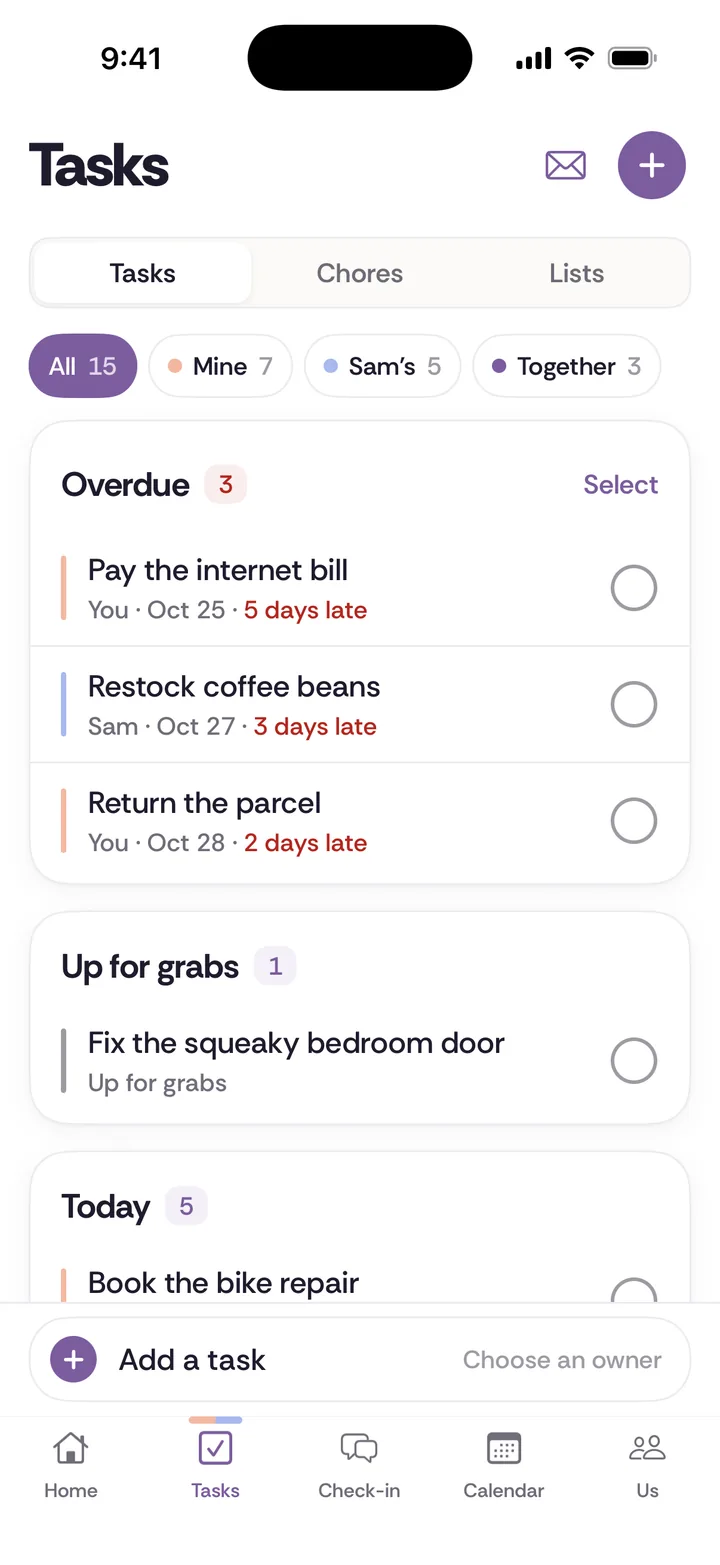
A sheet on the fridge is free and works well, and you can start with the chore split worksheet. If you would rather have it on your phones, Tiptoe is a free app for iPhone and web. Chores repeat on a schedule and each has one owner, with room for a weekly check-in as well. Both partners are free, with no card. For the rest of the move, see the first apartment checklist for couples.