Chores in a blended family work best when the two adults agree on the rules first, apply one set of house expectations to all the children living there, have each parent lead with their own children at the start, and roll changes out slowly. Then the couple has to divide the adult work too, including the invisible job of tracking two households' schedules, whether that falls to a husband, wife, boyfriend or girlfriend.
Most advice on this topic is about charts for the children. Those matter, but the harder question for a couple is what happens between the two of you. Who is the one who asks a stepchild to clear the table? What does it do to your relationship when you feel your partner's children do less than yours? Who emails the other household about the Friday switch? Here is how to set that up.
What should the two of you agree first?
Talk privately, without children around, before any new rule is announced. This could take two or three conversations. Cover the following.
- What is expected of every child? Decide what each age should do, and write it down.
- What is an adult job, and what is a child job? Children doing tasks does not take away the planning behind it.
- Who gives instructions to whom? Especially the first year or so.
- What happens if a chore is not done? Agree on a simple consequence before you need it.
- What about allowance? Will it be tied to chores at all, and is it the same across children?
- What happens when children are only there some of the time? See below.
- What do we each find hardest to see? Say this honestly. Many people find it easier to go gently on their own children and to notice someone else's mess.
Words you can use: "I want us to agree on how chores work before we tell the kids. I know this may feel touchy because they are our kids. I am not criticizing yours. Can we each say what we expect and where we think we differ?"
How do you set "This house" rules?
Children can live with different rules in different places. What wears on them, and on you, is unclear or uneven rules within one home. So set rules for your home only, and do not make them about the other household.
- Say it like this: "In this house, everyone clears their own plate and puts their laundry in the basket."
- Do not say: "I do not know how it works at your mom's, but here we actually do things properly."
The KidKarma guide to blended family chores offers the same "this house" framing, and it suggests not criticizing the other home's approach. That is sound advice, especially if the other household does things very differently. You do not control it, and your children should not have to defend it to you.
Base chores on age and time spent in the house, not on who is whose child. If one teenager cooks once a week and another does not, there should be a reason you can both say out loud.
Who should give instructions and follow up?
In the beginning, each parent generally leads with their own children. This is a common suggestion in stepfamily advice, and it makes sense: a child who is still getting used to a new adult may hear a chore request as a claim about who is in charge.
That does not mean the stepparent has no role. Try the following.
- The rules belong to the house. The stepparent can say, "It is your night for dishes," because that is the house's rule and not their own.
- The parent handles consequences. If the child refuses, the stepparent should not fight it out. They tell the parent, and the parent follows up the same day.
- The parent backs up the stepparent in front of the child. "Jordan is right. It is your night." Any disagreement between adults happens later, in private.
- Review the arrangement over time. Relationships change. A stepparent may take on more as trust builds, and that does not have to follow a set timeline.
Words you can use as the stepparent: "I am not trying to be your parent. In this house, everyone has a job, and tonight the dishes are yours."
Words you can use as the parent: "When you are at this house, you do what everyone does here. If you have a problem with the rule, come and talk to me about it. Do not take it out on them."
How do you handle different custody schedules?
Fairness becomes harder when children are there different amounts of time. A child who is there every other weekend will not have the same chores as a child there all week. Set expectations based on a simple rule, such as these.
- Tasks tied to being there. Everybody who is home that day clears their own plate, tidies their room and helps at dinner.
- A fixed job per stay. A child who comes for a weekend might take the trash out on Sunday before leaving, or strip their bed.
- Weekly jobs go with whoever is around. Laundry, say, does not have to be fair by the week. It might balance out over a month.
- Do not save up jobs. A child who has been away should not come back to a pile of work. That can feel like a penalty for moving between homes.
- A short welcome back. Some children need a little time to settle after moving between homes. Consider starting with chores the next morning, not the moment they arrive.
What about the adult jobs, including the invisible ones?
Blended families have extra invisible work that often goes to one adult by default. It can even fall on the stepparent, who may find they have become the household manager for children who are not theirs, without anybody having decided that. Make these jobs visible. Write a name next to each.
- Keeping the custody calendar and noticing conflicts
- Communicating with the other household
- Keeping each child's clothes, medicine and homework moving between homes
- Tracking school forms and events for every child, from possibly more than one school
- Knowing each child's doctor, dentist and allergies
- Planning for holidays and summers when schedules change
- Buying birthday gifts for parties, and working out who is invited
- Sorting out child support, shared costs and who pays for what
- Packing and unpacking the handoff bag
- Noticing how a child seems after they switch homes
A good default for couples: each parent owns the logistics and contact with the other household for their own children. It is usually their relationship, and doing this work keeps them involved in their children's lives. If you want to arrange it differently, you can, but choose it together.
A useful question to ask: "Whose job is this, really?" If a stepparent is doing most of the school forms for a stepchild, that can be fine, if they want to and everyone knows it. If it happened by default and it is causing resentment, that is worth bringing up. Our guide to one partner doing more and the four jobs behind each chore can help you work it through.
What if you feel your partner's children do less than yours?
This might be the hardest conversation on this page. Many stepfamilies will meet some version of it.
Say what you have seen, and not what it means. "Over the last two weeks, Maya has done dishes four times and Leo has not done them at all" is specific. "Your kids get away with everything" is not.
Ask what you might be missing. There may be a reason, such as a child having a hard time, a different schedule or a health issue. Ask, and be prepared to hear it.
Bring it back to the shared rule. "We agreed each child does dishes on their nights. Should we change the rule, or do we need to follow it better?"
Have the talk privately, and not in the moment. Try your weekly check-in. It is a place for this sort of thing, and you can raise it as something small before it becomes something larger.
Words you can use: "I want to talk about something that I am a bit nervous to bring up, because they are your kids and I care about them. I have noticed Leo has not done his nights for a couple of weeks, and I am starting to feel it. Can we look at that together?"
And to respond: "That is hard to hear, and I can see why you are feeling it. Let me look at it, and I will talk to him this week."
How do you roll it out?
Change is a lot for children in a new household. So do not change everything on the first day.
Week 1. The adults agree, and each parent talks to their own children. Keep it short, and explain the reason: "This is a bigger household now, so everybody gets a job."
Week 2. Start with one or two simple jobs, the same for everyone. Clearing your own plate and keeping your own space in order are good ones.
Week 3. Add age-appropriate jobs. Older children may want a say. Ask them what they would rather do, from a list.
Week 4. Hold a short family meeting, and ask what is working. Let children speak without being corrected. Change what you can.
Each week after that. The two adults have their own short check-in, without the children.
Expect some pushback. A child who complains about chores might be saying something about the new family, or about missing the old one, or might simply not want to do dishes. It is worth staying curious. For a child who is having a hard time, or if you are worried about them, talk to a family therapist or the child's doctor. Tiptoe is not therapy.
When is it about more than chores?
Chore plans assume that the adults are basically safe with one another. If you are afraid of your partner, if there are threats, or if money, children or family are being used to control you, please do not try to negotiate through a chore chart. See our safety page. If you are concerned about a child's safety, use local child protection services or emergency services.
How should you keep track of all this?
A paper calendar and a chore list on the fridge work well, since children can see them too. For a chart, you can start from the chore split worksheet, and the complete chore split guide covers the adult side. If you want an app the children use themselves, a dedicated children's chore app may suit you better. KidKarma, for one, describes per-child task lists and split-custody features on its own guide, as of November 2026.
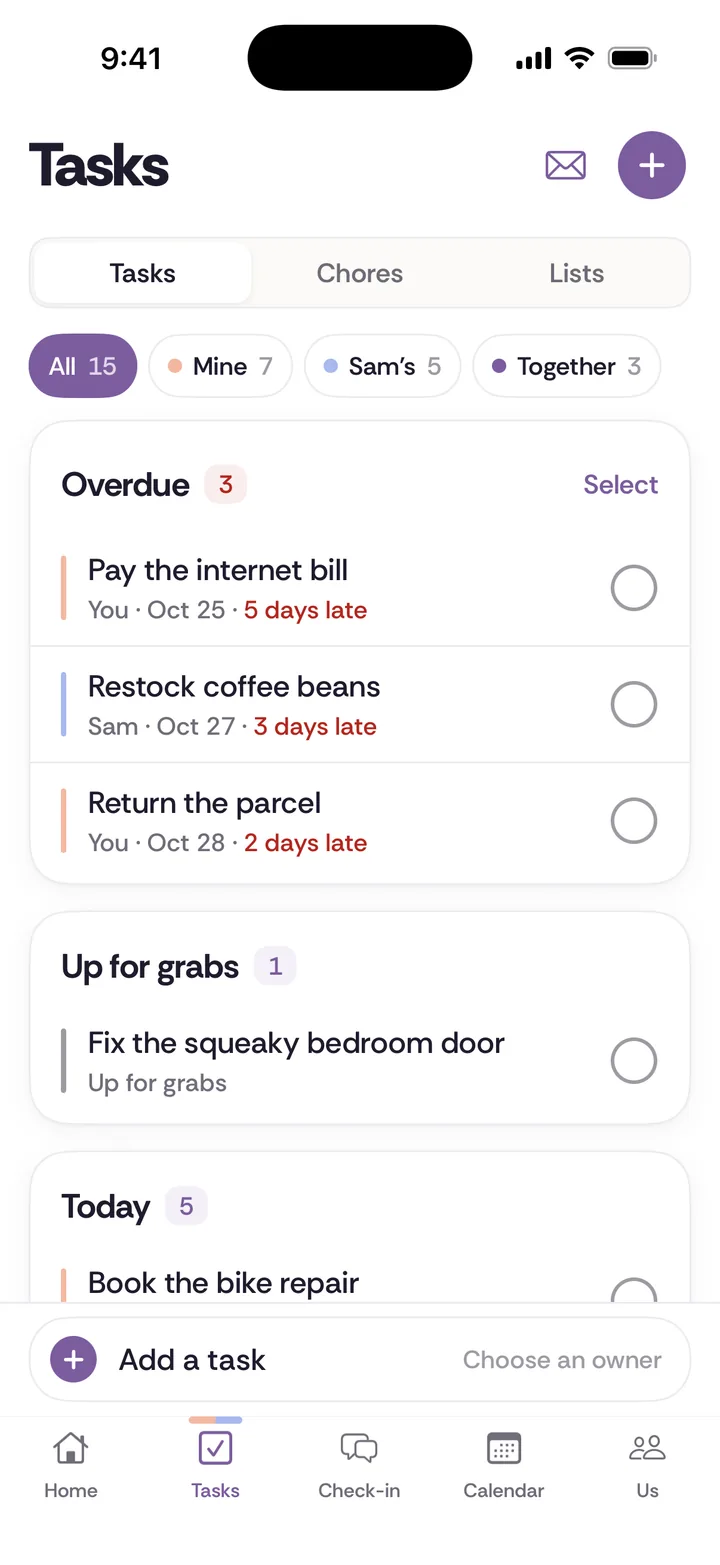
Tiptoe is for the two adults, not the children. It is a free app for iPhone and web where tasks go to you, your partner or both of you, chores repeat on a schedule with one owner, and the Calendar tab holds both partners' plans in one place. It helps with the adult work: the handoffs, forms and who owns what.