Disclosure: Tiptoe makes this page. We have tried to be accurate about what Any.do does better, and for many couples it is the right pick.
Any.do works for couples through its Family plan, which costs $8.33 a month billed yearly or $9.99 month to month, and which gives you a shared space with assigning, shared boards and a grocery list that sorts by aisle. Its free plan is a personal space, so a couple should plan on Family to share. Choose Any.do if you want a polished personal planner plus a shared space, or if one of you uses Android. Choose a couples app such as Tiptoe if you want repeating chores with one owner and a weekly check-in, and you both use iPhone or the web. People search this as "Any.do with my husband" or "Any.do with my girlfriend," and the setup is the same for any pair.
All Any.do facts below come from its own site or help center, as of November 2026.
What does a couple actually pay for Any.do?
This is the first thing to sort out, because Any.do has four plans and only some of them share.
- Personal, free. Any.do's pricing page lists tasks and lists, reminders, a calendar, a daily planner and sync across devices. Its help center says the plan includes your Personal Space only, and it describes a Personal Space as private and visible only to you.
- Premium, $4.99 a month billed yearly or $7.99 month to month. It adds advanced personal features, and Any.do's product documentation says it is single-user and cannot be shared. Two Premium accounts would not give you a shared list.
- Family, $8.33 a month billed yearly or $9.99 month to month. It covers up to four members at one price, so a couple pays the same as a family of four.
- Teams, $4.99 per member per month billed yearly or $7.99 month to month. It is designed for work, and a Family plan is the better match for most couples.
One caution: an Any.do blog post describes shared lists and task assignment as part of its free tier. The help center and product documentation say otherwise, and they read as the current position. Check inside the app before you plan around free sharing.
How do couples set up Any.do Family?
Any.do's Getting Started with Family article covers the following.
Step 1. Subscribe to Family, then open Family settings on the web or in the mobile app.
Step 2. Tap Add Member and send your partner the invite. Each member gets the shared space and also keeps a private personal space.
Step 3. Create shared boards or grocery lists in the Family Space. You have up to four. Once all four exist, new boards stay private until you free a slot.
Step 4. On a shared board, use Assign Member to give a task to a specific person. Assigned tasks appear in that person's My Day, 7 Days and All Tasks views, and unassigned tasks do not.
Those limits are easy to live with, and they can be useful. Four boards might be Home, Groceries, Money and Trip.
What does Any.do do better than Tiptoe?
These are real strengths, and they may decide it for you.
- More platforms. Any.do's documentation lists iOS, Android, web, a Mac desktop app and browser extensions, and says Windows users use the web app. Tiptoe has an iPhone app and web, and no Android app.
- It is a full personal planner. You keep your own private task lists and a daily planner in the same app as your shared ones. Tiptoe is built around the space the two of you share.
- A grocery list that sorts itself. The Family page describes a shared list that auto groups grocery items by aisle. Tiptoe has shared lists, but we do not claim aisle sorting.
- WhatsApp reminders. The documentation says Family reminders and task creation by WhatsApp cover both personal and shared board tasks. If your household runs on WhatsApp, that is a real convenience.
- Project boards and AI features. Family includes project boards for things like a vacation or a renovation, plus AI features, recurring tasks, color tags and location reminders.
- It covers up to four people. If a teenager or a parent also needs tasks, Family has room. Tiptoe is built for two people in one shared space.
What is less suited to a couple about Any.do?
Any.do's Family plan is built for households in general, so a few things couples often want are not the point of it. None of this is a criticism.
- It costs money from the first shared task. Tiptoe's free plan lets you share your first 30 tasks and chores at no cost, which is enough to find out whether you will both use a shared app.
- Chores are just recurring tasks. The plan includes recurring tasks, but its help article does not describe a chore type with one standing owner or a way to hand it over. You can do that by agreement.
- There is no built-in weekly conversation. Any.do is a planner, so you would add a repeating task for it.
- No record by person. We did not find a page describing how Any.do shows what each person handled. You can see assigned tasks, which is enough for many couples.
How do Any.do and Tiptoe compare on the things couples care about?
Price for two. Any.do Family: $8.33 a month billed yearly or $9.99 month to month, for up to four. Tiptoe: free for both partners for the first 30 tasks and chores combined, with deleted items still counting, then $9.99 a month, billed monthly, for both of you. Any.do is a little cheaper on yearly billing, and the two match month to month, but Tiptoe has a free stretch for sharing and Any.do's free plan does not.
Platforms. Any.do has iPhone, Android, web and Mac. Tiptoe has iPhone and web.
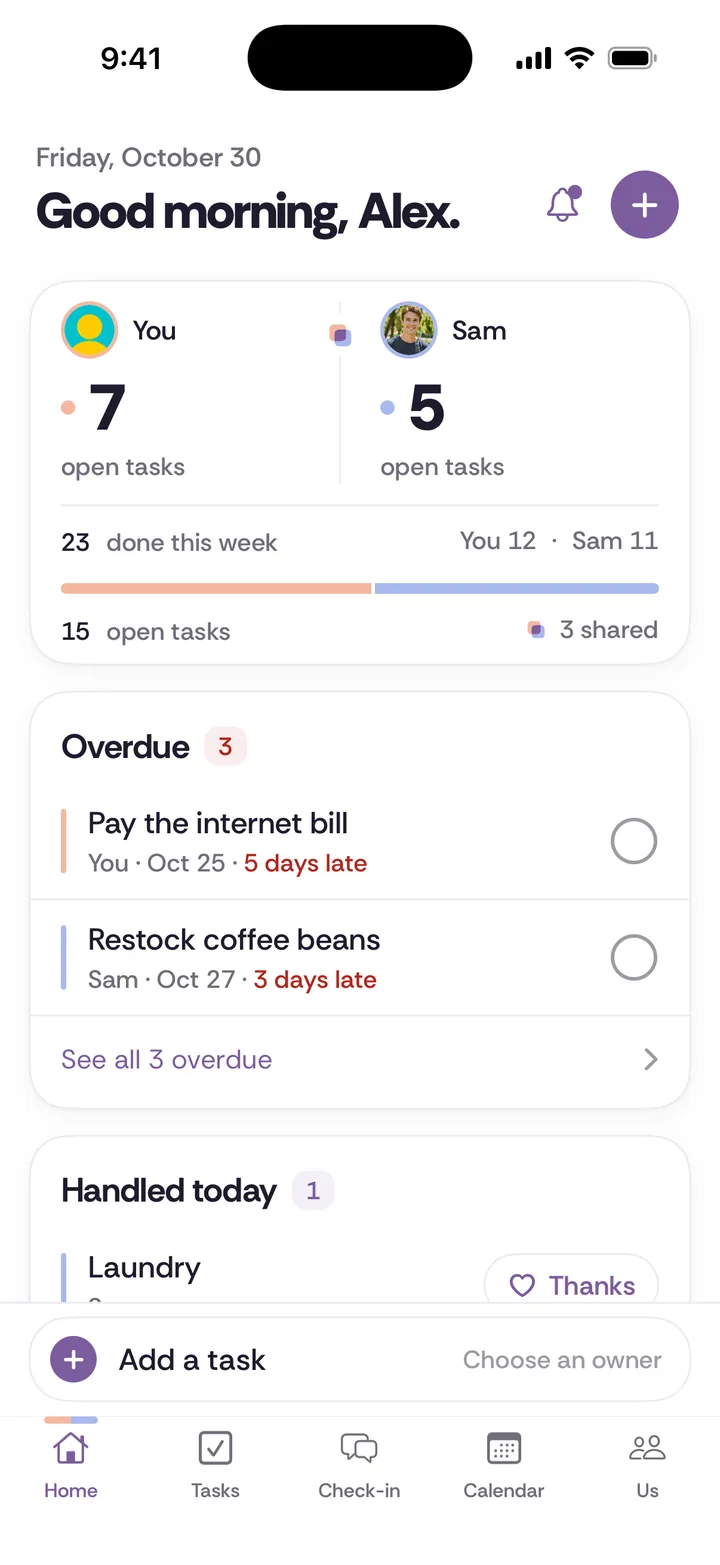
Who owns an item. In Any.do, you assign a task on a shared board to a member. In Tiptoe, each task goes to You, your partner, or Together.
Repeating chores. In Any.do, recurring tasks are a Premium feature that Family includes. In Tiptoe, chores repeat on a schedule, have one owner, and change hands through a proposed handoff.
Groceries. Any.do's list sorts by aisle. Tiptoe has shared lists, without that claim.
Credit and thanks. In Tiptoe, a completed item counts for the person it was assigned to, and you can send a thank-you. Any.do's pages describe assignment, not credit.
Talking about it. Tiptoe has a weekly check-in with shared topics, where decisions become owned tasks. Any.do's plan pages do not list one.
Calendar. Both include a calendar. Tiptoe's calendar holds both partners' plans, key dates and dated tasks.
Private items. Any.do gives each member a personal space that only they can see, which is a clean and clear approach. Tiptoe keeps private and shared records separate, and profiles can hold private gift ideas.
How should a couple use Any.do so it does not become one person's job?
The risk with any planner is that the more organized partner sets it up, fills it in and quietly becomes its manager. Then the other person gets assigned tasks, like work tickets, and resents it, while the organizer resents having to assign them.
Every chore has four jobs: notice, plan, do, and follow up. Assign Member is good at the third. You have to arrange the other three by agreement.
Here is a simple set of rules for your four boards.
- Use the board for things with a single owner. "Car stays legal and running" belongs to one person, who handles the renewal, the service and the checks.
- Write outcomes rather than errands. "Kids' school forms are in on time" works better than "Sign the form."
- Only the owner adds tasks to their area. If you notice the car's oil light, tell the owner once. They decide what happens next, and that is the whole-job ownership idea.
- Give the grocery list a real owner too. Both of you can add to it, while one person owns the ordering and the running-out problem.
- Pick one time a week to look at it together. Add "Ten minutes, the house" as a repeating task, and use the check-in format if that helps.
Our guides on the four jobs in every chore and on a complete chore split go further.
What do four shared boards look like in practice?
The four-board limit forces a useful decision about what you actually share. For a couple with two jobs and no children, it could be Home, Groceries, Money and Trips. For parents, it could be Home, Groceries, Kids and School. Everything else, such as your work tasks and that gift you're planning, stays in your own private space, where your partner won't see it.
What can you say when one of you wants this and the other does not?
Say the actual concern first. The app is the second sentence.
"I don't actually want to manage a task app. I want to stop being the one who remembers. Could we try the Family plan for a month with just four things each, and you choose yours first?"
Or if you are the one being invited:
"I'm fine using it. But if you assign me things as they occur to you, I'm going to feel like your employee. Can we agree on the areas I own, and then you leave those with me?"
Both of those are fair. If the talk gets stuck on who does more, our guide on what to do when one partner does more can help you take the next step, without turning it into a score.
When should you pick Any.do, and when Tiptoe?
Pick Any.do if:
- Either of you uses Android.
- You want one app for your own planning and your shared tasks.
- Aisle-sorted groceries or WhatsApp reminders would make your life easier.
- More than two people need tasks in the same plan.
Pick Tiptoe if:
- You both use iPhone or are fine with web.
- You want chores with one owner and proposed handoffs.
- You want a weekly check-in and a shared calendar in the same place as your tasks.
- You want to try sharing at no cost before paying anything.
If you would rather not pay for anything just yet, start on paper. Write the areas of your home on a sheet, with one name each, and look at it weekly. Our chore split worksheet is free. Or see all the shared to-do apps we compared, including the ones that are free for two.