Tiptoe is not affiliated with Eve Rodsky, Fair Play or its publisher. This page explains the method from published sources, and it is not a substitute for the book.
We could not find an official Fair Play app: as of November 2026, the official Fair Play site and its shop list books and a card deck, with no app. You can still run the method in any shared to-do app or on paper by writing each card you keep as one item with one owner, and by checking in weekly. Fair Play is a system by Eve Rodsky for dividing household work, and couples use it with a husband, wife, boyfriend or girlfriend alike; it is about the arrangement rather than about whose fault anything is.
What is the Fair Play method?
Fair Play is a system set out in Eve Rodsky's book of the same name. Her publisher describes it as 4 rules, 100 household tasks and a series of conversation starters for you and your partner, and says she interviewed more than five hundred men and women to learn what invisible household work involves. The book was a Reese's Book Club pick, and it inspired a documentary.
Her site describes the tasks and the rules as a way of deciding who should take the lead on every chore, played as a figurative card game with your partner. Three ideas do most of the work.
Full ownership. In her own words, "Fair Play is based on full ownership of the cards in your hand." You do not help with a card. You hold it.
Conception, Planning and Execution, known as CPE. Rodsky says that a partner should take on full Conception, Planning and Execution for the cards they hold. One writer's plain summary is that conception is thinking of the issue and deciding what to do about it, planning is working out the tasks, and execution is doing it.
Minimum Standard of Care. You agree what acceptable looks like for a card. Rodsky's own example, for her sons' sports, is "our minimum standard of care which is sunscreen and a helmet."
She also says plainly that the system is focused on fairness, not "tit-for-tat scorekeeping." That matters, because many people assume the cards are for counting.
What are the four rules?
The rules are in the book. Good Morning America's summary is a useful short version, and this is our paraphrase of it.
- All time is created equal. Ms. magazine quotes this first rule in its original wording. One person's hour is not worth more than the other's.
- You both have a right to be interesting. Each partner deserves time for themselves and their interests. Rodsky calls this time Unicorn Space, and she defines it as the "creative, magical space necessary to develop and pursue your passions."
- Start where you are now. Begin from your current situation, including what you want from sharing the work.
- Set your own values and standards. Decide what matters to your home, and then agree how each task will be handled.
What do the cards look like?
Good Morning America describes 100 household tasks in four suits: Home (such as dishes and groceries), Out (such as transporting kids), Caregiving (such as medical and dental appointments), and Magic (such as playing Santa or the Tooth Fairy). Rodsky's Q&A adds that 30 "daily grind" cards are the repetitive household tasks, and that holding all the cards "equates to more than a full-time job."
The physical product is The Fair Play Deck, published by Clarkson Potter, listed at $25 as of November 2026. The publisher describes task cards and Unicorn Space cards. Good Morning America reported that the cards were a free download after buying the book. We could not confirm that this is still available, so check the official site. Be careful with the many unofficial "printable" sites that appear when you search for this, since they don't look connected to Rodsky or her publisher.
Is there a Fair Play app?
As of November 2026, we could not find an official one. The official site lists the book, the cards, the documentary, a podcast and facilitators, and doesn't mention an app. We could only find third-party apps.
One example is FairShift on the App Store, whose listing says it is "based on Eve Rodsky's Fair Play methodology" and includes a card deck, a fairness score and a load tracker. The listing doesn't say whether Rodsky is involved, and it shows two different sets of prices. If you try an app like this, look for a clear statement of who made it, and check whether its fairness score fits your goals, since Rodsky herself says the system isn't about keeping score.
You don't need a Fair Play-branded app to run Fair Play. You need a place where each card has one name on it and both of you can see it.
How do you run Fair Play, step by step?
The first three steps come from the deck's publisher description. The rest are our suggestions, which you can adapt, and they are not from Rodsky.
Step 1. Sit down when you are both relaxed. The publisher suggests an hour, when you're feeling good, with food and drink. Don't do it right after a fight. Say something like this:
"I'd like to try something for a month. It's a way to decide who owns what at home, so neither of us has to keep track of everything. Can we take an hour on Saturday?"
Step 2. Lay out the cards, and keep only the ones that apply to your family. A couple with no kids will drop much of the Caregiving suit. The publisher's wording is to choose only the ones that apply, so you decide what counts.
Step 3. Take turns choosing what you'll own completely. The deck's description is that you take turns deciding which tasks you'll own. Choosing matters, because a card you've picked feels different from one that was handed to you. Include Unicorn Space cards too.
Step 4. Start small. You don't have to move everything on day one. Rodsky's own account in Good Morning America began with one card, extracurricular sports. Pick three or so that would make the biggest difference, and move only those first.
Step 5. Define the standard for each card, out loud. Keep it to a sentence or two. Do this before the first time the job comes up. "Kitchen is wiped and dishwasher is running by bedtime," or "Kids have sunscreen and a helmet."
Step 6. Agree how hands-off you'll be. The person holding the card does it their way, within the standard. If you see something going wrong, say it once and leave it with them.
Step 7. Check in every week. Rodsky says she and her husband check in every week. Our weekly check-in page has a simple format you can use for this.
Step 8. Re-deal when life changes. A new job, a new baby, an illness or a parent who needs care all change what is fair. Treat that as normal rather than as someone failing.
How does this fit with notice, plan, do, and follow up?
We usually talk about four jobs in every chore: notice, plan, do, and follow up. Rodsky's CPE covers the same ground in three parts, with a different vocabulary and a fuller system around it. Conception is close to noticing and deciding. Planning is planning. Execution is doing. We separate out following up because it is a part people often forget: checking that the appointment happened, the form was accepted, or the tap stopped dripping.
Whichever vocabulary you use, the test is the same. Take the example Good Morning America reports from Rodsky's own home. Her husband took on extracurricular sports in full, including registering the kids, paperwork, snacks and carpools, and she said that gave her 8 hours of her week back. Driving to practice would have been helping. Owning the whole thing removed it from her head. Our guide to the four jobs in every chore and our page on the mental load go into that more.
How do you use paper alongside the deck?
Paper is free, and it may be the best fit for the first month.
- Write one line per card you kept: the short name, the owner and the standard.
- Put it where you both see it. The inside of a cupboard door gives you some privacy from guests.
- Mark changes rather than progress. You don't need to tick anything off, because you're tracking who owns what, and not how often it was done.
- Take it to your weekly check-in. Ask: which card is working, and which should change?
Our free chore split worksheet has a layout for this, and the chore split calculator can give you a rough sense of weekly hours. Treat those hours as a conversation starter rather than as a verdict.
How do you use an app alongside the deck?
Any app with shared lists and an owner on each item will do. Here's how to translate the cards.
- One item per card you kept. Use your own short wording, and keep the deck for its full text.
- One owner. Use "together" only if you genuinely do it together.
- The standard goes in the notes. "Bins out by 8 on Thursday" is enough.
- Repeat on a schedule for the daily grind cards. Set the repeat, then let the owner handle their own reminders.
- Keep Unicorn Space on there too. A recurring item with your name on it makes it harder to lose.
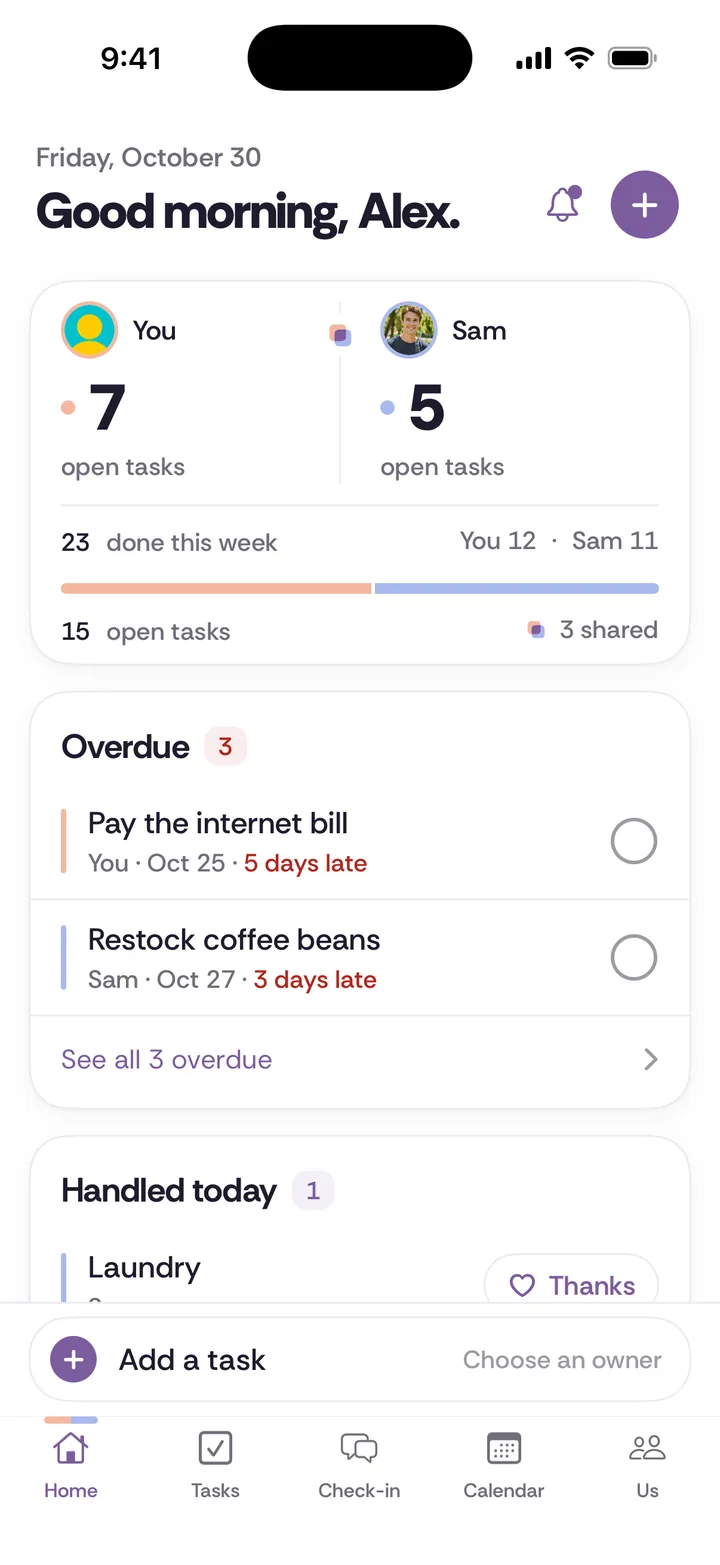
Free ways to do this include shared Apple Reminders on two iPhones, or Microsoft To Do or Todoist with mixed phones. Tiptoe also fits this pattern, if you use iPhone or web. Chores repeat with one owner, and handoffs are proposed, a completed item counts for the person it was assigned to, and there's a weekly check-in. It's free for both of you for your first 30 tasks and chores, so that may be enough for the cards you start with. It isn't connected to the Fair Play system, and it does not include the cards.
What are the common problems with Fair Play?
- The list feels overwhelming. One hundred tasks is a lot at once. Remember that you only keep the ones that apply, and you can start with a few.
- One partner isn't convinced. Don't argue about the book. Offer a small test, with wording from our guide on bringing up something small.
- The standard becomes a way to supervise. If you keep inspecting, you still hold the job. Our guide on how to stop nagging helps with this.
- A card keeps coming back to you. Talk about it at your check-in, and check whether the standard or the ownership was ever really clear. Our guide on what to do when one partner does more can help here. Fair Play's site lists facilitators for those who'd like personal support.
- It feels unsafe to raise this at all. If you're afraid of your partner's reaction, a chore system is not the right next step. Our safety page has support resources.